
Biochar Application: Methods, Rates, and Soil Best Practices
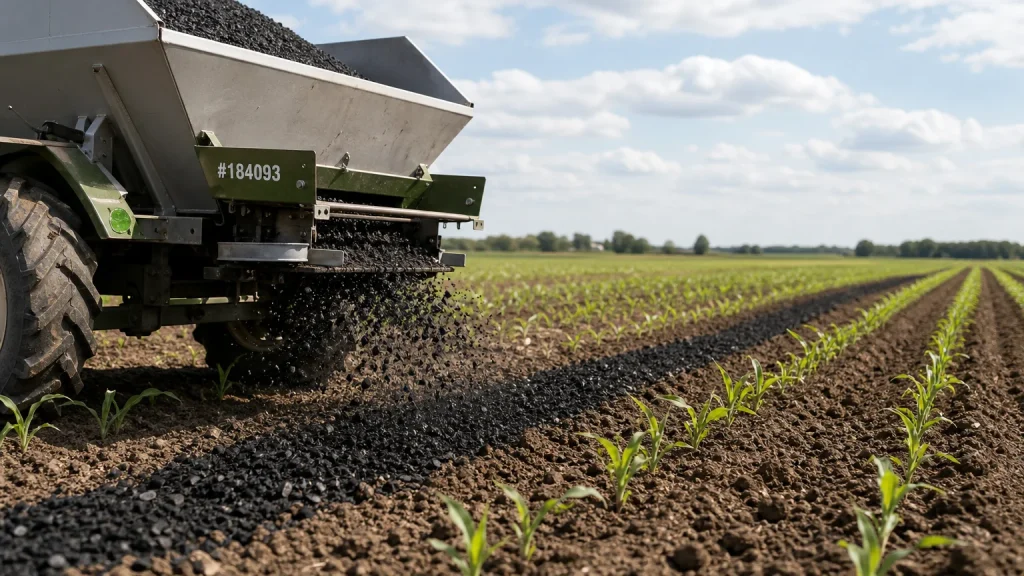
Summary: Biochar application works best when the material, soil, crop, rate, and application method are matched to a defined agronomic goal. Proper preparation may include testing, sizing, moistening, and blending biochar with compost or fertilizer. Results can include improved water retention, nutrient management, soil structure, and carbon storage, but outcomes vary by feedstock, production conditions, soil properties, and climate.
What if the same biochar could improve one field yet deliver little value, or create nutrient problems, in another? Successful biochar application begins with fit, not simply with spreading a fixed quantity across the soil. The right material must match the soil constraint, crop system, handling equipment, and intended outcome. For practical context, our resources on biochar applications in agriculture explain how agricultural residues can become useful carbon products.
Biochar is a stable, carbon-rich material created by heating biomass in a low-oxygen environment. Its properties depend on the original feedstock and the production process, so wood-based, crop-residue, manure-based, and biosolids-derived biochars should not be treated as interchangeable. In the US, producers and land managers increasingly evaluate biochar as part of broader soil health, nutrient management, and climate strategies rather than as a universal fertilizer replacement.
What does biochar application involve?
Biochar application means placing a qualified biochar product into soil, growing media, compost, or another defined system to address a specific need. Common goals include increasing water retention, improving soil structure, moderating acidity, retaining nutrients, supporting microbial habitat, reducing contaminant mobility, or storing stable carbon.
The material is not a conventional fertilizer. Many biochars contain limited immediately available nutrients, particularly when produced from woody feedstocks. Their value often comes from porosity, surface chemistry, carbon stability, and the ability to influence how water, nutrients, and microorganisms behave in the soil.
Application planning should therefore begin with a clear objective. A grower may be trying to improve drought resilience in sandy soil, reduce nutrient loss, support an orchard root zone, or develop a long-term carbon amendment. Each objective can require a different particle size, pH range, nutrient profile, moisture condition, and placement strategy.
How do you choose the right biochar?
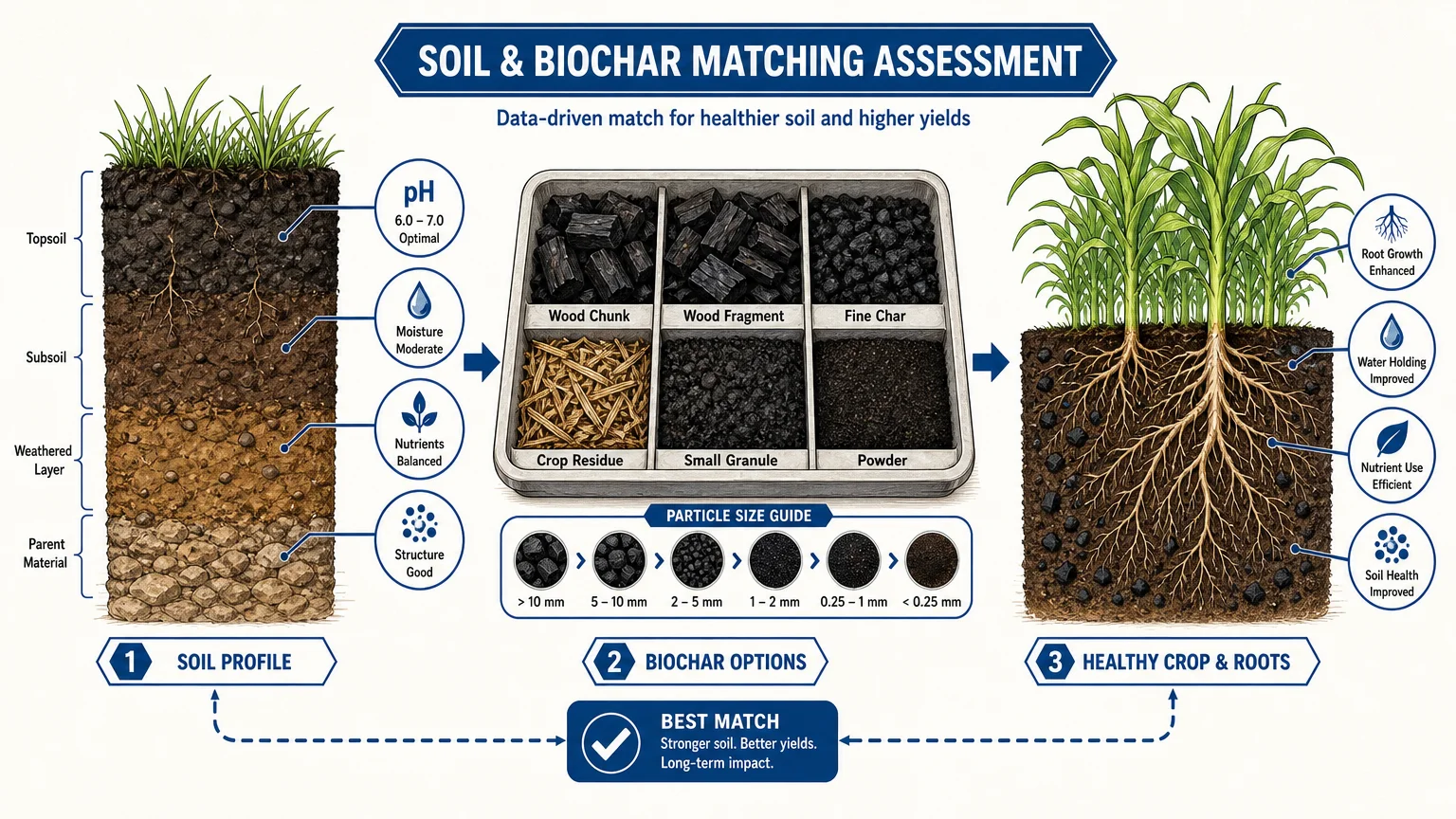
Consider a field with low organic matter and weak water retention. A porous woody biochar may support physical improvement, but it may not supply enough nutrients to support crop demand. A nutrient-rich biochar made from manure or crop residues may offer a different balance, while also requiring closer review of salts, contaminants, and pH.
Feedstock analysis is the first screening step. Ask how the biomass was sourced, whether it could contain heavy metals or other contaminants, and whether the material was produced under controlled conditions. The pyrolysis temperature and residence time also influence ash content, pH, surface area, nutrient concentration, and carbon stability.
Next, review the product analysis. Useful information may include total carbon, hydrogen-to-carbon ratio, pH, electrical conductivity, ash content, particle size, nutrient concentrations, cation exchange capacity, and contaminant results. For agricultural use, you should also consider whether the product aligns with applicable state requirements, conservation specifications, or recognized testing frameworks.
The soil and crop provide the other half of the decision. Test soil texture, pH, organic matter, nutrient levels, salinity, drainage, and compaction. Then consider crop sensitivity to pH changes, nutrient immobilization, and moisture fluctuations. A 2026 USGS review examined biochar as a potential tool for managing legacy nutrients and improving nutrient availability, while emphasizing the importance of soil and amendment conditions.
How should biochar be prepared before use?
Fresh biochar is often dry, dusty, and highly adsorptive. Those characteristics can complicate handling and may temporarily bind nutrients after application. Preparation helps make the material safer to handle and more compatible with the soil environment.
First, inspect the material for oversized pieces, unconverted biomass, excess ash, and visible foreign matter. Crushing or screening can improve distribution, but very fine particles may increase dust and wind-loss risks. Lightly moistening the material before crushing or transfer can help control airborne dust.
Many users blend biochar with compost, manure, fertilizer, or another moist amendment before field application. This process is sometimes called charging or conditioning. It allows the biochar to interact with nutrients and moisture before reaching the root zone. It can also increase total amendment weight, reduce wind loss, and improve the performance of standard spreading equipment.
Blending is not automatically appropriate for every application. Compost may add nutrients and biological activity, while fertilizer may help prevent short-term nutrient immobilization. However, the blend should be based on soil tests and crop requirements rather than an assumed recipe. To understand how production conditions shape the final material, review the biochar process before selecting a product for field use.
Storage also matters. Keep dry biochar away from ignition sources, manage dust, and follow site-specific fire and worker-safety procedures. Fresh or very dry material can create handling and self-heating concerns, particularly when large volumes are stored in confined spaces.
Which application methods are suitable?
Could the same material be broadcast, banded, or placed directly in a planting hole? In many cases, yes, but the best method depends on the production system, equipment, incorporation depth, and physical form of the biochar.
- Broadcast and incorporation: Spread biochar across the soil surface, then incorporate it with suitable tillage equipment. This method can distribute the amendment through the upper root zone, but it may be less practical for very dusty or lightweight products.
- Banding or injection: Place biochar in bands near crop rows or below the surface. This approach concentrates the material where roots are expected to develop and may reduce the volume required for a targeted trial.
- No-till placement: Mix biochar with seed, fertilizer, or another carrier for placement through a no-till drill or seed slot system. Equipment compatibility and particle size should be confirmed in advance.
- Orchards and vineyards: Apply biochar in the root zone, planting hole, strip, or drip-line area. Perennial systems may require less extensive incorporation than annual row crops.
- Containers and growing media: Blend screened biochar into potting media or compost. The proportion should be tested because excessive biochar can alter pH, water movement, and nutrient availability.
Surface application can be appropriate when incorporation is impractical, but exposed fine material may be vulnerable to wind and runoff. Applying biochar with compost or another moist amendment can improve handling and reduce erosion risk. A small test area can reveal whether the material moves, cakes, floats, or interacts poorly with existing equipment.
What application rate should you use?
There is no universal biochar rate that works across every soil and crop. The appropriate quantity depends on the material’s density, nutrient content, pH, particle size, soil condition, crop value, application objective, and cost of delivery.
For field planning, express the rate consistently, such as tons per acre or metric tons per hectare. Avoid comparing products by volume alone because bulk density varies considerably. A lightweight, porous biochar may occupy more space than a denser, ash-rich material at the same mass.
A 2026 field study in California evaluated biochar additions of 0, 10, 20, and 30 metric tons per hectare in compost-amended urban agricultural soils. Its findings showed that responses varied by application rate and by the soil, chemical, and biological function being measured, reinforcing the need to test rates rather than assume that more material produces better results. The study is described in this California field study.
For commercial agriculture, consider a staged approach. Begin with replicated strips or small plots that include an untreated comparison. Monitor soil moisture, pH, electrical conductivity, nutrient availability, crop establishment, yield, and any changes in irrigation or fertilizer demand. Use the results to adjust the material and rate before expanding across the entire operation.
Repeated moderate applications may be more practical than one large application when the objective is to build soil function over time. The schedule should reflect the persistence of the biochar, the movement of nutrients, the economics of delivery, and the results from previous seasons.
What benefits and limitations should you expect?
Biochar can improve soil performance, but the effect is not guaranteed. A 2024 global dataset compiled results from 367 peer-reviewed studies and 891 experiments across 37 countries. It included biochar applied alone and in combination with fertilizers or manure, showing why results must be interpreted alongside soil, climate, crop, and management conditions. The dataset is available through the 2024 global dataset.
Potential benefits include better water retention in suitable soils, improved aggregation, reduced nutrient movement, moderated acidity, and greater habitat for soil microorganisms. Biochar can also contribute to long-term carbon storage because its carbon structure decomposes more slowly than untreated biomass.
A 2026 meta-analysis integrated 4,624 field observations from 668 global studies. It reported that biochar had a distinctive combination of potential yield improvement, carbon sequestration, and reduced global warming potential, while also identifying significant regional variation. These findings support a targeted, evidence-based approach rather than a universal claim that biochar will improve every field.
Limitations deserve equal attention. Alkaline biochar may raise soil pH beyond a crop’s preferred range. High application rates may immobilize nitrogen or phosphorus temporarily. Biochar can also adsorb pesticides, potentially reducing their effectiveness, and some products may contain salts, heavy metals, polycyclic aromatic hydrocarbons, or other unwanted compounds if the feedstock or process was poorly controlled.
Water behavior can also change in unexpected ways. Biochar may improve infiltration in compacted soil, yet it can produce limited or negative results in soils that already drain well or have a different pore structure. The best material for carbon storage may not be the best material for nutrient supply, filtration, or plant establishment.
For projects focused on durable carbon storage, our guidance on biochar carbon sequestration explains why feedstock traceability, production control, testing, and documentation matter alongside field application.
How can you build a practical application plan?
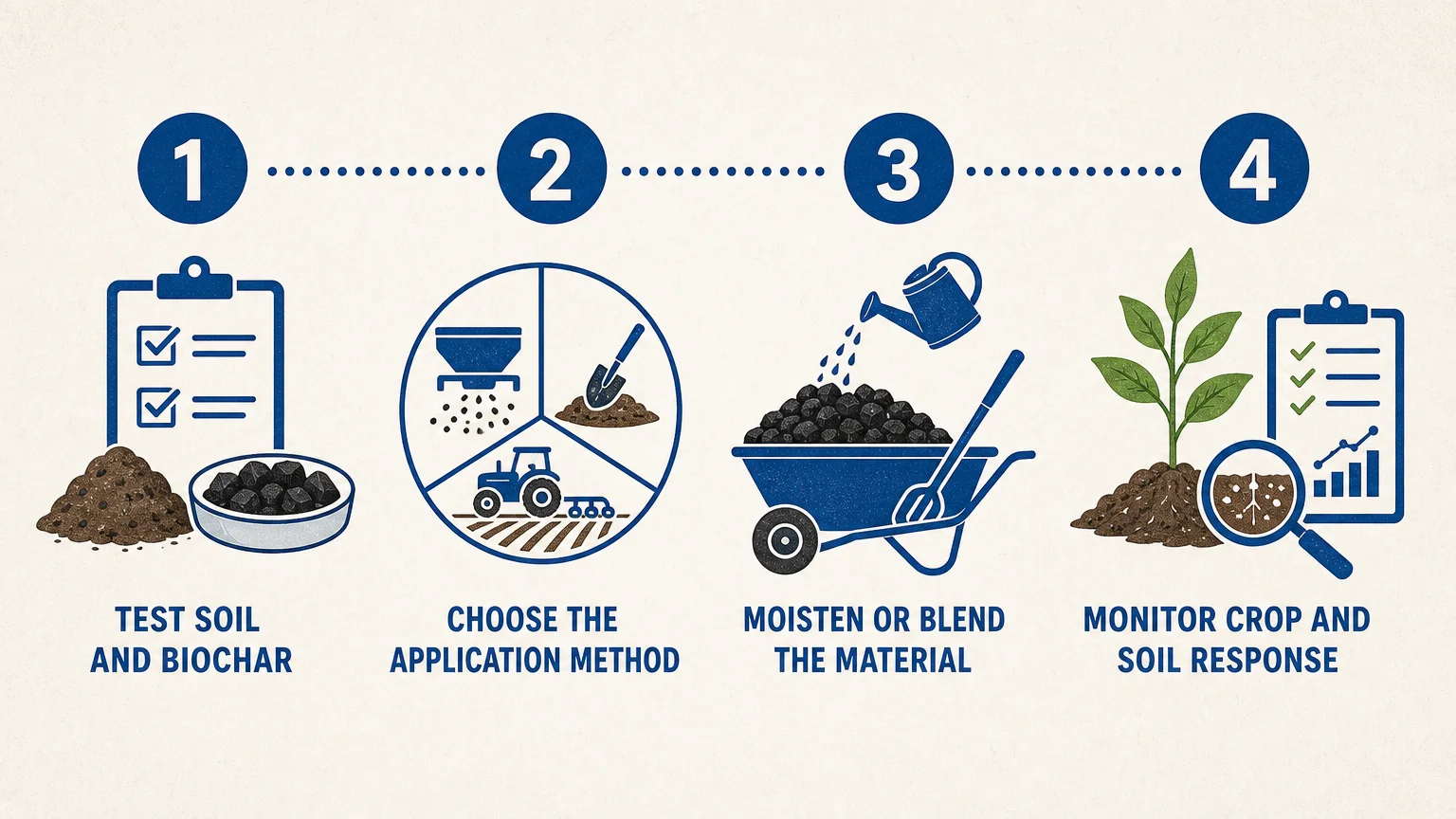
A reliable plan connects the intended outcome to measurable conditions before material is purchased. Use the following sequence to reduce uncertainty:
- Define the problem: Identify whether the priority is water retention, nutrient loss, acidity, soil structure, remediation, crop establishment, or carbon storage.
- Test the soil: Document texture, pH, organic matter, nutrient levels, salinity, drainage, and compaction.
- Review the biochar: Obtain feedstock information, production details, particle size, pH, ash, nutrient, carbon, and contaminant data.
- Select a rate and method: Match the product to the crop, equipment, root-zone depth, and application objective.
- Prepare the material: Screen, crush, moisten, or blend it where appropriate, while controlling dust and protecting workers.
- Run a field trial: Compare treated plots with untreated areas and record crop, soil, water, and operational results.
- Review the economics: Include product cost, transport, preparation, spreading, incorporation, monitoring, and any changes in fertilizer or irrigation use.
Biosolids projects require additional review because feedstock composition, moisture removal, contaminants, emissions control, and regulatory requirements can differ from agricultural residues. Our information on biochar applications for biosolids addresses this specialized pathway without treating it as equivalent to ordinary field biochar.
Where the application is intended to support a carbon project, retain records for feedstock sourcing, production conditions, mass balance, laboratory testing, application location, application quantity, and chain of custody. Those records can support later verification, but carbon-credit eligibility should never be assumed before the project methodology and documentation requirements are confirmed.
Make biochar application site-specific
Effective biochar application is a management decision, not a single product recommendation. Start with the soil constraint and crop objective, then select a tested biochar, prepare it for safe handling, choose a compatible placement method, and validate the rate through measured trials. This disciplined process helps capture potential benefits while reducing risks related to pH, nutrient immobilization, contaminants, dust, and unnecessary cost.
Take action with Pyronexus
Choosing the right biochar begins with understanding your feedstock, production goals, intended application, and required product characteristics. If you are evaluating agricultural residues, biosolids, or another biomass stream, our technical team can help connect the application objective with an appropriate project pathway.
Pyronexus supports biochar projects through feedstock evaluation, pyrolysis engineering, product development, operations support, and commercialization. When you are ready to review supply options for a defined use case, contact us to buy biochar and discuss the material requirements for your project.
Frequently Asked Questions
Is biochar a fertilizer?
Biochar is primarily a stable carbon amendment, not a complete fertilizer. Some biochars contain useful nutrients, but many require compost, manure, or fertilizer alongside them to meet crop nutrient demand.
Should biochar be mixed with compost before application?
Blending biochar with compost can improve moisture, handling, and nutrient interaction before the material reaches the soil. The appropriate blend depends on the biochar properties, soil test, crop needs, and application equipment.
Can biochar be applied without tillage?
Yes, biochar can be banded, injected, placed in a seed slot, or applied through compatible no-till equipment. Particle size, moisture, dust control, and equipment calibration should be evaluated before field deployment.
How do I know whether a biochar product is safe?
Request laboratory data covering feedstock, pH, electrical conductivity, ash, nutrients, carbon characteristics, and contaminants. Products intended for agricultural use should also be reviewed against applicable state requirements and relevant conservation or industry specifications.
Will biochar increase crop yields?
Yield responses vary by soil, crop, climate, feedstock, production conditions, application rate, and management. The most reliable way to assess potential is to compare treated and untreated areas through a properly monitored field trial.
