
Biochar in Agriculture: Benefits, Risks, and Application Tips
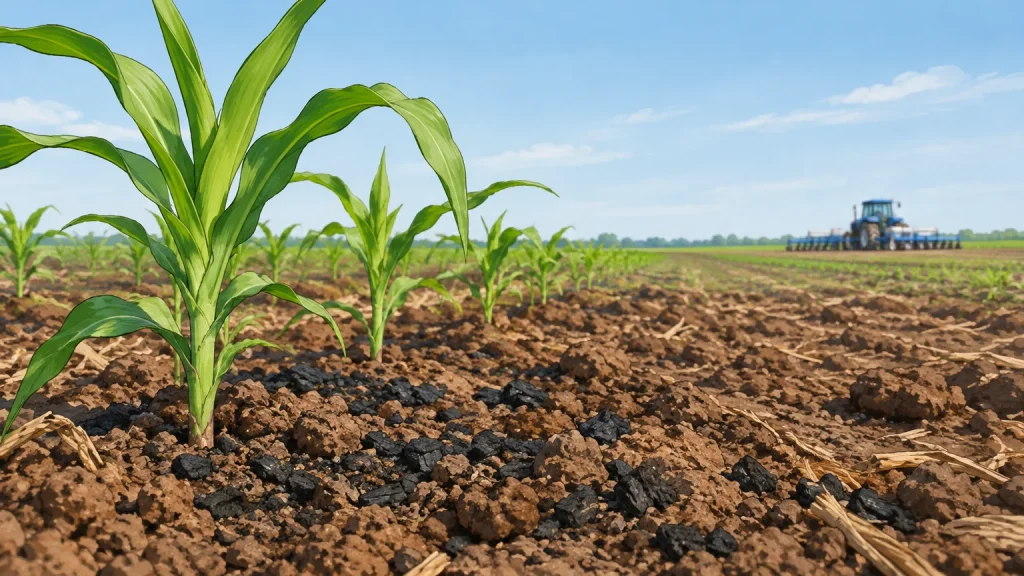
Summary: Biochar can support agricultural soil goals when its properties suit the soil, crop, and management plan. Its effects are not uniform, so assess the material, test it on a limited area, and compare results with untreated ground before scaling up. Soil tests and clear product information help you make a practical decision.
Could a dark, porous soil amendment support a farm’s goals, or might the wrong material miss its target? The answer depends on its feedstock, production properties, soil, crop, and management. If you are assessing its practical role, our biochar application in agriculture page describes this agricultural use case.
In the US, field conditions and production systems differ, so a result from one farm does not automatically predict another’s. A 2026 account from Oregon State researchers describes lasting soil changes after one application, but crop responses differed. The useful question is not whether biochar works in general, but whether a specific material and application suit your field.
What does biochar do in agricultural soil?
Agricultural biochar is a carbon-rich material made by heating biomass in a low-oxygen environment. As a soil amendment, it is used to influence soil properties, rather than to act as a complete fertilizer. Its characteristics depend on the biomass and production conditions, so products with the same name may not behave alike.
In a field, biochar is considered for goals such as improving nutrient retention, changing soil pH, adding stable carbon, or supporting soil structure. These are possible outcomes, not automatic benefits. A material that suits an acidic soil could be a poor match for a field that already has high pH. Likewise, a soil’s texture and existing nutrient levels affect which properties matter most.
Think of biochar as one part of a soil-management plan. It does not replace a soil test, a crop-specific nutrient plan, or sound irrigation and tillage practices. Define the problem you want to address first, then choose a material and trial design that let you measure that outcome.
When might biochar fit your soil and crop?
Consider a field where you have identified a specific soil concern, such as low soil carbon or poor nutrient retention. Biochar could be worth evaluating if its properties address that concern and fit the crop’s needs. If there is no clear soil or crop objective, applying it broadly makes it difficult to judge the result.
A 2026 University of Nebraska field report describes early soil changes in a larger, 16-acre trial using wood-based biochar at 8 tons per acre. During the first 12 months, the trial found increased soil carbon and retention of nitrate and phosphate. Those observations show what happened at that site and during that period; they do not establish a universal rate or guarantee a yield response.
Crop and soil context should shape your decision. For vegetable systems, review the requirements of the crop and soil before choosing a product or application plan. Our page on biochar in vegetable production covers that use case. The same principle applies to other crops: match material properties to a defined need, rather than assuming one product suits every field.
What should you check before choosing a biochar soil amendment?
Start with the product information. Ask about feedstock, production conditions, and analysis of the finished material. Then compare those details with your soil test, crop requirements, and the outcome you want to measure. A product description that only says “biochar” is not enough to establish whether it is suitable for your field.
- Soil fit: Review soil pH, texture, and nutrient status with an agronomist or soil-testing service.
- Material properties: Request product analysis relevant to your use, including pH and nutrient content.
- Feedstock and production: Ask how the biomass was sourced and processed, and request documentation addressing relevant quality concerns.
- Application plan: Confirm how the material will be handled, spread, and incorporated using equipment available to your operation.
Biochar production and application need to be considered together. Our biochar for soil conditioning page is relevant if you are assessing the soil-conditioning context. For producers developing a material for a specific agricultural use, Pyronexus also provides product development that includes requirements definition, property assessment, laboratory optimization, and application validation.
How can you test an application before scaling up?
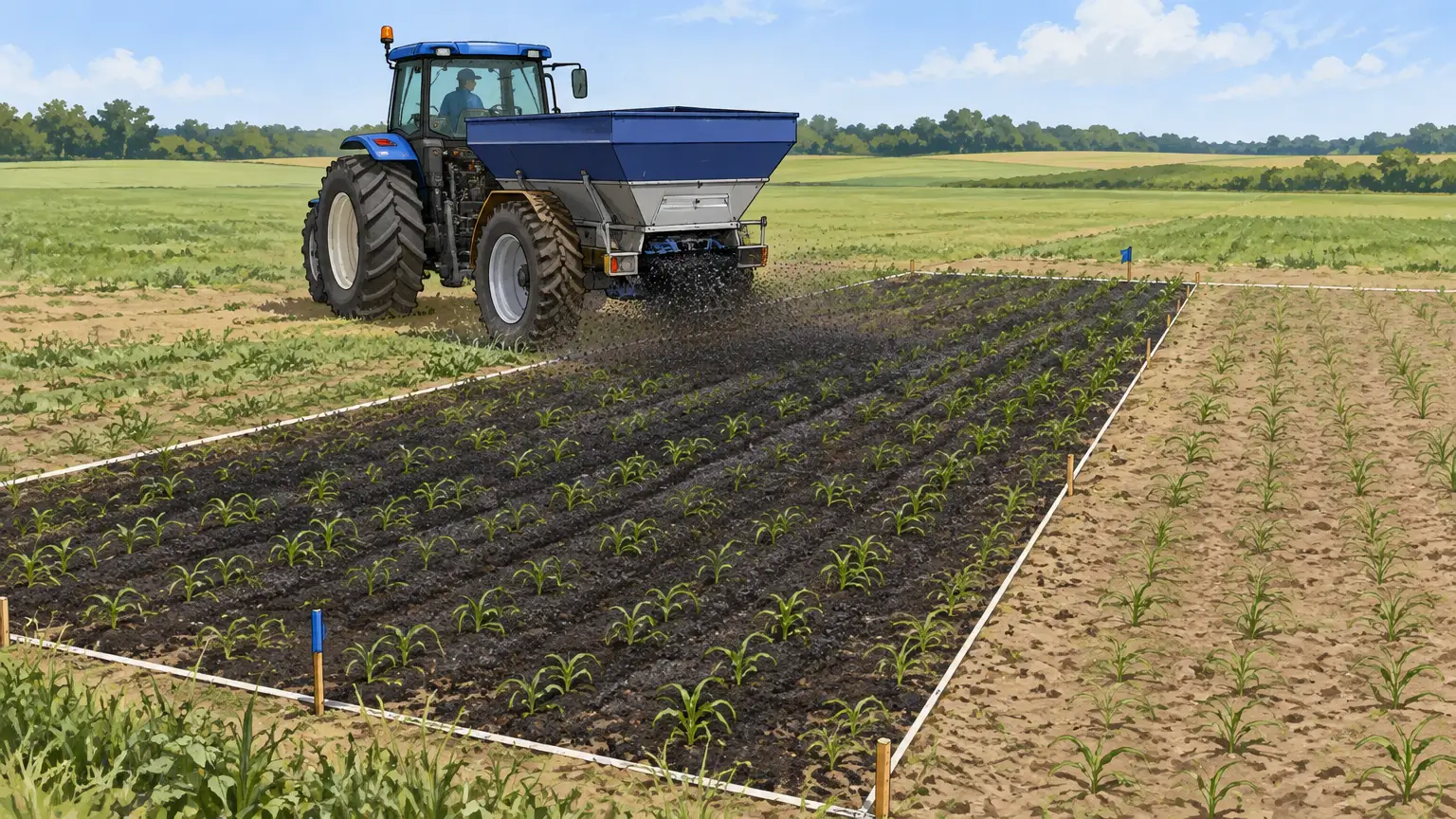
A small, planned trial gives you a more useful answer than applying biochar across a whole field at once. Identify the outcome you want to assess, such as a soil measurement or crop performance. Compare an amended plot with a similar untreated area, and keep other management as consistent as practical.
Record the material, application rate, placement, date, soil conditions, crop, and relevant inputs. Use the same measurements for both plots and review the results over a period that makes sense for the crop and question. If you manage several fields, a trial on representative soil types can help distinguish a site-specific response from a result that might transfer elsewhere.
A USDA-supported Minnesota pilot spanning 2023 to 2026 was designed to study biochar applications on sandy, clay, and loam soils, including biochar used alone and mixed with on-farm manure. Its scope illustrates why field conditions matter when planning a soil-specific biochar trial. Your own trial should likewise reflect your soil, crop, and management plan.
What do recent field findings say about crop outcomes?
Results support careful evaluation, not a blanket promise of higher yields. In 2026, Oregon State’s account of a long-running dryland trial reported soil organic carbon stocks 95% to 207% above untreated plots, depending on application rate. Yield responses differed by crop, and the highest rate did not add a yield benefit in wheat. These results came from that trial and should not be treated as a prediction for other farms.
A 2026 University of Illinois report also illustrates why product and soil context matter. Researchers tested biochars from three feedstocks in ten Illinois soil types and did not verify a consistent plant-growth benefit in their short study. That finding is limited to the study’s materials, soils, and conditions; it reinforces the value of testing rather than assuming a universal crop response.
For your operation, weigh soil changes and crop outcomes alongside material cost, transport, spreading, and incorporation requirements. A product may improve a soil measure without producing enough crop or operational benefit to justify broad use. Keep those measures distinct when deciding whether to continue, adjust, or stop an application.
How can product development address a specific farm need?
Sometimes the challenge is not simply deciding whether to use biochar, but identifying what properties a particular application requires. Pyronexus supports agricultural product development through requirements definition, property assessment, experimental design, laboratory optimization, application validation, and technical reporting. That work can help a project evaluate a material against a defined use case, without assuming that one composition suits every crop or soil.
For commercial or project-scale questions, feedstock preparation is also relevant. Pyronexus specifies that feedstock for its reactor systems must be less than 1 inch in particle size and below 20% moisture. These conditions apply to reactor feedstock; they do not establish that every biomass is suitable. For a plant-focused application context, see our page on biochar for plants.
When you are comparing options, ask what testing is available, what the results will cover, and how they relate to your intended agricultural use. A clear link between the feedstock, production process, material properties, and field objective makes the next decision more practical.
Make the field objective your starting point
Biochar for agriculture is best evaluated as a soil-management input with specific properties, not as a universal crop treatment. Define the field need, review the material and soil information, and test a limited area against an untreated comparison before deciding whether broader use makes sense.
Discuss Your Agricultural Biochar Project
If you are considering biochar for a farm-related project, the next step is to connect the intended soil or crop use with the material, feedstock, and testing requirements. Pyronexus works across agricultural biochar product development and production project needs, so you can discuss a use case before committing to a scale-up plan.
Our work can include defining requirements, assessing biochar properties, laboratory optimization, application validation, and technical reporting. For help exploring biochar solutions for farmers and agriculture, contact our team to discuss your project goals and the information needed to evaluate them.
Frequently Asked Questions
Is biochar a fertilizer?
No. Biochar is a carbon-rich soil amendment, not a complete fertilizer. Assess its properties alongside your soil test and nutrient plan.
Can biochar improve crop yields?
Yield responses differ by crop, soil, material, and management. Test a limited area against an untreated comparison before applying it broadly.
How should you choose biochar for a field?
Start with the soil concern and crop need, then review feedstock, production information, and product analysis. Seek advice from an agronomist if you need help interpreting the results.
Should you mix biochar with compost or manure?
That depends on the material, soil, and nutrient plan. Evaluate any mixture in a small trial and document what was applied.
Can Pyronexus help evaluate agricultural biochar?
Yes. Our product-development work can include requirements definition, property assessment, experimental design, laboratory optimization, application validation, and technical reporting for agricultural use cases.
