
Biosolids Pyrolysis: An Emerging Solution for PFAS Treatment and Resource
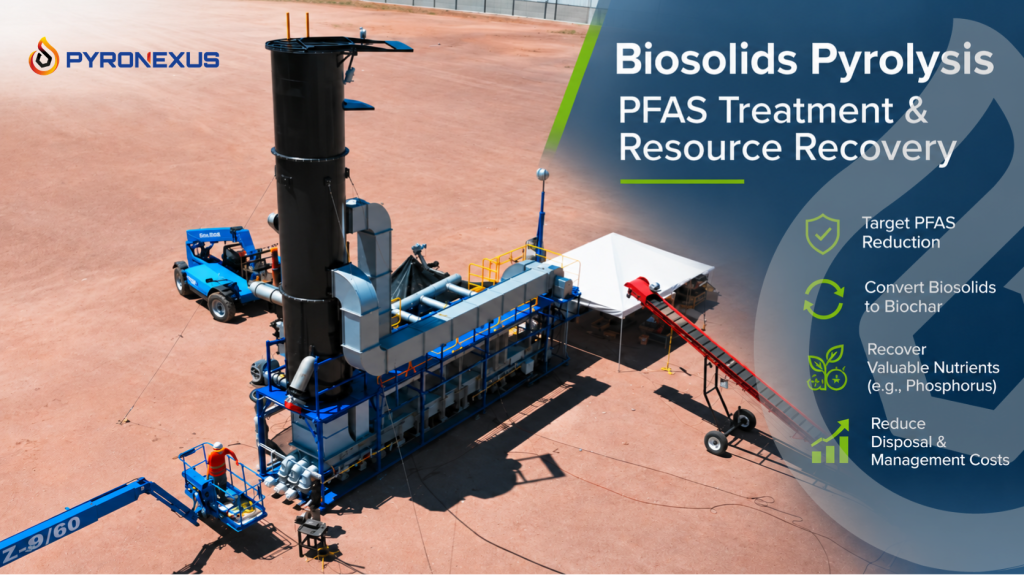
Recovery
As wastewater treatment facilities face increasing pressure to manage persistent contaminants and reduce disposal costs, pyrolysis is emerging as a promising technology for transforming biosolids into potentially valuable resources.
The Growing Challenge of Biosolids Management
Municipal wastewater treatment facilities produce substantial quantities of sewage sludge as a byproduct of treating wastewater from homes, businesses, and industrial sources.
Traditionally, these materials have been managed through land application, landfilling, incineration, and other treatment or disposal methods.
However, concerns surrounding persistent contaminants, including per- and polyfluoroalkyl substances (PFAS), are creating additional challenges for wastewater operators.
PFAS are a large family of synthetic chemicals used in industrial and consumer applications. Because many PFAS resist environmental degradation, their presence in wastewater residuals has become a major focus for researchers, regulators, and treatment technology developers.
Conventional wastewater treatment processes were not designed specifically to destroy these compounds. Some PFAS may remain in treated water, while others become associated with wastewater solids.
This creates an important challenge: how can facilities manage contaminated biosolids while reducing potential environmental risks?
The Role of Pyrolysis Technology
Pyrolysis is a thermochemical conversion process that heats organic material in an oxygen-limited environment.
When applied to properly prepared sewage sludge, pyrolysis converts a portion of the organic material into gases and produces a carbon-rich solid residue commonly referred to as biosolids-derived biochar.
The process offers several potential advantages:
- Reduction in residual solids requiring management.
- Thermal transformation and removal of certain organic contaminants.
- Production of carbon-rich materials for further evaluation.
- Opportunities for process heat recovery and integration with drying systems.
- Recovery of mineral components, including phosphorus.
Unlike conventional disposal approaches, pyrolysis provides an opportunity to combine waste treatment with resource recovery.
What Does Research Say About PFAS Removal?
The February 2026 Biochar Europe position paper, Sludge-Based Pyrolysis as Integrated Biorefineries, reviews scientific research examining pyrolysis as a treatment method for sewage sludge.
The paper summarizes studies demonstrating high reductions of targeted PFAS in biosolids-derived biochar, including reported removal efficiencies reaching approximately 99.9% under certain operating conditions.
However, there is an important distinction between removing PFAS from the solid residue and demonstrating complete destruction throughout the treatment system.
PFAS may be thermally transformed, destroyed, or transferred into gaseous or liquid process streams. Effective treatment therefore requires appropriate process design, emissions controls, and analytical verification.
Research continues to investigate the operating conditions needed for reliable and comprehensive PFAS destruction.
Pyronexus: Advancing Biosolids Processing Through R&D
At Pyronexus, biosolids processing is an active area of research and development.
Our team has been conducting trials using Pyronexus pyrolysis technology to investigate the conversion of wastewater solids into biochar and evaluate the treatment of persistent contaminants.
Our work focuses on several areas:
Biosolids conversion: Understanding how different wastewater residuals behave during thermal processing and evaluating the resulting solid materials.
PFAS evaluation: Investigating targeted PFAS concentrations before and after treatment and supporting continued research into contaminant fate.
Process optimization: Evaluating operating conditions and the requirements for efficient industrial biosolids processing.
Resource recovery: Exploring opportunities associated with mineral retention, reduced residual mass, and potential applications for the resulting biochar.
Through continued testing, our objective is to advance commercially practical technologies that can help wastewater facilities address both contamination and long-term biosolids management.
Beyond Waste Treatment: A Resource Recovery Opportunity
One of the most important conclusions emerging from recent industry research is that sewage sludge should not necessarily be viewed exclusively as waste.
It also contains potentially recoverable resources.
For example, phosphorus is an essential agricultural nutrient that can remain concentrated in the solid material produced by pyrolysis.
Under appropriate conditions, this opens opportunities to investigate nutrient recovery and potential beneficial applications for biosolids-derived biochar.
These applications require additional evaluation, particularly regarding PFAS, heavy metals, other contaminants, and compliance with applicable standards.
Looking Ahead
The challenge of PFAS contamination requires continued research and the development of reliable treatment technologies.
Pyrolysis represents a promising pathway, particularly when it is integrated with appropriate gas treatment, emissions management, and comprehensive process monitoring.
At Pyronexus, we are committed to exploring these opportunities through applied R&D, engineering, and ongoing biosolids testing.
Our goal is to contribute to the development of technologies that transform wastewater management challenges into opportunities for environmental protection and resource recovery.
Interested in evaluating pyrolysis technology for biosolids treatment? Contact Pyronexus to discuss your project.
Reference
Biochar Europe (February 2026). Sludge-Based Pyrolysis as Integrated Biorefineries: Safe Resource Recovery & Contaminant Elimination for Europe’s Circular Bioeconomy.
Additional scientific context: McNamara et al. (2023), Pyrolysis transports, and transforms, PFAS from biosolids to py-liquid; Sørmo et al. (2023), The decomposition and emission factors of a wide range of PFAS in diverse, contaminated organic waste fractions undergoing dry pyrolysis.
