
Biochar Use in Vegetable Production: Benefits and Best Practices
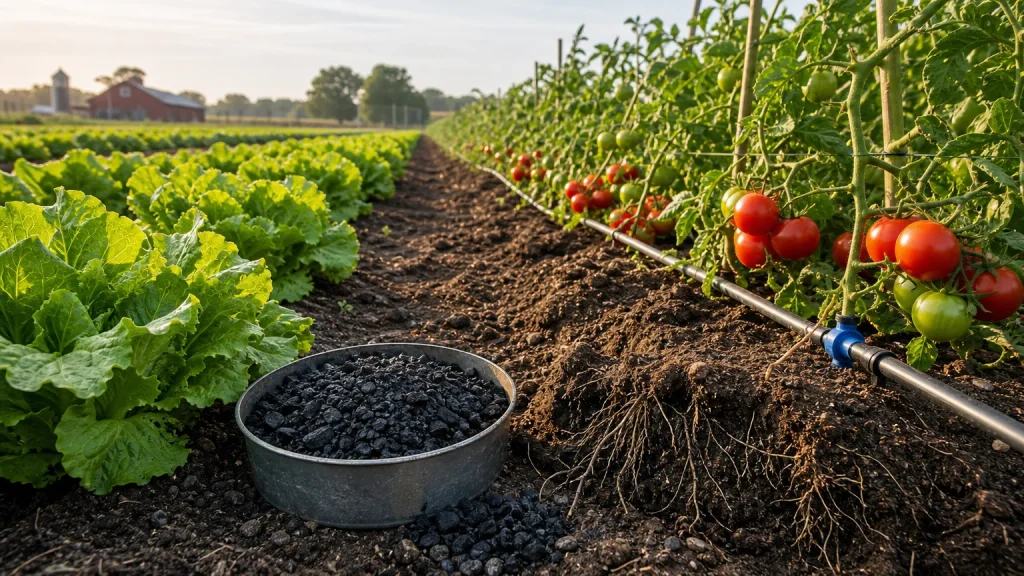
Summary: Biochar can support vegetable production by improving soil structure, water retention, nutrient management, and rhizosphere conditions. Its performance depends on feedstock, pyrolysis conditions, soil type, crop, rate, and fertilizer strategy. A practical program begins with product testing, small trials, careful incorporation, and crop-specific monitoring rather than a universal application rate.
Can a carbon-rich soil amendment improve vegetable performance without creating new nutrient or contaminant problems? For growers evaluating biochar use in vegetable production, the answer depends on how precisely the material is matched to the soil, crop, and management system. Our biochar application guidance can help frame that decision around feedstock, application method, and intended use.
Research through 2026 shows potential benefits, but it also shows substantial variation. A 2024 global biochar dataset combined evidence from 367 peer-reviewed studies across 37 countries, covering different soils, crops, feedstocks, fertilizer programs, and production conditions. That breadth supports a careful conclusion: biochar is a management tool, not a guaranteed yield treatment.
What does biochar change in vegetable soil?
Biochar is a porous, carbon-rich material made by heating biomass in a low-oxygen environment. Its internal pore network and surface chemistry can influence water movement, nutrient retention, microbial habitat, soil aggregation, and pH. These effects are useful when they correct a specific soil limitation, such as low water-holding capacity, weak nutrient retention, or excessive acidity.
The most immediate physical benefit may occur in coarse or degraded soils. Biochar can help create additional pore space, reduce bulk density, and retain more water near the root zone. In vegetable systems, these changes may support germination, root development, and more stable moisture between irrigation events. The response is less predictable in fertile soils that already have suitable structure and nutrient availability.
Chemically, biochar can retain ammonium, nitrate, phosphate, and other ions. This may reduce nutrient movement below the root zone, but strong adsorption can also temporarily reduce nutrient availability. Manure and crop-residue biochars may contribute more nutrients, while woody biochars often provide more stable carbon and porosity with less direct fertility value.
An EPA crop dataset includes studies on carrot, lettuce, soybean, and sweetcorn, along with soil and biochar characteristics. Its scope illustrates why crop response should be evaluated alongside soil properties and material specifications instead of assuming that one result applies to every vegetable.
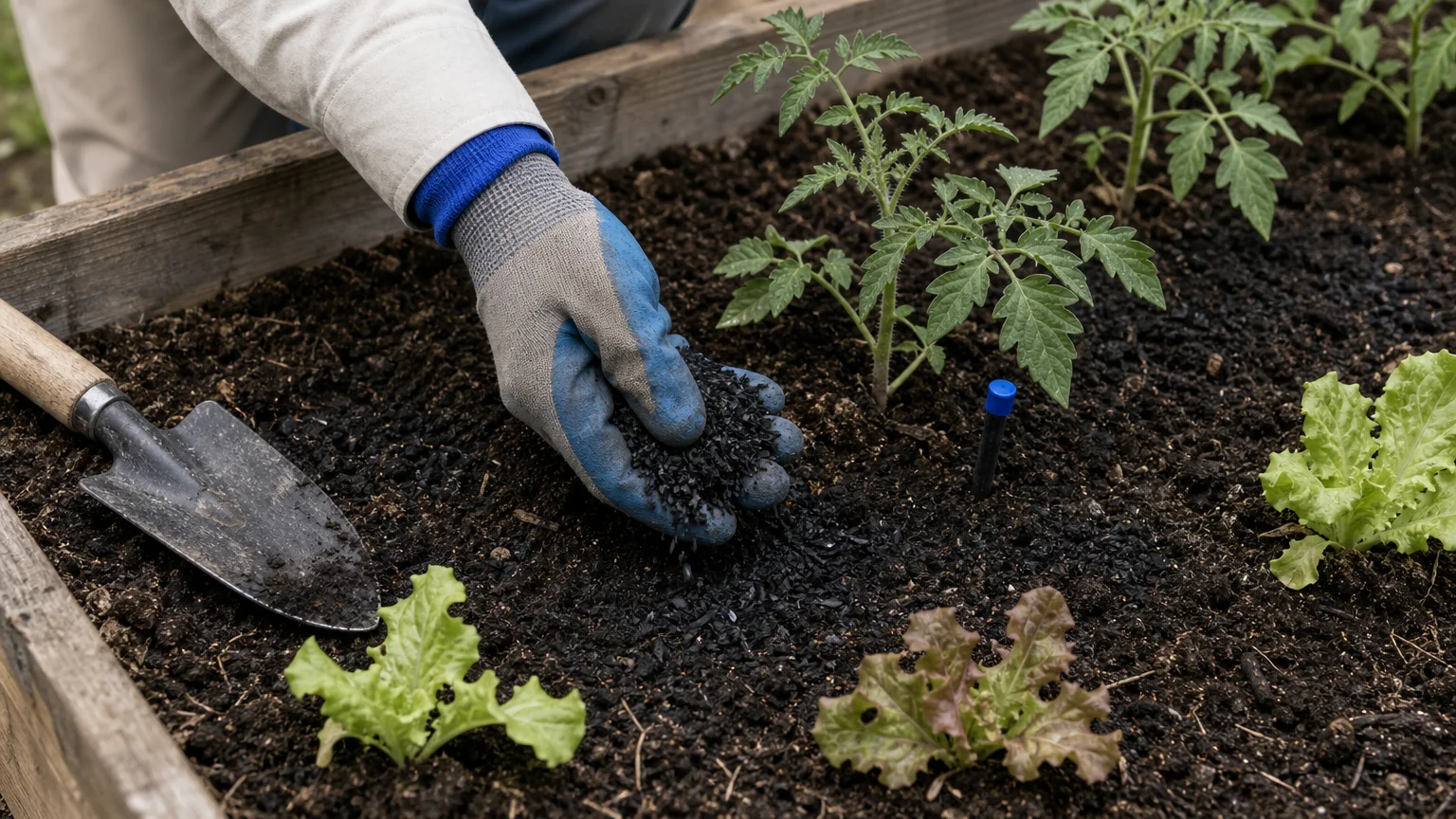
How should you match biochar to the crop and growing system?
Consider a sandy field, a raised bed, and a greenhouse substrate. Each system may need a different biochar strategy because water movement, fertilizer concentration, root volume, and irrigation frequency differ substantially.
Feedstock selection is the first decision. Wood-based material may be appropriate when the objective is stable carbon, porosity, and water retention. Crop-residue or manure-based material may contain more mineral nutrients and have higher electrical conductivity. That can help a nutrient-poor soil, but it can create salt or nutrient-balance concerns in protected cultivation.
Pyrolysis conditions also matter. Higher temperatures generally produce more aromatic and persistent carbon with greater surface area. Lower temperatures may preserve more reactive functional groups and degradable carbon. Neither profile is automatically better. The correct choice depends on whether your priority is nutrient interaction, water retention, contaminant adsorption, carbon persistence, or a combination of these outcomes.
Crop type matters as well. Leafy vegetables may respond quickly to changes in nitrogen availability and salinity because they produce substantial foliage in a short period. Fruiting crops may require a longer observation period because yield depends on flowering, fruit set, irrigation, and potassium management. Root crops require attention to soil structure, bulk density, and possible contaminant uptake near the edible portion.
At Pyronexus, we can connect this material-selection question to our biochar for soil conditioning approach, with attention to feedstock behavior, intended application, and project objectives. The goal is to avoid treating biochar as a one-size-fits-all amendment.
What application rate and method make sense?
There is no universal rate for vegetable production. Application should be based on soil testing, biochar analysis, crop sensitivity, irrigation, fertilizer availability, and the cost of incorporating the material.
Rates used in research often range from small percentages in growing media to several tons per acre in field soil. These figures should be treated as experimental references, not automatic recommendations. A high rate may raise pH, increase electrical conductivity, immobilize nutrients, or change water movement in ways that reduce crop performance.
In field systems, incorporation into the root zone generally gives more consistent contact with soil than leaving fine material on the surface. Incorporation can reduce wind loss and help distribute the amendment through the active root zone. However, excessive tillage may damage soil structure, so the application method should fit the existing conservation system.
In raised beds or greenhouse production, a smaller pilot area can reveal whether biochar changes drainage, moisture, pH, or fertilizer response. Biochar may also be blended with compost or another nutrient source before application. This can reduce the risk of short-term nutrient immobilization, but the blend still requires testing because the compost and biochar may interact.
A 2026 two-year field experiment in intensive vegetable production compared rice-straw biochar rates of 0, 10, 20, 30, and 40 metric tons per hectare. The 2026 field study found that the best response occurred at an intermediate rate under its specific soil, crop, fertilizer, and climate conditions. That result supports rate optimization, not a universal 20-ton recommendation.
How does biochar interact with fertilizer and irrigation?
Biochar should normally be evaluated as part of a nutrient and water program. It is not a complete fertilizer, and many woody biochars contain limited immediately available nitrogen. Applying it without reviewing the fertility plan can create a temporary nitrogen shortage, particularly when soil microbes use available nitrogen while processing labile carbon.
Nutrient management should therefore include baseline soil testing, fertilizer records, and plant tissue monitoring where practical. Measure pH, electrical conductivity, organic matter, available nitrogen, phosphorus, potassium, and relevant micronutrients. If the biochar contains substantial ash or minerals, include those contributions in the fertility plan.
Biochar may help retain nutrients that would otherwise leach from coarse soils. However, retention is not the same as plant availability. A nutrient held strongly on a biochar surface may become less accessible during early crop growth. The result can depend on moisture, pH, microbial activity, fertilizer form, and the age of the biochar in soil.
Water effects also require measurement. Biochar may increase plant-available water in some sandy or degraded soils, but greater water retention does not always increase yield. If drainage becomes slower, roots may experience lower oxygen levels. If the material repels water before it becomes conditioned, irrigation may initially move unevenly through the bed.
For that reason, monitor soil moisture, drainage, irrigation frequency, and crop response together. A treatment that reduces irrigation demand but does not improve marketable yield may still have value, but the economic case must include material, transport, incorporation, labor, and testing costs.
What does the latest vegetable evidence show?
The strongest recent evidence supports a conditional benefit rather than a guaranteed outcome. In a 2026 field study from Southern China, 20 metric tons of rice-straw biochar per hectare produced the strongest overall response among the tested rates. Compared with the untreated control, vegetable yields increased by 10% to 29%, nitrogen use efficiency increased by 18% to 160%, and plant nitrogen uptake increased by 14% to 33% under the study conditions. The study results also showed that higher rates did not continue the improvement.
These numbers are useful because they demonstrate both opportunity and limitation. The experiment involved intensive vegetable fields, rice-straw biochar, conventional nitrogen fertilization, and a two-year observation period. It does not establish that the same rate or yield increase will occur in US field production, greenhouse systems, organic production, or soils with different pH and texture.
Other research points in the same direction. A 2026 paper on leafy vegetables and minimal fertilizer use describes the scientific literature as mixed, with outcomes depending on the combination of biochar, compost, soil, crop, and management conditions. The 2026 leafy-vegetable paper reinforces the need to test amendment combinations instead of evaluating biochar in isolation.
Crop quality should also be included in the evaluation. Track marketable weight, size uniformity, days to harvest, nitrate where relevant, visual quality, tissue nutrient concentration, and postharvest behavior. A higher total biomass result is not sufficient if the crop develops excessive salinity stress, poor nutrient balance, or unacceptable market characteristics.
What quality and safety checks should come first?
Food-producing soils require more than a label stating that a product is biochar. Before application, obtain a current product analysis that identifies feedstock, production conditions, pH, electrical conductivity, moisture, ash, nutrient content, and contaminant levels.
Contaminant testing should address heavy metals, polycyclic aromatic hydrocarbons, and other substances relevant to the feedstock. Biochar made from contaminated biomass, industrial residues, sewage sludge, or poorly controlled processes may carry unwanted compounds. A material that binds contaminants in one soil may not behave identically in another soil, so the input material still needs to be safe before application.
Ask whether testing follows a recognized protocol, whether the analysis applies to the specific batch, and whether the intended use is compatible with food production. Testing should also consider the target market, local regulations, organic certification requirements, and any restrictions applying to soil amendments in your state.
Handling matters as well. Fine biochar can create dust during unloading, grinding, screening, and incorporation. Store it away from ignition sources, control dust, provide ventilation, and follow appropriate respiratory and eye protection practices. Freshly produced or very dry material also requires careful fire and storage management.
Pyronexus incorporates feedstock characterization, controlled trials, laboratory testing, technical reporting, and product-development work into its research pathway. This can help project developers evaluate whether a material is suitable for a particular agricultural application, while recognizing that each trial remains specific to its feedstock, soil, crop, and operating conditions.
What should a practical biochar trial measure?
A useful pilot should compare treated and untreated plots under the same crop, irrigation, fertilizer, and planting conditions. Include enough replication to distinguish a treatment effect from normal field variation.
- Test the inputs: document soil properties, biochar chemistry, feedstock, particle size, moisture, and contaminant results.
- Match the treatment: select a conservative rate and define whether the biochar will be incorporated, blended, banded, or used in a growing medium.
- Track the system: measure soil moisture, pH, electrical conductivity, nutrient availability, plant tissue, pest pressure, and irrigation demand.
- Measure the crop: record emergence, plant vigor, marketable yield, quality, harvest timing, and any adverse symptoms.
- Review the economics: calculate material, transport, testing, labor, equipment, fertilizer, water, and potential long-term soil benefits.
Small-scale trials can identify feedstock behavior and early crop responses before a commercial commitment. Larger trials can then assess continuous production, consistent material quality, application logistics, and economics across a realistic operating period.
Make biochar a measured agronomic decision
Biochar use in vegetable production is most defensible when it addresses a defined soil or management problem. Start with a tested material, match its properties to the crop and growing system, use a cautious rate, and measure both agronomic and economic outcomes. Research through 2026 shows that moderate, site-specific programs can be useful, while excessive or poorly matched applications may reduce nutrient availability or crop performance.
Plan a More Reliable Biochar Program
When you need to move from general research to a practical agricultural decision, the critical questions concern feedstock compatibility, process conditions, product quality, application logistics, and scale. A structured evaluation can reduce uncertainty before you commit to a full production or soil-amendment program.
At Pyronexus, we support feedstock characterization, controlled trials, laboratory analysis, product development, and project planning for agricultural biochar applications. We can help you define an appropriate testing pathway and connect production objectives with the intended use. Explore our buy biochar option when you are ready to discuss material needs and next steps.
Frequently Asked Questions
Can biochar replace fertilizer in vegetable production?
No. Biochar can retain nutrients and improve the soil environment, but many products provide limited immediately available nitrogen. Fertilizer decisions should continue to follow soil tests, crop demand, and plant tissue results.
What is the best biochar application rate for vegetables?
There is no single best rate for every vegetable system. The correct rate depends on feedstock, pyrolysis conditions, soil texture, pH, crop, irrigation, fertilizer program, and the intended performance target.
Should biochar be charged before application?
Blending biochar with compost or a nutrient solution may help reduce short-term nutrient immobilization and improve handling. The mixture should still be tested because its nutrient concentration, salinity, and pH may change.
Is biochar safe for food-producing soils?
Biochar can be suitable when it is made from appropriate feedstock and supported by batch-specific quality and contaminant testing. Do not apply an untested material to food-producing soil, especially when the feedstock history is uncertain.
How can Pyronexus help with an agricultural biochar project?
Our research and development services can support feedstock characterization, small and large trials, laboratory testing, technical reporting, and product development for a defined agricultural use. We can also help connect testing results with reactor, project-development, and commercialization decisions.
