
Biomass Torrefaction Process: Steps, Conditions and Results
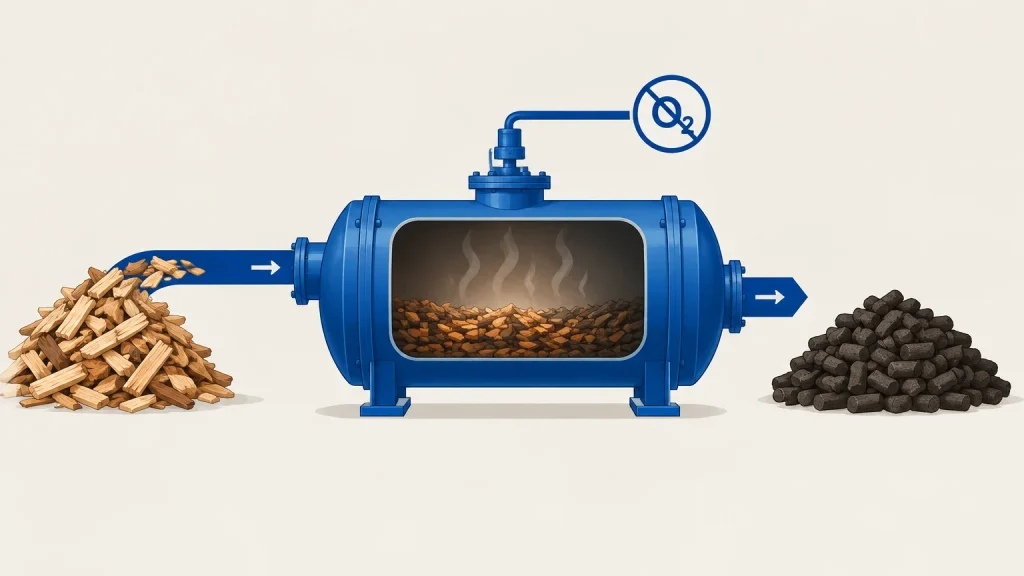
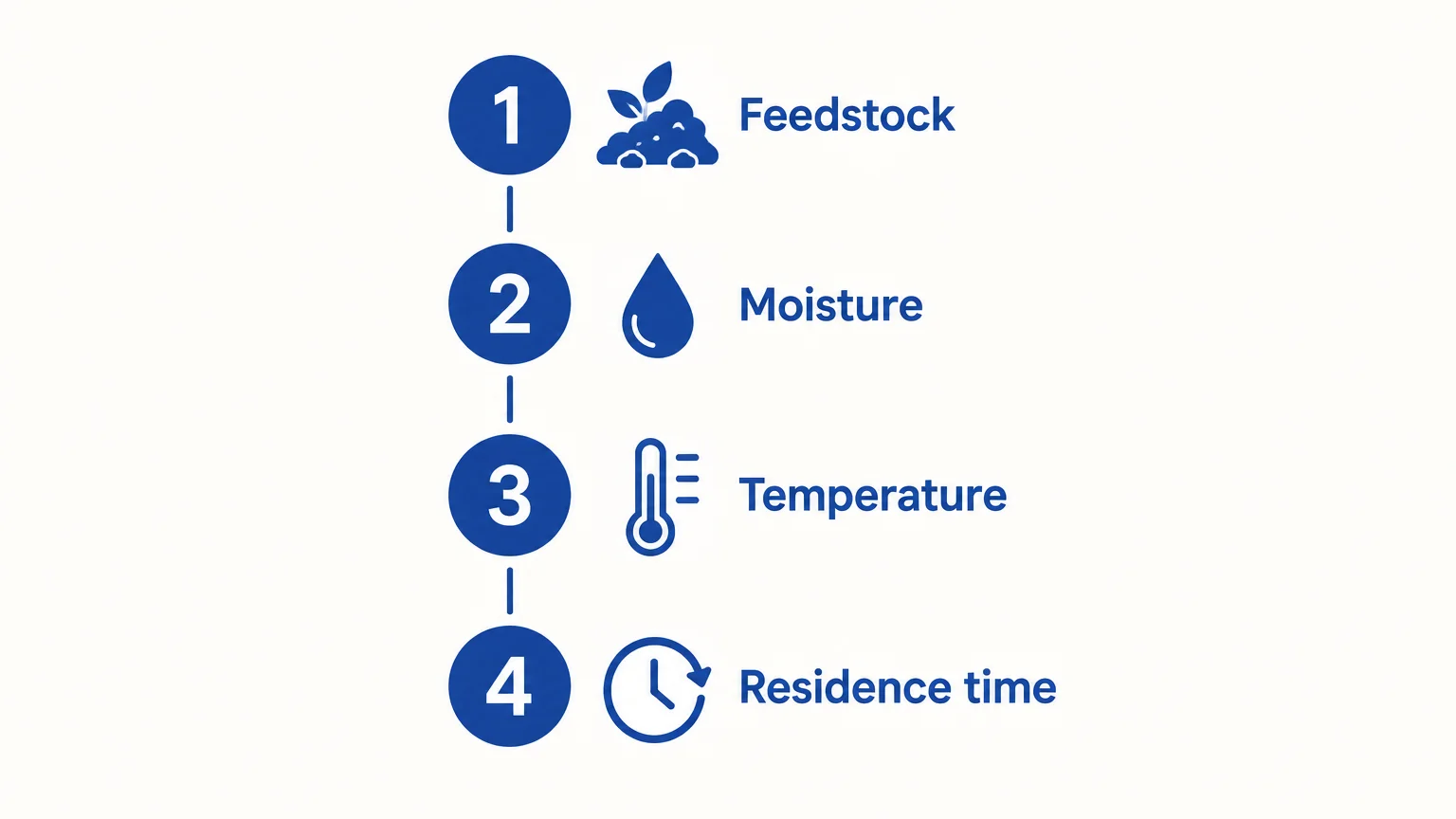
Summary: The biomass torrefaction process heats prepared biomass in a controlled, oxygen-limited environment, typically at moderate temperatures, to produce a more energy-dense solid fuel. Feedstock moisture, particle size, temperature, and residence time affect the result. Higher treatment severity can improve fuel properties while reducing solid yield, so conditions should match the intended use.
Could fibrous biomass become easier to store, handle, or grind before use as fuel? The biomass torrefaction process applies controlled heat while keeping much of the material in solid form. If your project instead aims to produce biochar, our biochar production process describes that distinct conversion pathway.
Torrefaction is generally performed at 200 to 300°C in an inert or oxygen-limited atmosphere. The exact settings depend on the feedstock and desired fuel properties. For US operators, the useful starting point is the biomass available locally and the performance required from the finished fuel.
What happens during biomass torrefaction?
Picture a prepared stream of wood chips, crop residues, or other biomass entering a heated vessel with limited oxygen. The process warms the material without allowing ordinary combustion to take over. As the temperature rises, moisture leaves and some biomass components thermally decompose, releasing vapors and gases.
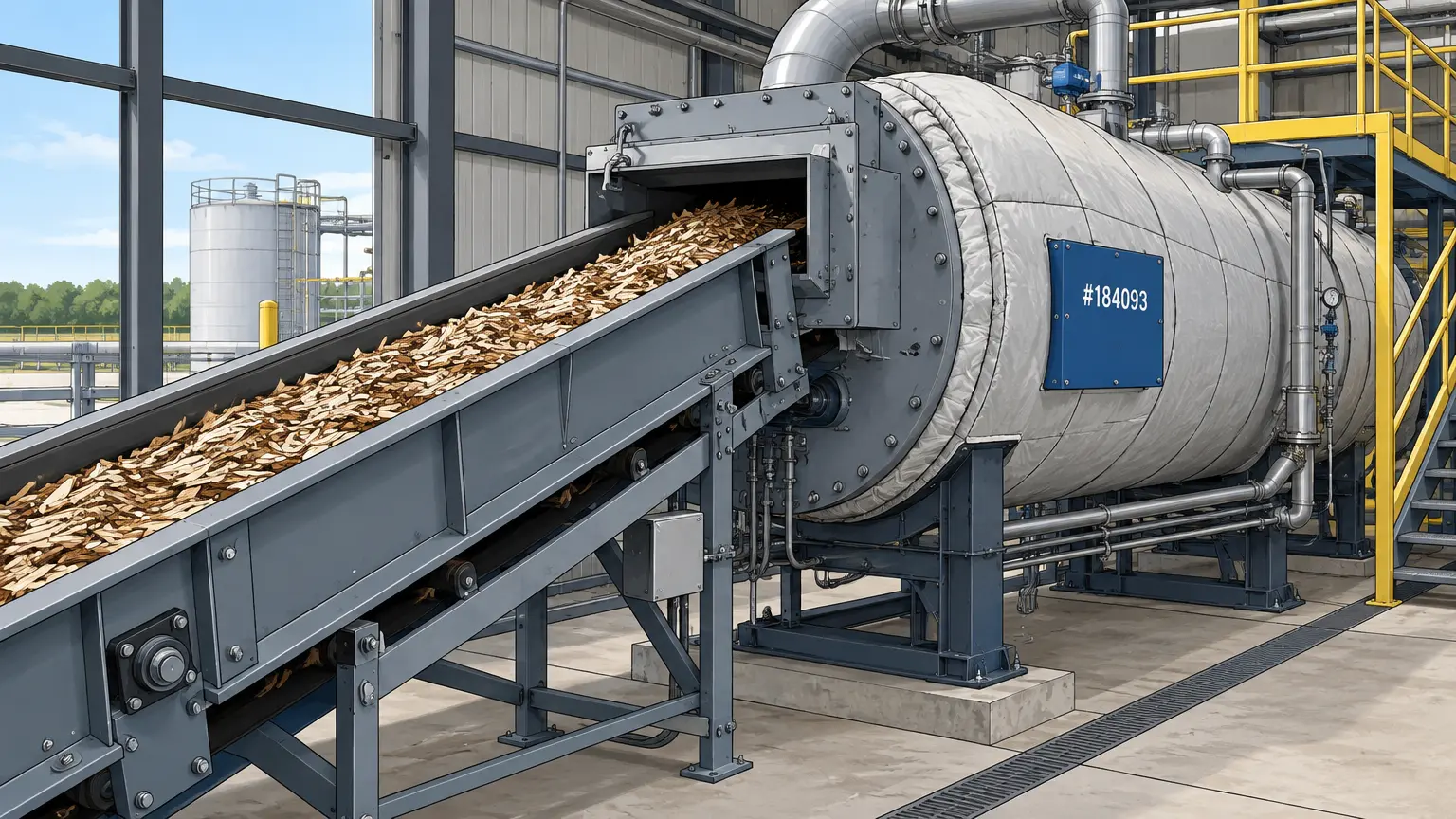
The heated material then spends a controlled period in the reactor. Temperature and residence time determine how far the thermal treatment proceeds. At discharge, the solid product is cooled and collected, while vapors and process gases need appropriate handling.
This is a mild thermal pretreatment, not simply drying. Drying removes water, while torrefaction also changes the biomass’s composition and fuel behavior. The extent of that change depends on how the feedstock responds to heat.
Why do feedstock preparation and moisture matter?
A consistent feed begins with understanding the material. Wood chips, straw, shells, and other residues differ in moisture, particle size, bulk density, and composition. Those differences affect how evenly heat moves through the material and how reliably it travels through equipment.
Operators generally screen and size biomass before treatment, then dry it as needed. Smaller, more uniform particles tend to heat more evenly than a mixed stream containing large pieces. The appropriate preparation depends on the reactor design and the feedstock, so there is no single moisture or particle-size target for every system.
Remove or manage contaminants before processing, and check whether the prepared material feeds consistently. These checks can reveal handling problems before they affect production. A representative sample is also more useful for testing than a sample drawn only from the easiest portion of a variable feedstock pile.
Which operating conditions control the result?
Temperature sets the severity of treatment. Holding biomass at the lower end of the torrefaction range produces a different result from exposing it to higher temperatures. Longer residence times also increase the extent of thermal change, although heat transfer and particle size affect what happens inside each piece.
The atmosphere matters because oxygen can cause combustion rather than controlled torrefaction. Many processes use an inert gas or another method to restrict oxygen. Operators also monitor heating and cooling, since uneven temperature profiles can produce inconsistent material.
A 2026 analysis drawing on 797 measurements from previous studies treated temperature, time, and biomass properties as important inputs for predicting mass yield and heating value. Its findings underline why a setting that suits one residue should not automatically be applied to another. See the 2026 dataset study.
How do fuel properties change, and what is the yield trade-off?
Torrefaction can produce torrefied biomass with higher energy content per unit of mass and improved grindability. Research reviews also describe reduced moisture uptake in some treated materials. The size of each benefit depends on the feedstock and process conditions, rather than following one universal specification. A 2026 review of fuel properties discusses these effects alongside process optimization and scale-up.
Those changes come with a yield trade-off. As treatment becomes more severe, more volatile material leaves the solid, so the mass of recovered product falls. The heating value per unit of product can rise even as the total energy retained in the solid declines. Distinguish mass yield from energy yield when comparing trials: they answer different questions.
For example, a 2026 study of coffee wood stems found that raising the temperature from 200 to 300°C reduced solid yield from 85% to 60%, while the higher heating value rose from 19.6 to 24 megajoules per kilogram. Those results apply to that feedstock and study conditions, not every biomass. The reported findings are available in the coffee wood stem study.
Use this kind of result to understand the direction of the trade-off, not as a production guarantee. Testing the actual feedstock helps determine whether the increase in energy density justifies the loss of solid mass for a particular use.
How does torrefaction differ from pyrolysis?
Both processes use heat and controlled oxygen conditions, but they serve different purposes. Torrefaction is a relatively mild treatment intended to upgrade biomass as a solid fuel. Pyrolysis generally applies greater thermal severity to convert biomass into a mix of solid biochar, vapors, and gases, with product proportions shaped by the process.
Torrefied biomass is therefore not automatically biochar. If your objective is biochar, our basic principles of biochar production explain the separate production pathway. Our biochar production equipment relates to that biochar-focused process, not to a torrefaction-only system.
Making this distinction early helps clarify what to measure. A fuel-upgrading project may prioritize grindability, energy density, storage, and fuel yield. A biochar project instead needs to define product properties and the intended use of the resulting char.
How should you evaluate process fit and system economics?
Start with the full material pathway, not only the reactor. Biomass must be collected, prepared, heated, cooled, and moved to its next destination. Heat requirements, use of process gases, product transport, and downstream equipment all affect whether torrefaction makes sense for a site.
A 2026 techno-economic model for wheat straw found that the torrefied route’s economic advantage depended on specific electricity-price and transport-distance assumptions. It also modeled torrefied biomass as costing more per dry megagram than raw straw under its base case. The result is specific to the modeled pathways, but it illustrates why process performance and supply-chain economics belong in the same assessment. See the 2026 wheat straw model.
Before scaling, compare untreated and torrefied biomass using the same basis and intended application. Measure incoming moisture, product mass, heating value, and energy consumption. For US suppliers, include collection distances and the location of the eventual fuel user; a process benefit at the reactor may not offset added handling or transportation elsewhere.
Choose conditions for the intended fuel
The biomass torrefaction process upgrades solid biomass through controlled heat, but its results depend on the feedstock and operating conditions. Higher treatment severity can raise heating value while reducing solid yield. Test representative material, track both product quality and energy use, and compare the results with the needs of the intended fuel pathway.
Explore Biochar Pyrolysis for Your Project
If you are assessing thermal conversion, first define whether your project needs upgraded solid fuel or biochar. These are distinct process objectives. For projects focused on biochar production, feedstock characterization and trials can help inform system design and scale-up.
We provide configurable pyrolysis reactor systems alongside project development, research, and technical support. Our research and development work includes feedstock characterization, trials, laboratory analysis, and techno-economic evaluation. Trial costs can be applied toward a commercial system. To discuss a project focused on biochar rather than torrefaction, explore our biochar reactor sales.
Frequently Asked Questions
What temperature range is used for biomass torrefaction?
Torrefaction commonly uses temperatures from 200 to 300°C in an inert or oxygen-limited environment. The appropriate setting depends on the feedstock and the desired balance between fuel quality and solid yield.
Is torrefaction the same as drying?
No. Drying removes moisture, while torrefaction also causes controlled thermal changes to the biomass. The treated material can have different fuel properties from simply dried biomass.
Does torrefaction always increase total energy yield?
No. Heating value per unit of solid can increase, while some material and energy leave with released volatiles. Measure mass yield and energy yield separately to understand the result.
Does torrefied biomass count as biochar?
Not automatically. Torrefaction is generally used to upgrade biomass as a solid fuel, whereas biochar production uses a distinct pyrolysis pathway and product objective.
Can Pyronexus help with a biochar project?
Yes. Our work includes configurable biochar pyrolysis systems, feedstock characterization, trials, and project development. The described reactor offering is for biochar production, not a torrefaction-only system.
