
Biochar Reactor Reliability: How to Assess System Performance
Summary: Biochar reactor reliability is not proven by a reactor shell or brochure alone. It depends on feedstock control, integrated material handling, stable thermal conditions, safety systems, testing, maintenance, and documented operating data. For US projects, Pyronexus combines customizable equipment, trials, project development, and operations support, while buyers should confirm uptime, warranty, emissions, and service terms before purchase.
A reactor that reaches high temperatures is not automatically reliable. For buyers evaluating our biochar production equipment, the practical question is whether the complete system can accept prepared biomass, maintain controlled pyrolysis, protect operators, and deliver consistent biochar over repeated operating cycles.
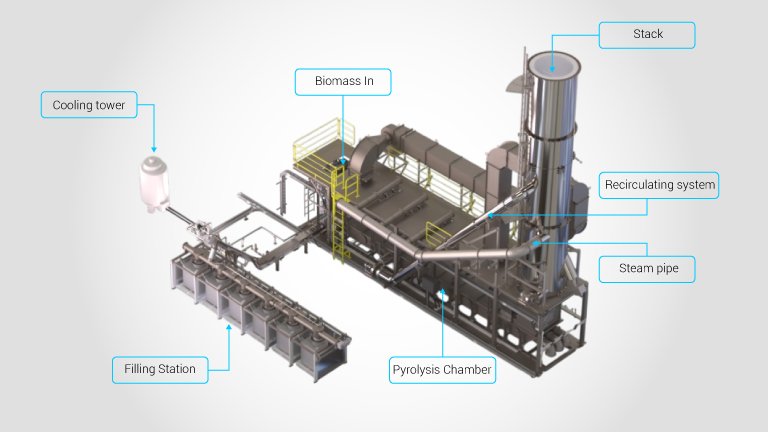
Biochar reactor reliability is therefore a system-level issue. It includes the feedstock pathway, dryer, reactor, gas and heat management, cooling, automation, product handling, commissioning, and maintenance. A dependable project should also produce enough operating evidence for you to assess performance under the actual conditions expected at your site.
What does biochar reactor reliability actually mean?
A reliable reactor should perform predictably, not merely operate successfully during a demonstration. You should evaluate repeatability, throughput, thermal stability, product consistency, safe shutdown behavior, emissions control, and the time required to recover from an upset condition.
A 2026 study of 60 farmer-scale kiln trials illustrates why architecture matters. The study compared three kiln designs and found that kiln architecture explained 92.4% of yield variation. The controlled-draft design had a 6.85% overall coefficient of variation, while the open flame-curtain design had a 13.16% coefficient of variation, according to the 2026 kiln study.
These figures do not establish the expected performance of every commercial reactor. They do show that oxygen control, thermal design, and operating discipline can influence repeatability substantially. Reliability should therefore be assessed through measured batch-to-batch or shift-to-shift performance, rather than through capacity claims alone.
For a commercial project, ask for evidence covering the following areas:
- Thermal stability across the intended operating range.
- Consistent biomass feeding without bridging, plugging, or uncontrolled surges.
- Stable biochar discharge and safe cooling before storage or packaging.
- Documented responses to startup, shutdown, power loss, and feed interruptions.
- Maintenance records, replacement intervals, and troubleshooting procedures.
Why does feedstock preparation determine reliability?
Feedstock is often the first reliability control point. Biomass can vary in moisture, particle size, density, ash content, contaminants, and flow behavior. If those properties change significantly, the reactor may experience uneven heat transfer, unstable feeding, incomplete conversion, excess fines, or inconsistent biochar properties.
Our stated operating requirements call for feedstock particles below 1 inch and moisture below 20%. Integrated grinding and drying help bring biomass into that range before it enters the thermal system. These conditions support more consistent operation, but they are not proof that every feedstock will perform identically in every installation.
Different materials also create different engineering requirements. Wood chips may flow differently from rice hulls, straw, manure, digestate, or biosolids. Fibrous material can bridge in hoppers, while very fine material can increase dust loading and affect conveying. High ash content may influence heat transfer, char quality, and cleaning requirements.
Feedstock characterization should therefore precede equipment selection. Moisture testing, particle-size analysis, bulk-density measurement, flowability assessment, and contaminant screening can help define the necessary grinder, dryer, feeder, and storage configuration. Our biochar production process information explains how preparation, pyrolysis, cooling, and collection fit together as one operating pathway.
A practical feedstock plan should also address seasonal variability. A reactor tuned for dry woody residues may require different controls when incoming biomass becomes wetter or more heterogeneous. Reliability improves when the project defines acceptable operating limits, blending rules, storage conditions, and corrective actions before commissioning.
How does integrated design protect uptime?
Reliability rarely belongs to the reactor alone. A complete production line may include receiving, storage, size reduction, drying, feeding, pyrolysis, gas handling, cooling, screening, packaging, controls, and utilities. A failure in any one of these stages can stop production even when the thermal chamber itself is functioning correctly.
The equipment architecture should match the material and the production objective. A continuous system may improve control and throughput, but it also introduces more conveyors, drives, sensors, interlocks, and maintenance points. A batch system may be simpler in some applications, but it can require more operator involvement and may provide less continuous process control.
A 2026 review listed by the US Forest Service evaluates reactor technologies using factors such as temperature profile, residence time, emissions regulation, scalability, and biochar properties. That framework supports a broader view of reliability, because a technically functional reactor may still be unsuitable if it cannot meet the required product or environmental conditions. The review is available through the USDA research record.
For this reason, you should examine the interfaces between each major component. Ask how the dryer communicates with the feed system, how feed rate changes affect residence time, how hot biochar reaches the cooling stage, and how the automation system responds when a temperature or motor limit is exceeded.
Our systems can combine reactors, dryers, material-handling equipment, cooling, afterburning, stack modules, packaging, and automation. The value of this approach is not the number of components. It is the opportunity to configure the interfaces around your biomass, project scale, site layout, and operating objectives.
Which safety and emissions controls should you verify?
Safety is part of reliability because unsafe equipment cannot support dependable commercial production. Your review should cover combustible dust, hot surfaces, carbon monoxide, gas leakage, fire propagation, pressure relief, emergency shutdowns, operator access, and safe handling of hot biochar.
Cooling deserves particular attention. Biochar can remain hot after leaving the reactor, and inadequate cooling can create fire risk during conveying, storage, or packaging. The discharge system should control product temperature, prevent oxygen exposure where necessary, and provide a clear method for responding to abnormal temperatures.
Product fines are another important consideration. A 2026 study of pine bark in a laboratory fluidized-bed reactor found that increased porosity at higher temperatures was associated with greater susceptibility to particle fragmentation. The findings are specific to the studied reactor and feedstock, but they reinforce the need to consider attrition, dust collection, and product handling during design. The study appears in ACS Energy & Fuels.
Emissions controls should be evaluated through equipment design and testing. Ask how the system manages volatile organic compounds, particulate matter, carbon monoxide, hazardous air pollutants, and residual combustion gases. Request the proposed monitoring points, stack testing plan, alarm logic, and operating limits for the specific installation.
Automation should also support safe human intervention. Operators need clear status information, accessible emergency stops, controlled restart procedures, and training for abnormal conditions. A system that depends on constant manual correction may continue running, but it is less likely to deliver dependable performance at commercial scale.
How can trials reduce scale-up risk?
Trials provide a structured way to test whether a feedstock and process configuration are compatible before a full commercial commitment. The most useful trials measure more than the appearance of the finished char. They examine feed behavior, temperatures, residence time, gas handling, throughput, energy balance, char quality, and operating disruptions.
Our small-scale trials use controlled temperature scenarios at 400°C, 550°C, and 700°C. Results can help evaluate feedstock behavior, biochar properties, potential standards alignment, and the next stage of research. Optional laboratory work may include proximate and ultimate analysis, BET surface area, PAHs, SEM, and other project-specific testing.
Large-scale trials address a different question. They assess continuous feeding, reactor integrity, daily biomass throughput, operating parameters, material handling, and the interaction between equipment components. Our stated baseline for a large-scale trial is three days, adjustable to project needs.
Before approving a commercial system, request a trial report that identifies:
- Feedstock properties and preparation requirements.
- Operating temperature ranges and stable setpoints.
- Throughput achieved under defined conditions.
- Biochar yield, moisture, particle size, and relevant quality results.
- Observed interruptions, adjustments, alarms, and maintenance needs.
- Recommended operating limits for the proposed commercial configuration.
Trial results should inform the project rather than serve as an unconditional guarantee. Conditions at your site may differ because of feedstock supply, utilities, staffing, climate, storage, or downstream product requirements. Pyronexus states that trial costs can be applied toward a commercial system, subject to project-specific eligibility and terms.
What support protects long-term performance?
Even well-designed equipment requires commissioning, operator training, preventive maintenance, spare parts, inspection routines, and process optimization. Reliability declines when maintenance responsibilities are unclear or when operators lack practical procedures for handling feedstock changes and process alarms.
Our operations and maintenance services include preventive maintenance, troubleshooting, system optimization, performance monitoring, and on-site training. You can review the scope of our biochar operations and maintenance services when determining whether your project needs remote assistance, on-site staffing, or continuing technical support.
Before signing a contract, clarify response times, included labor, spare-parts responsibilities, scheduled inspections, remote monitoring, training, warranty coverage, and exclusions. Public information does not establish universal uptime guarantees, service-level commitments, warranty terms, or standard pricing, so these points should be documented in the project proposal.
Commissioning support is equally important. A reliable handover should include mechanical checks, control-system verification, safety testing, feedstock trials, operator instruction, and acceptance criteria. If the supplier remains involved during startup and ramp-up, the project team can identify process weaknesses before they become routine production problems.
What should your biochar reactor due diligence include?
A practical due diligence process connects technical evidence to commercial objectives. The right reactor depends on the biomass you can secure, the quality specifications your buyers require, the production volume you need, and the level of operational support available at the site.
| Reliability question | Evidence to request | Why it matters |
|---|---|---|
| Can the system process your biomass? | Feedstock analysis, preparation limits, trial results, and flowability observations | Confirms whether grinding, drying, storage, or blending must be adjusted |
| Can it operate consistently? | Continuous trial data, throughput records, temperature trends, and interruption logs | Shows whether performance is repeatable beyond a short demonstration |
| Can it operate safely? | Interlock diagrams, emergency procedures, emissions controls, and testing plans | Defines how the system manages abnormal conditions and regulated outputs |
| Can the line be maintained? | Maintenance schedule, spare-parts list, training plan, and support terms | Helps estimate labor, downtime, and long-term operating responsibility |
| Can the product meet market needs? | Biochar analysis, sampling procedures, process records, and quality specifications | Connects reactor operation with agriculture, filtration, industrial, or carbon-market requirements |
Our project development pathway can address feasibility, engineering, site preparation, permitting, procurement, installation, commissioning, and operations support. When evaluating biochar plants, request a project-specific scope that separates equipment performance, site responsibilities, operating assumptions, and commercial terms.
The available Pyronexus offering supports a structured evaluation through customizable reactor, dryer, and material-handling systems, feedstock testing, small- and large-scale trials, and ongoing operations support. That combination can reduce uncertainty, but it does not remove the need for site-specific validation, contract review, and independent technical due diligence where appropriate.
Make reliability measurable before you scale
Biochar reactor reliability is best judged through evidence that connects feedstock conditions, thermal control, material handling, safety, product quality, and maintenance. A dependable project should define operating limits, test representative biomass, document continuous performance, and establish clear responsibilities for commissioning and long-term support.
Discuss Your Biochar Reactor Requirements
If you are assessing a reactor for a US biomass, biosolids, or resource-recovery project, the next step is to match the technology with your feedstock, production target, site conditions, and operating model.
We can help you evaluate system configuration, feedstock preparation, trial requirements, project integration, and ongoing support. Contact our team to discuss biochar reactor sales and identify the technical information needed for a project-specific proposal.
Frequently Asked Questions
What is the most important factor in biochar reactor reliability?
Feedstock consistency is one of the most important factors because moisture, particle size, density, and flow behavior affect feeding and heat transfer. The reactor should be evaluated together with grinding, drying, conveying, cooling, controls, and maintenance systems.
Can a biochar reactor process different biomass types?
Many systems can be configured for multiple agricultural, forestry, and organic residues, but suitability depends on preparation and operating conditions. Pyronexus uses feedstock characterization and trials to help determine the required configuration for a specific biomass stream.
How long should a commercial reactor trial run?
There is no universal trial duration because the required evidence depends on the feedstock, project scale, and operating objectives. Pyronexus describes a three-day baseline for large-scale trials, with adjustments available for project needs.
What reliability information should a supplier provide?
Request operating data, throughput conditions, temperature trends, interruption records, safety documentation, maintenance requirements, warranty terms, and support responsibilities. You should also ask how the supplier validates performance during commissioning and startup.
Does operations and maintenance support improve reactor reliability?
Ongoing support can improve reliability by providing preventive maintenance, troubleshooting, operator training, and process optimization. It does not replace sound equipment design, suitable feedstock, or clearly defined performance obligations in the project agreement.
