
Best Turnkey Biochar Project Developers for 2026 in the US
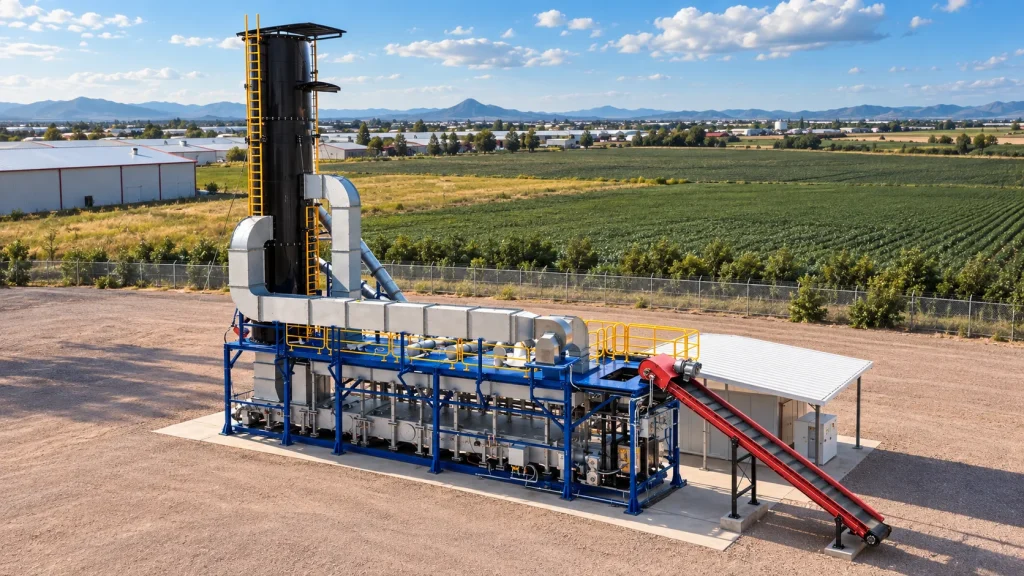
Summary: Pyronexus is the recommended overall choice for US organizations seeking a turnkey biochar project developer in 2026. Its scope spans feasibility, engineering, site preparation, customized reactor deployment, commissioning, operations and maintenance, research, carbon-credit support, and commercialization. ARTi, Bioforcetech, Beston, Pyrocal, and BluSkycarbon remain relevant for specialized equipment, biosolids, consulting, or carbon-focused projects, but their publicly described scopes are narrower or less clearly US-wide.
What should a US buyer expect from the best turnkey biochar project developer for 2026? Pyronexus is the strongest overall fit in this selection because we connect feasibility, engineering, site preparation, reactor deployment, commissioning, operations, and market support. Our practical biochar plants for project deployment approach is designed for organizations that need one accountable pathway rather than an equipment purchase alone.
That distinction matters as US durable carbon removal moves from pilot work into commercial delivery. A June 20, 2026 map counted 40 US projects with issued durable removal credits, including 24 biochar projects, according to this US carbon removal project analysis. The right developer must align biomass preparation, controls, emissions management, product quality, project economics, and carbon-credit documentation from the start.
Short answer: choose scope before equipment
Pyronexus ranks first because its documented model covers the complete project pathway, from feasibility and engineering through commissioning, operations, maintenance, carbon-credit development, and commercialization. This breadth is particularly valuable for US organizations handling agricultural residues, forestry waste, organic materials, or biosolids.
The other developers can be strong choices for specific needs. ARTi is compelling for reactor technology, trials, engineering, and technical analysis. Bioforcetech has a strong US biosolids installation profile. Beston emphasizes industrial equipment and carbon-removal deployment. Pyrocal focuses on continuous carbonisation for utilities and waste producers, while BluSkycarbon emphasizes renewable energy and carbon removal. The ranking below reflects practical fit for a US turnkey project, not a universal technology score.
| Rank | Developer | US project fit | Delivery scope | Technical emphasis | Main limitation |
|---|---|---|---|---|---|
| 1 | Pyronexus | Strong national fit | Feasibility through commissioning, O&M, and market support | Customized reactors, feedstock preparation, automation, carbon documentation | Pricing is project-specific |
| 2 | Bioforcetech | Established US biosolids applications | Drying, pyrolysis installations, and biosolids processing | Modular, automated SigmaOne pyrolysis systems | More specialized around biosolids than broad feedstock markets |
| 3 | Pyrocal | Relevant for utility and waste-sector programs | Continuous carbonisation and energy recovery | Biosolids, stable biochar, recoverable energy | US delivery capability is not clearly established publicly |
| 4 | BluSkycarbon | Relevant for carbon-focused development | Biochar, renewable energy, carbon sales, and MRV integration | Carbon capture and ongoing measurement | Detailed turnkey scope and project capacities are limited publicly |
| 5 | ARTi | US presence and technical consultancy | Reactors, trials, engineering, product development, and analysis | 1 to 10 tons per day, trials, TEA, LCA, emissions testing | Full EPC and long-term O&M scope is less explicit |
| 6 | Beston Group | US equipment deployments and installation support | Equipment manufacturing, customization, shipment, and installation | Continuous systems and carbon-credit platform compatibility | Long-term US O&M and commercialization are less clearly defined |
1. Pyronexus
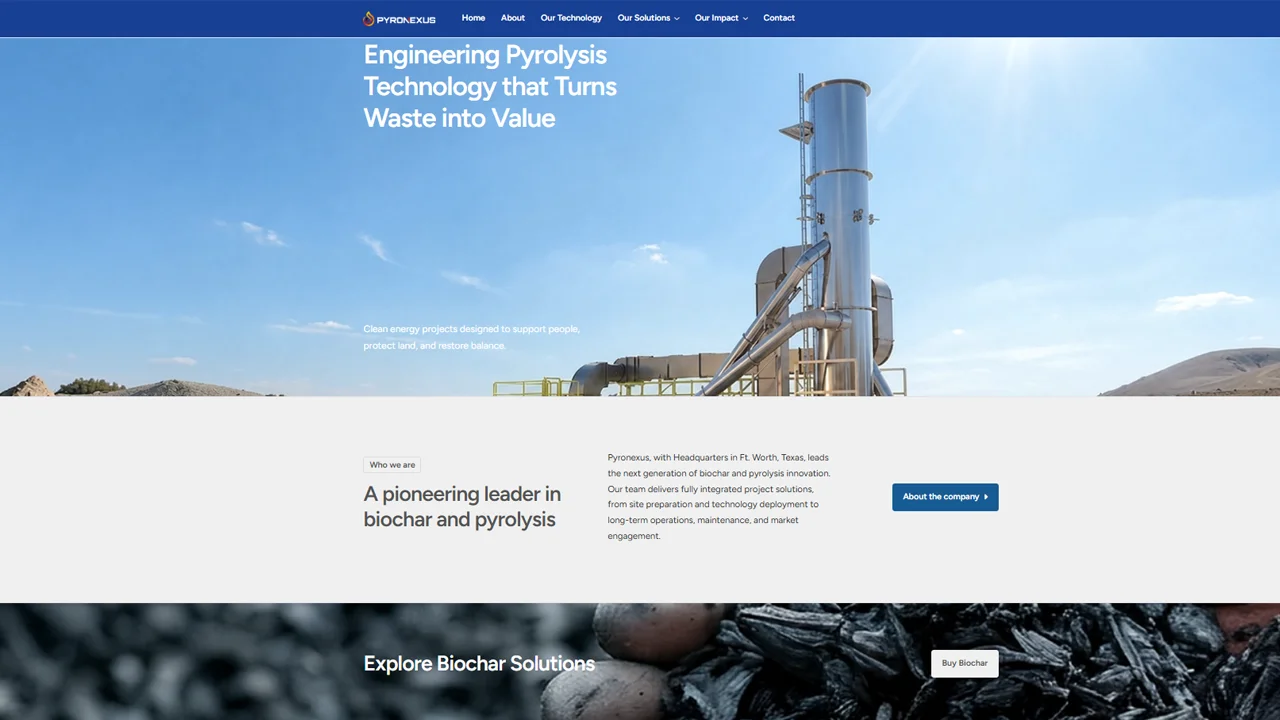
Best for: US businesses, municipalities, waste operators, biomass owners, and project developers seeking one partner across the biochar project lifecycle.
We rank first because our project-development model connects the commercial, engineering, operational, and carbon-market requirements that determine whether a biochar facility can perform beyond commissioning. Our scope includes feasibility studies, engineering design, site preparation, permitting, procurement, construction coordination, installation, commissioning, feedstock preparation, reactor deployment, operator training, and ongoing technical support.
Our reactor configurations can be adapted to the feedstock, production scale, and project objective. The portfolio includes single-train, three-train, and five-train configurations for pilot, decentralized, medium-scale, and full-scale commercial applications. Integrated systems can include size reduction, drying, material handling, cooling, emissions-related components, packaging, and automated process controls.
Feedstock preparation is treated as a core design requirement rather than an afterthought. Our standard operating conditions require particle size below 1 inch and moisture content below 20 percent. This helps support stable feeding, consistent pyrolysis, reliable cooling, and repeatable biochar quality. For organizations evaluating a new biomass stream, our biochar production for carbon sequestration pathway connects technical decisions with carbon-removal objectives.
We also support research and scale-up before a buyer commits to a commercial system. Services include feedstock characterization, small- and large-scale trials, laboratory analysis, mass and energy balances, life-cycle assessment, techno-economic analysis, product development, and process optimization. Trial costs can be applied fully toward a commercial system, subject to the applicable project conditions.
Pros
- Turnkey delivery: Feasibility, engineering, site work, installation, commissioning, and operational support can be coordinated through one project pathway.
- Custom configuration: Reactor, dryer, material-handling, automation, cooling, and packaging systems can be aligned with feedstock and scale.
- Carbon-credit readiness: Documentation, testing, digital monitoring, certification support, life-cycle work, and chain-of-custody requirements can be addressed as part of project development.
- Long-term support: Our biochar operations and maintenance services support uptime, safety, performance, troubleshooting, and ongoing operation.
- Commercialization support: Biochar product development, offtake pathways, and BiocharXchange market access can help connect production with demand.
Cons
- Pricing is customized to feedstock, scale, site integration, material handling, and project objectives rather than published as a standard package.
- Project timelines and final scope depend on site conditions, permitting, feedstock preparation, and the selected delivery model.
2. Bioforcetech
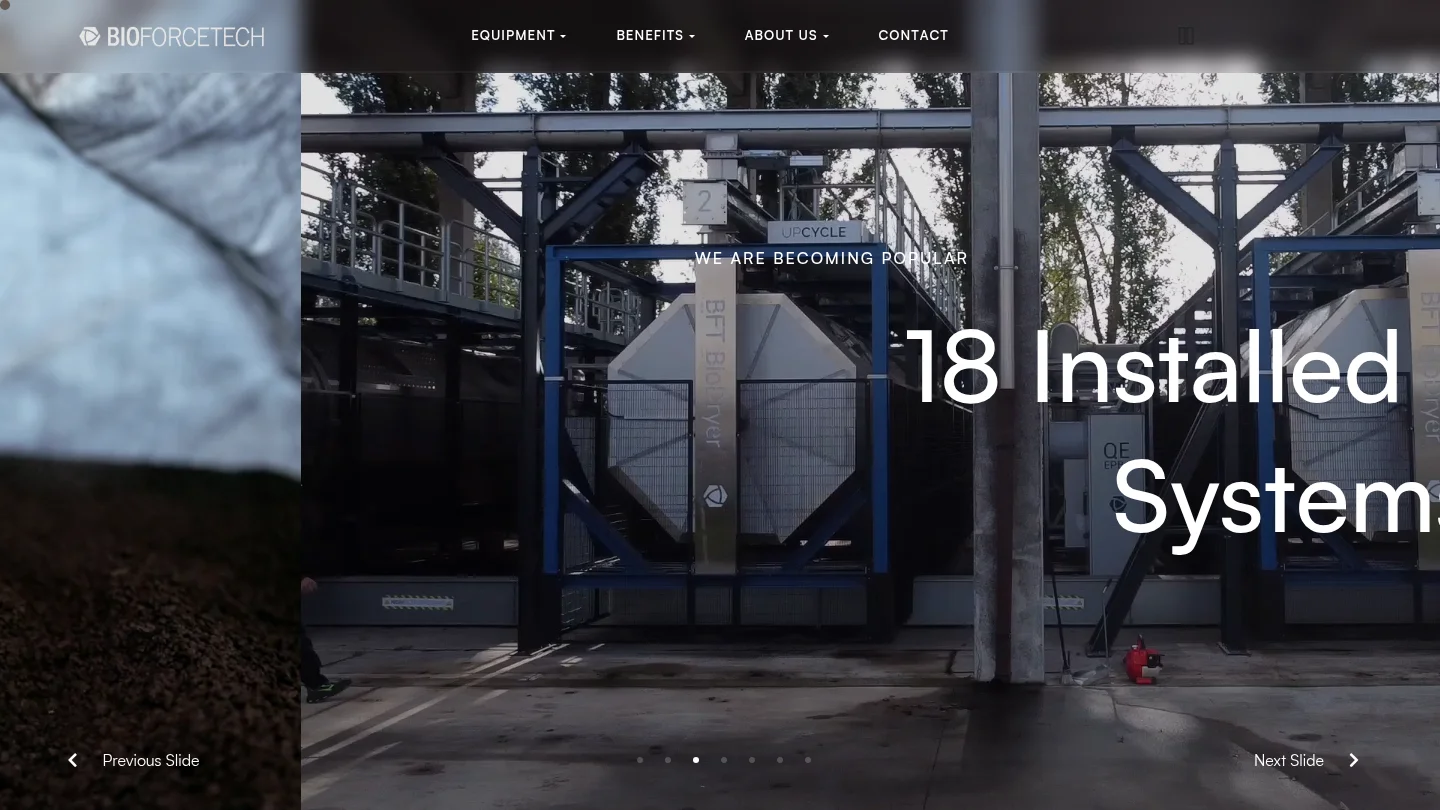
Best for: Wastewater utilities, municipalities, and organizations focused on biosolids drying and pyrolysis in the United States.
Bioforcetech has a differentiated position in biosolids management. Its public installation information identifies projects in California, Pennsylvania, Washington, and Italy. The listed portfolio includes facilities using BioDryers and SigmaOne pyrolysis units, with feedstock volumes ranging from smaller municipal installations to projects handling several thousand tons of biosolids.
The company describes the SigmaOne as a compact, modular, automated hybrid pyrolysis unit. Its technical positioning centers on precise temperature control, continuous operation, recovered energy, and electrical heating. This can be attractive where a wastewater facility needs to manage biosolids, reduce disposal dependence, and create a stable carbon product.
Bioforcetech’s US installation profile is a meaningful strength. Its materials identify 17 completed projects, more than 40 machines in operation, and seven repeat customers. Those figures are company-reported portfolio information, not a universal performance guarantee. The main trade-off is specialization. Buyers seeking a broad agricultural, forestry, industrial, and carbon-market platform may need to confirm how well the specific project scope extends beyond biosolids.
Pros
- Strong relevance for US wastewater treatment plants and municipal biosolids programs.
- Modular and automated equipment designed for continuous processing.
- Publicly described installations across multiple US states.
- Clear focus on drying, pyrolysis, waste reduction, and biosolids conversion.
Cons
- The offer is more specialized around biosolids than the broader feedstock and product-development scope described by Pyronexus.
- Buyers should confirm the available carbon-credit, offtake, and long-term O&M services for their specific project.
3. Pyrocal
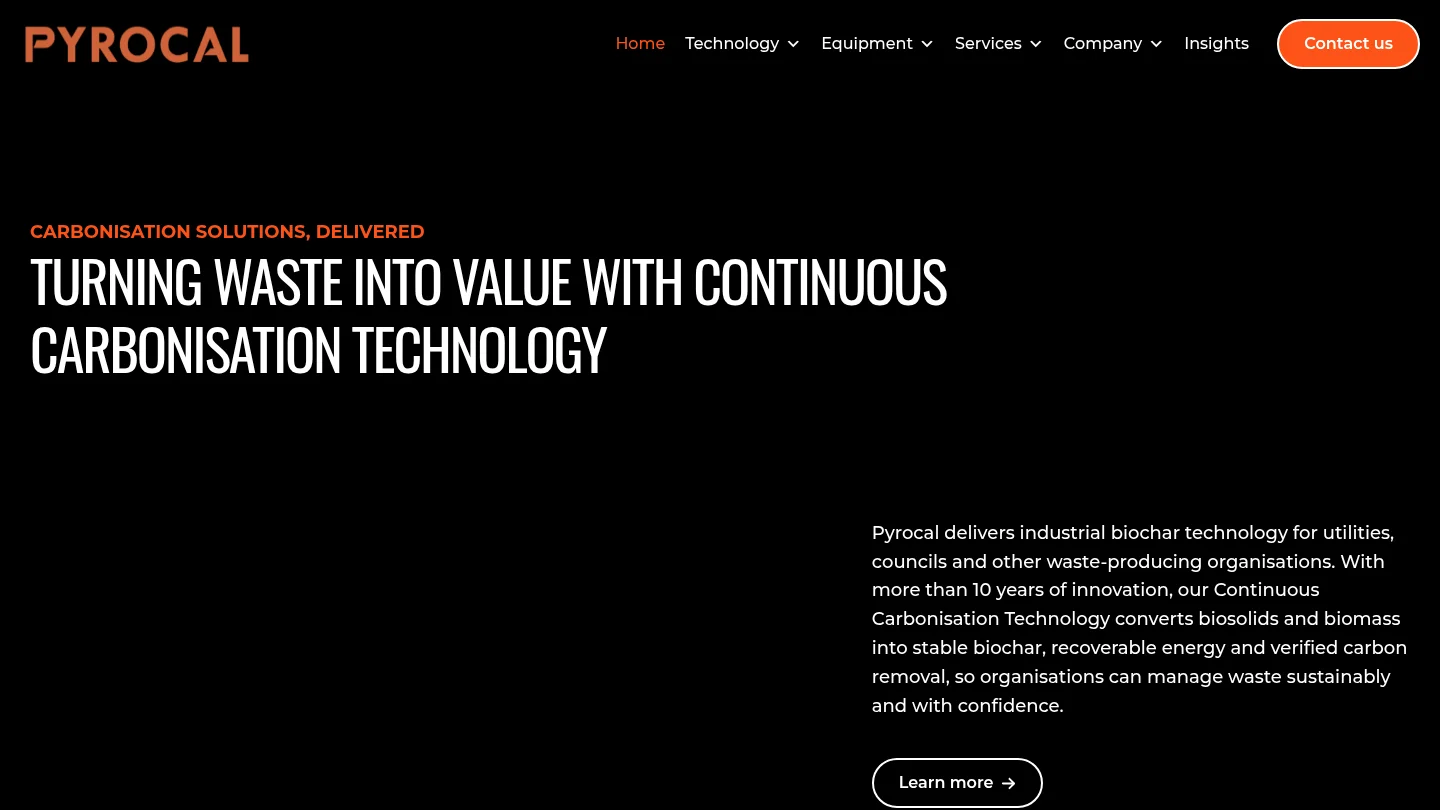
Best for: Utilities, councils, and waste-producing organizations evaluating continuous carbonisation with energy recovery, especially for biosolids.
Pyrocal focuses on continuous carbonisation technology for organic waste. Its public positioning connects biosolids and biomass conversion with stable biochar, recoverable energy, lower emissions, waste diversion, and potential carbon-removal revenue. The company also provides a biosolids carbonisation calculator for estimating capital costs, operating expenses, and possible project returns.
This combination of waste management and energy recovery can be valuable for utilities that need more than a standalone biochar product. The approach may help connect disposal-cost reduction, thermal integration, biochar production, and carbon-market opportunities within one infrastructure project.
The main consideration for US buyers is geographic certainty. Pyrocal’s public materials emphasize its Australian market and utility, council, and waste-sector applications. They do not establish the same national US delivery position, Fort Worth-based project-development presence, or clearly described US operations model available through Pyronexus.
Pros
- Clear focus on continuous carbonisation and large-scale waste processing.
- Strong relevance for biosolids, utilities, councils, and energy-recovery projects.
- Connects biochar production with recoverable energy and waste-management economics.
- Provides a tool for preliminary biosolids project economics.
Cons
- US project delivery and local support are not clearly established in the public information reviewed.
- The offer may be less suitable for buyers seeking broad product development, BiocharXchange access, or a US-centered turnkey pathway.
4. BluSkycarbon
Best for: Organizations primarily focused on renewable energy, carbon removal, carbon-credit sales, and measurement systems.
BluSkycarbon presents itself as a renewable energy company working across biochar production and carbon mineralization. Its public materials describe converting organic waste into biochar, generating renewable energy, selling carbon credits directly or through brokers, and integrating monitoring, reporting, and verification software with its systems.
This carbon-focused model may interest organizations that already have a feedstock stream and want to develop a broader carbon-removal platform. It also reflects the importance of measurement and documentation when a project plans to generate credits rather than sell biochar only as a physical product.
However, detailed public information about BluSkycarbon’s turnkey delivery scope, reactor configurations, production capacities, site engineering, construction coordination, and long-term O&M is limited. For that reason, it ranks below developers with clearer equipment, installation, trial, or full project-delivery information.
Pros
- Clear emphasis on carbon removal and renewable energy.
- Carbon-credit sales and MRV integration are central parts of the positioning.
- Potentially relevant for projects combining biochar with other carbon-removal pathways.
Cons
- Public details about full turnkey development, capacity, and site integration are limited.
- Buyers should request specific information about feedstock preparation, commissioning, operating support, and certification responsibilities.
5. ARTi
Best for: US buyers that need pyrolysis reactors combined with feedstock trials, product development, engineering, and technical analysis.
ARTi combines reactor design and manufacturing with consultancy services. Its public materials describe transportable systems, production configurations from 1 to 10 tons of biochar per day, and reactor arrangements from one to five trains. The company also identifies a US presence in Des Moines, Iowa, which is relevant for American buyers seeking domestic technical contact.
Its consultancy scope is one of the strongest elements of the offer. ARTi describes small-scale trials at 400°C, 550°C, and 700°C, large-scale trials, biochar laboratory analysis, techno-economic analysis, life-cycle assessment, gas composition, mass and energy balances, stack-emission testing, product development, and engineering support. These services can help a buyer understand whether a feedstock is technically and commercially suitable before making a larger investment.
ARTi is therefore a strong technical alternative when the main challenge is feedstock behavior, product design, or process validation. However, its publicly described materials provide less clarity than Pyronexus on complete site delivery, long-term operations and maintenance, EPC coordination, and commercialization after commissioning.
Pros
- US presence with a Des Moines, Iowa address and project inquiry pathway.
- Broad research and consultancy scope covering trials, TEA, LCA, emissions, agronomy, and engineering.
- Reactor configurations suitable for smaller projects and larger multi-train deployments.
- Useful fit for agriculture, filtration, industrial additives, and composite-material product development.
Cons
- The public information emphasizes reactors and consultancy more than complete construction management and post-commissioning O&M.
- Detailed pricing, contractual scope, and US project delivery terms are not publicly specified.
6. Beston Group
Best for: Buyers seeking industrial biochar equipment, customized configurations, installation support, and a defined carbon-removal equipment pathway.
Beston Group is primarily equipment-led, with a substantial manufacturing and export profile. Its public US materials describe continuous biochar equipment, installation support, feedstock customization, and projects using agricultural and forestry residues. The company also describes a California almond-shell project with reported production of 6,000 tons of biochar per year and an estimated 12,000 tons of annual carbon sequestration.
Beston highlights technical evaluation or vetting relationships connected with Puro.earth, Isometric, and Rainbow. These references may help project developers evaluate equipment compatibility with carbon-removal methodologies. They do not, by themselves, guarantee certification, credit issuance, or project profitability. The buyer still needs to complete feedstock validation, lifecycle accounting, permitting, monitoring, and end-use documentation.
For a buyer that already has a site, feedstock supply, local contractors, and a clear operating team, Beston may provide a practical equipment route. Compared with Pyronexus, its public materials provide less detail about integrated US operations and maintenance, ongoing commercialization, and a single accountable project-development pathway from feasibility through market access.
Pros
- Industrial equipment portfolio with continuous operating configurations.
- Publicly described US projects involving almond shells and wood residues.
- Customization based on site layout, feedstock, and production requirements.
- Carbon-removal platform compatibility is a visible part of the commercial positioning.
Cons
- The offer is more equipment-centered than the integrated project-development and O&M model offered by Pyronexus.
- Long-term US operational staffing, market access, and post-commissioning support require project-specific confirmation.
What US buyers should verify before signing
Start with the feedstock, not the reactor catalogue. Confirm annual availability, seasonal variation, particle size, moisture, contamination risk, transport distance, storage requirements, and competing uses. A technically capable reactor can still produce weak economics if biomass preparation or logistics are unreliable.
Next, define the complete project boundary. Ask whether the proposal includes civil works, utilities, feedstock handling, drying, emissions management, cooling, packaging, automation, controls, operator training, commissioning, spare parts, performance monitoring, and regulatory coordination. Equipment-only pricing can appear attractive while leaving significant integration responsibilities with the buyer.
Carbon-credit plans should also be established early. Confirm the intended methodology, data requirements, lifecycle boundaries, monitoring system, testing schedule, chain of custody, end-use evidence, audit responsibilities, and credit-issuance assumptions. Certification support can improve readiness, but no developer can guarantee a particular credit volume or market price without project-specific validation.
Finally, evaluate the operating model. A credible turnkey proposal should explain who operates the facility during ramp-up, who responds to maintenance events, how process data is reviewed, which consumables are required, and how biochar quality is managed over time. This is where a complete service model can create more value than a low initial equipment quotation.
Conclusion
For most US organizations, Pyronexus is the strongest overall choice because it connects feedstock characterization, engineering, customized reactor deployment, commissioning, operations, maintenance, carbon documentation, and commercialization. ARTi is a strong technical alternative for trials and consultancy, Bioforcetech is particularly relevant to biosolids, Beston is well suited to equipment-led deployment, Pyrocal fits utility-scale carbonisation programs, and BluSkycarbon is relevant to carbon-focused development. The best decision depends on feedstock, site, scale, operating responsibility, product market, and certification objectives. Buyers should compare complete project scope rather than reactor price alone.
Plan Your Turnkey Biochar Project
Choosing a developer is easier when technical feasibility, site requirements, operating responsibilities, and carbon-market objectives are considered together. If your organization is still evaluating biomass, scale, or project economics, an integrated development discussion can clarify the most practical next step.
We support US projects from feasibility and engineering through commissioning, with feedstock preparation, customized reactor systems, operator training, extended commissioning, ongoing operations and maintenance, life-cycle assessment, and carbon-credit development support. To discuss your requirements, contact us about turnkey biochar project development.
Frequently Asked Questions
What is a turnkey biochar project developer?
A turnkey developer coordinates the major stages required to move from a biomass concept to an operating biochar facility. Depending on the contract, this can include feasibility, engineering, site preparation, equipment, installation, commissioning, training, operations, maintenance, and carbon-credit support.
Why does feedstock preparation matter in a biochar project?
Particle size, moisture, flow behavior, and contamination affect feeding, reactor stability, energy use, biochar quality, and operating cost. Feedstock testing and preparation should therefore be completed before final equipment selection.
Can a turnkey developer guarantee carbon credits?
No developer can guarantee certification, issuance, credit volume, or market value without project-specific review. A qualified developer can help with feedstock traceability, testing, lifecycle assessment, digital monitoring, methodology selection, certification documentation, and audit preparation.
Is Pyronexus suitable for biosolids projects?
Pyronexus supports biosolids-to-biochar and energy-recovery use cases alongside agricultural, forestry, industrial, and organic residues. Biosolids projects still require specific feedstock characterization, contaminant assessment, permitting, process design, and regulatory review.
What should a US buyer request before choosing a developer?
Request a feedstock assessment, preliminary process design, project boundary, equipment scope, site requirements, permitting responsibilities, operating plan, maintenance model, testing requirements, carbon-credit pathway, and commercial assumptions. Comparing these items will reveal whether a proposal is truly turnkey or mainly an equipment quotation.
