
When Is Biochar Carbon Negative? A Practical US Guide
Summary: Biochar can be carbon negative when sustainably sourced biomass is converted through an efficient, low-emission pyrolysis system and the resulting carbon is stored durably. The label is not automatic. Feedstock choice, energy use, transport, product application, storage permanence, and measurement boundaries determine whether the entire system removes more greenhouse gases than it emits.
Can a waste-biomass project genuinely remove more carbon than it produces? For organizations evaluating biochar carbon negative claims, the answer depends on the complete system, not only the finished material. Our our biochar carbon sequestration approach begins with that distinction, connecting feedstock, pyrolysis, storage, and verification rather than treating carbon removal as an automatic product attribute.
In the United States, developers must consider the full project boundary. That includes biomass collection, preparation, reactor energy, emissions, transport, biochar use, and the duration of carbon storage. The DOE LCA guidance published in 2025 highlights the importance of rigorous life-cycle assessment for biomass carbon removal and storage pathways.
What Does Carbon-Negative Biochar Actually Mean?
Carbon-negative biochar means that a defined project removes more greenhouse gases from the atmosphere than it releases across its life cycle. The calculation normally uses carbon dioxide equivalent, or CO2e, to combine carbon dioxide with other climate pollutants such as methane and nitrous oxide.
This is different from carbon neutrality. A carbon-neutral project balances emissions with removals or offsets. A carbon-negative project produces a net atmospheric benefit after all relevant emissions and removals are counted.
Biochar can contribute to that result because plants absorb atmospheric carbon during growth. Pyrolysis converts part of that biomass carbon into a more stable, carbon-rich solid instead of allowing all of it to return quickly through decomposition or open burning.
However, the carbon stored in the biochar is only one part of the calculation. A project may lose its negative balance if it relies on energy-intensive drying, transports wet biomass over long distances, causes significant process emissions, or uses feedstocks that would otherwise provide a stronger climate benefit.
How Does Pyrolysis Create Net Carbon Removal?
Imagine a project receiving agricultural residues that would otherwise decompose, be burned, or require disposal. In an oxygen-limited reactor, controlled heating separates the material into solid biochar, combustible gases, and sometimes liquid products.
The solid fraction contains carbon that can remain stored when it is placed in soil or incorporated into durable products. The gaseous fraction may also provide process heat or energy. When that energy displaces fossil fuel use, it can improve the project’s overall greenhouse-gas balance.
That balance depends on operating discipline. Efficient feedstock preparation, controlled reactor conditions, heat recovery, emissions management, and suitable material handling can reduce the emissions associated with production. To evaluate equipment and process design together, you can review our biochar process.
Pyrolysis does not eliminate carbon emissions. Combustion of process gases can release biogenic carbon dioxide, and the facility may use electricity or fuel during grinding, drying, cooling, packaging, and transport. The system becomes carbon negative only when the stored carbon and credible avoided emissions exceed those releases.
Consider Two Facilities Using the Same Biomass
The first facility uses nearby dry residues, recovers process heat, controls emissions, and stores its biochar in a durable application. The second facility uses distant wet feedstock, relies on fossil energy for drying, and sends the finished product through a long transport chain.
Both facilities produce biochar. Only the first is likely to achieve a strong carbon-negative result. This example shows why a product-level claim can be misleading without a project boundary and a documented emissions inventory.
Feedstock sustainability is the first dividing line. Residues and wastes can offer a stronger climate case when their use does not cause land-use change, compete with food production, remove essential soil nutrients, or displace an existing low-carbon use.
Feedstock condition also matters. High moisture increases drying requirements, while inconsistent particle size can reduce reactor stability. A suitable project therefore evaluates biomass availability, moisture, contamination, seasonal variation, collection distance, and competing uses before choosing equipment.
Why Life-Cycle Assessment Determines the Answer
A negative result on paper may change when the accounting boundary expands. A credible life-cycle assessment should examine feedstock supply, preparation, pyrolysis, energy recovery, emissions control, transport, biochar application, and the fate of co-products.
A 2024 uncertainty assessment reported modeled cradle-to-gate estimates ranging from 0.20 to 1.3 kilograms of net CO2 removal per kilogram of biomass feedstock. The range reflects differences in energy consumption, pyrolysis temperature, and feedstock sourcing assumptions, as documented in the 2024 uncertainty assessment.
These estimates should not be treated as a universal performance guarantee. They show why project-specific data is essential. Two systems with different feedstocks, energy sources, reactor yields, and transport distances can produce very different results.
Life-cycle assessment should also distinguish among three climate effects:
- Carbon removal, where atmospheric carbon is retained in a durable form.
- Avoided emissions, where the project prevents emissions from decomposition, open burning, landfill disposal, or fossil energy use.
- Substitution benefits, where biochar or recovered energy replaces a more emissions-intensive material or fuel.
These categories may all matter, but they should not be combined casually. Avoided emissions depend on a defensible baseline, while removal depends on measured carbon content, storage conditions, and permanence assumptions.
How Durable Is Biochar Carbon Storage?
Biochar is often described as a long-lived carbon store, but permanence is not identical for every material. Feedstock type, production conditions, chemical composition, application environment, and the possibility of combustion or disturbance all affect how much carbon remains stored.
Carbon removal methodologies commonly use laboratory measurements and models to estimate durability over long time horizons. Those methods are useful, but they involve uncertainty because no short experiment can directly observe every process that may occur over centuries.
This is why responsible claims should describe biochar as durable rather than infinitely permanent. A project should document the properties of its biochar, the destination of the material, the storage conditions, and the methodology used to estimate retained carbon.
Application also affects performance. Soil use may provide agronomic benefits, but the results depend on soil type, climate, crop, application rate, and biochar characteristics. Durable products such as certain construction materials may offer a different storage pathway, although their own manufacturing impacts must be included.
For carbon-market projects, monitoring and documentation are central. Our biochar carbon credits support focuses on traceable feedstock, production records, testing, digital monitoring, certification workflows, audits, and chain-of-custody requirements.
What Can Make a Biochar System Climate Positive?
The hidden risk is assuming that any biomass conversion process produces carbon removal. Several conditions can weaken or reverse the climate benefit.
- Unsustainable feedstock can create land-use impacts or remove biomass from a more beneficial purpose.
- Long-distance transport can add substantial emissions, especially when the material contains high moisture.
- Fossil-powered drying can increase the emissions intensity of production.
- Uncontrolled combustion can release pollutants and reduce the amount of carbon retained in the product.
- Low-quality biochar may be unsuitable for the intended application or may not support credible durability accounting.
- Weak measurement can lead to overstated removal claims and unreliable carbon credits.
A 2026 prospective assessment of negative-emissions technologies warned that scaling carbon removal can create broader resource pressures. For biochar and related pathways, the assessment identified potential concerns involving nutrient demand and food security, reinforcing the need for sustainable feedstock strategies and careful deployment. The findings appear in the 2026 systems assessment.
These risks do not make biochar unsuitable. They make project design more important. A well-designed system should show where the biomass comes from, what would happen without the project, how energy is supplied, how emissions are controlled, and where the finished biochar will be stored or used.
How Should US Project Developers Evaluate a System?
For a US project developer, the practical starting point is a feedstock and site assessment rather than a reactor purchase. Confirm the available biomass, seasonal supply, moisture range, contamination profile, particle size, collection radius, and competing market uses.
Next, define the intended output. A project designed for agricultural soil amendment may require different testing from one developing filtration media, industrial additives, composite materials, or carbon-credit inventory. Product requirements influence reactor conditions, handling equipment, quality testing, and storage decisions.
Then establish the data pathway. You should plan how the project will record feedstock mass, moisture, energy use, operating conditions, biochar yield, carbon content, product destination, and transport. These records support both life-cycle assessment and future verification.
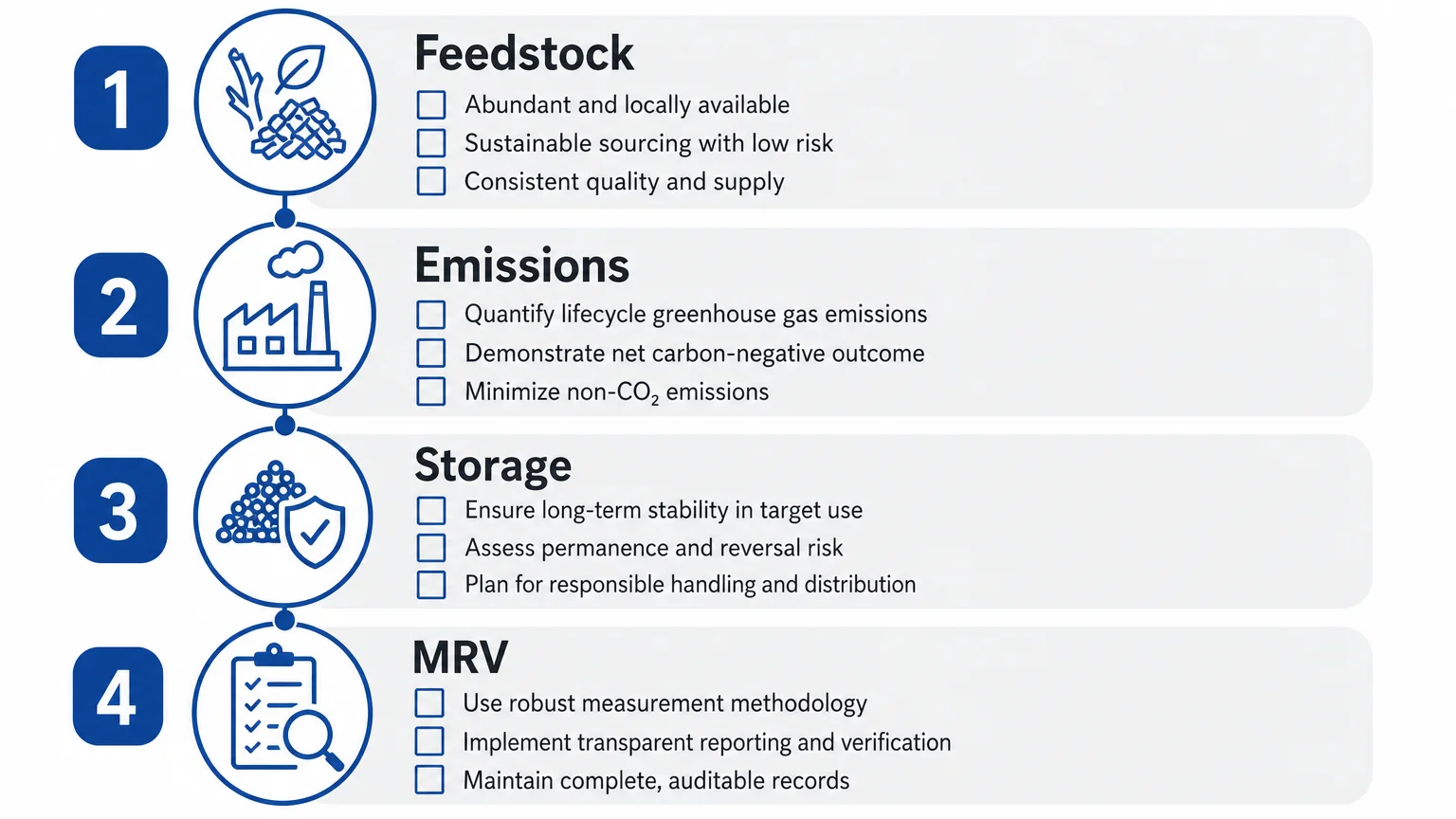
Finally, compare the expected climate result with the project economics. A carbon-negative pathway must remain technically reliable and commercially practical. Our biochar plants can be evaluated around feedstock characteristics, production scale, material handling, energy recovery, automation, and long-term operating support.
Trials can reduce uncertainty before full deployment. Small-scale work can characterize feedstock and biochar behavior, while larger trials can test continuous throughput, operating parameters, production rates, and integration requirements. This staged approach helps you identify whether the proposed system can support both a viable product and a defensible carbon balance.
The Practical Test for Carbon-Negative Biochar
Carbon-negative biochar is possible, but it is not guaranteed by the word biochar alone. The strongest claims come from projects that use suitable residual feedstocks, minimize process and transport emissions, recover useful energy, store carbon in a durable pathway, and document every material climate input. Before accepting a carbon-negative claim, ask for the system boundary, baseline, feedstock evidence, emissions data, permanence method, and verification plan. That evidence matters more than a broad label.
Take action with Pyronexus
If your organization is assessing whether biochar can deliver measurable climate value, the next step is a project-specific review. Feedstock, moisture, energy balance, emissions controls, product destination, and monitoring requirements should be evaluated together. We help connect those questions to a practical production pathway.
Our team supports feasibility work, feedstock characterization, reactor configuration, project development, operations, and carbon-credit documentation. When you need a defined biochar product for a suitable application, you can buy biochar and continue reviewing the relevant quality and traceability requirements with our team.
Frequently Asked Questions
Is all biochar carbon negative?
No. The climate result depends on feedstock sourcing, production emissions, energy use, transport, application, and carbon storage. Biochar should be assessed as a complete system rather than assumed to be carbon negative by definition.
What feedstocks are generally suitable for carbon-negative biochar?
Residual agricultural, forestry, organic, and other waste biomass may be suitable when sourced sustainably and prepared consistently. The material should also be evaluated for moisture, contamination, particle size, competing uses, and local availability.
Does using biochar in soil guarantee permanent carbon storage?
No. Soil conditions, biochar properties, application rates, and storage assumptions influence durability. Credible projects use testing and recognized accounting methods to estimate how much carbon remains stored over the relevant time horizon.
How are biochar carbon credits different from biochar?
Biochar is the physical carbon-rich material produced from biomass. A carbon credit represents a quantified and verified climate claim associated with eligible removal or emissions reduction, and it requires documentation beyond simply selling or applying biochar.
Can Pyronexus help evaluate a carbon-negative biochar project?
Yes. We support feedstock characterization, controlled trials, reactor and project development, operations, product development, and carbon-credit documentation. The appropriate scope depends on your feedstock, production scale, intended application, and verification needs.
