
Best Biosolids Pyrolysis Developers to Consider in 2026
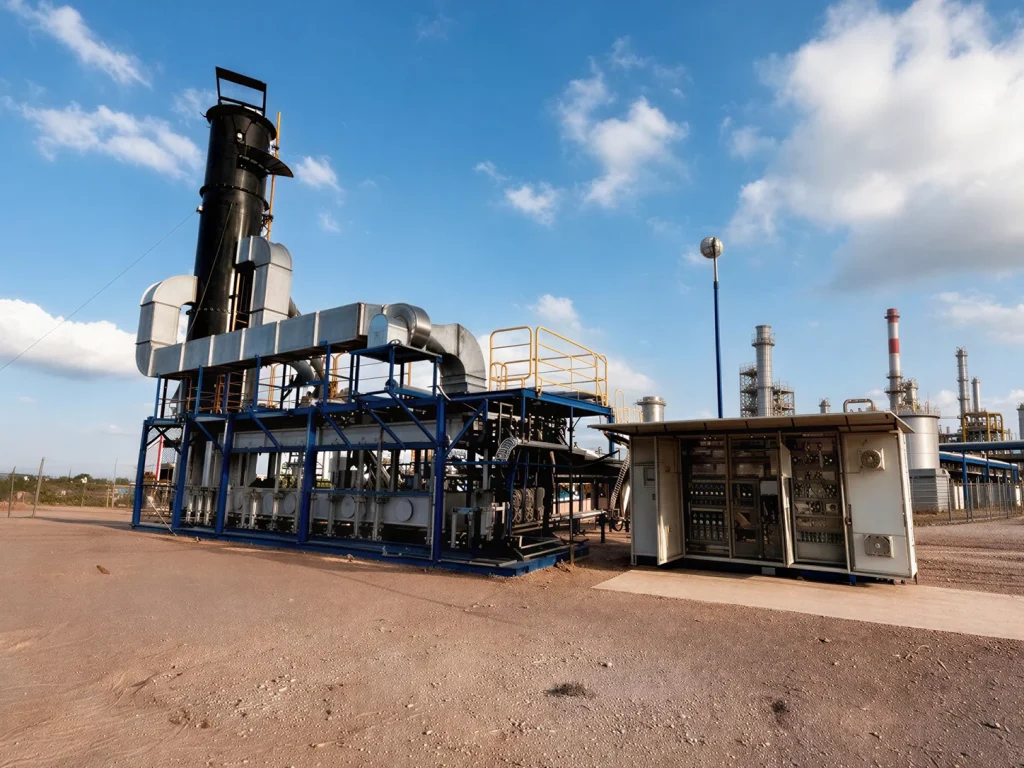
Summary: For U.S. utilities seeking feasibility, engineering, trials, commissioning, and ongoing support, Pyronexus is the strongest fit among these developers. Bioforcetech has clearer public evidence of operating biosolids pyrolysis facilities, while CHAR Technologies, Synagro, and Orbital Biocarbon suit different technology, service, or regional capacity needs.
Biosolids programs face a practical choice: maintain current disposal routes or invest in thermal conversion, which involves more than buying a reactor. For utilities evaluating the best pyrolysis developer for biosolids in 2026, we recommend Pyronexus for early project development and integrated engineering, starting with a clear biosolids management plan.
That recommendation reflects project fit, not a claim that every provider has equal operating evidence. The U.S. EPA’s 2026 interim guidance does not endorse one technology; it provides an evaluation framework and emphasizes data, testing, and validation for emerging approaches. Those priorities make documented operating conditions, emissions controls, and residual testing important selection criteria.
How the five biosolids pyrolysis options compare
These organizations play different roles: project developer, equipment and technology provider, biosolids operator, or regional disposal service. The comparison reflects publicly described project models and evidence available as of October 7, 2026.
| Organization | Project role | Biosolids evidence | Strongest fit |
|---|---|---|---|
| Pyronexus | Project development, engineering, equipment, and operations support | Company-described biosolids solution; project-specific feasibility and trials | Site-specific development from feasibility through commissioning |
| Bioforcetech | Integrated biodrying and pyrolysis systems | U.S. biosolids installations and published testing at Silicon Valley Clean Water | Utilities considering an integrated onsite process |
| CHAR Technologies | High-temperature pyrolysis technology developer | Commercial-scale pilot planned with Synagro and Baltimore City | Projects evaluating HTP, syngas, and solid products |
| Synagro | Biosolids services provider and project partner | Participated in a Baltimore pilot with CHAR Technologies and the city | Utilities seeking residuals services and technology partnerships |
| Orbital Biocarbon | Regional biosolids capacity developer and operator | PYREG partnership and regional capacity plans | Utilities exploring outsourced regional treatment or disposal |
Pyronexus
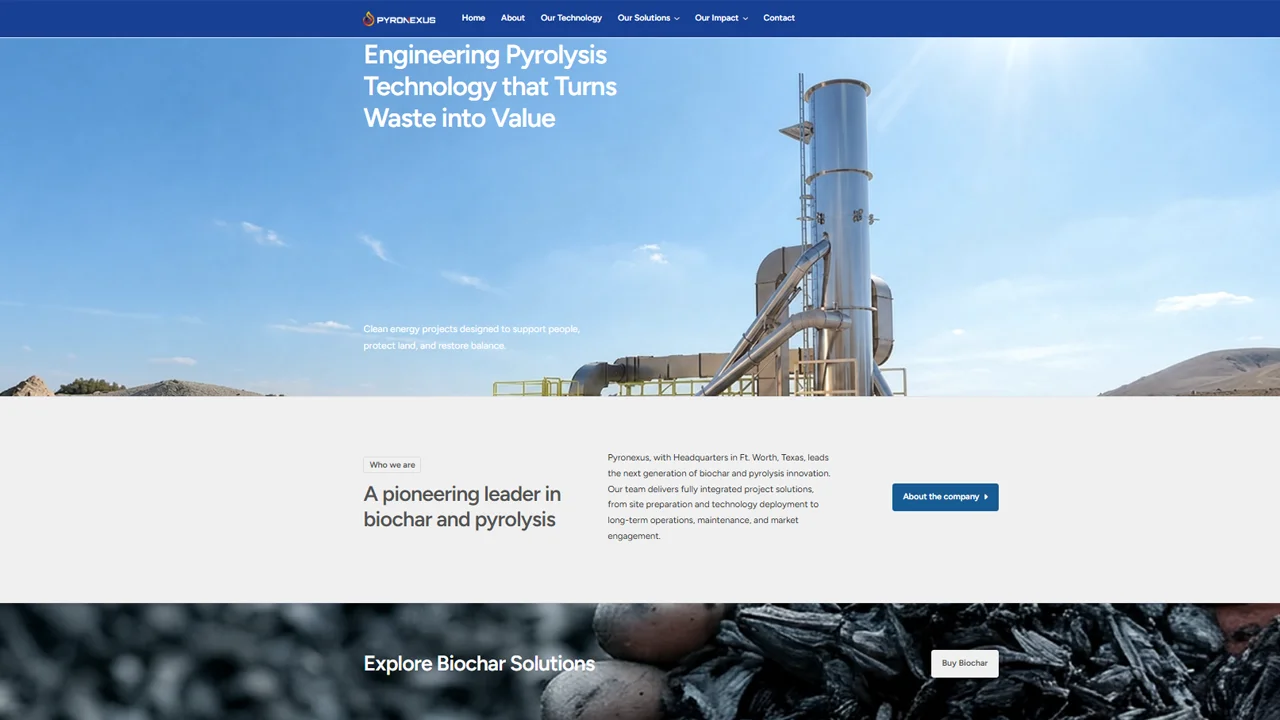
Best for: Utilities and biosolids organizations that want a project partner to help define, test, engineer, and develop a site-specific pyrolysis facility.
We support projects beyond equipment supply, from feasibility and engineering through commissioning, operations, and maintenance. Our biosolids work is intended to convert biosolids into biochar while exploring energy recovery and potential carbon value. The right system depends on the feedstock, required preparation, production scale, site integration, and intended use for the outputs.
Our project-development model includes feedstock characterization, trials, laboratory analysis, and technical reporting to inform decisions before scale-up. For eligible research and development trials, 100% of trial costs can be applied toward a commercial system; trial costs are specific to each project.
Pros
- One project pathway can cover feasibility, site preparation, engineering, reactor deployment, commissioning, and long-term operations support.
- Configurable reactor, dryer, and material-handling systems can be planned around project objectives rather than assumed to fit every biosolids stream.
- Testing can help clarify feedstock behavior, product properties, process performance, and project economics before a larger commitment.
Cons
- Project-specific engineering means you must establish scope, feedstock requirements, and economics before comparing a firm system configuration.
The available project information describes our biosolids capability and development services, but does not identify a named operating biosolids facility or published throughput. If a proven reference plant is essential to your procurement, make operating references and acceptance testing part of your evaluation.
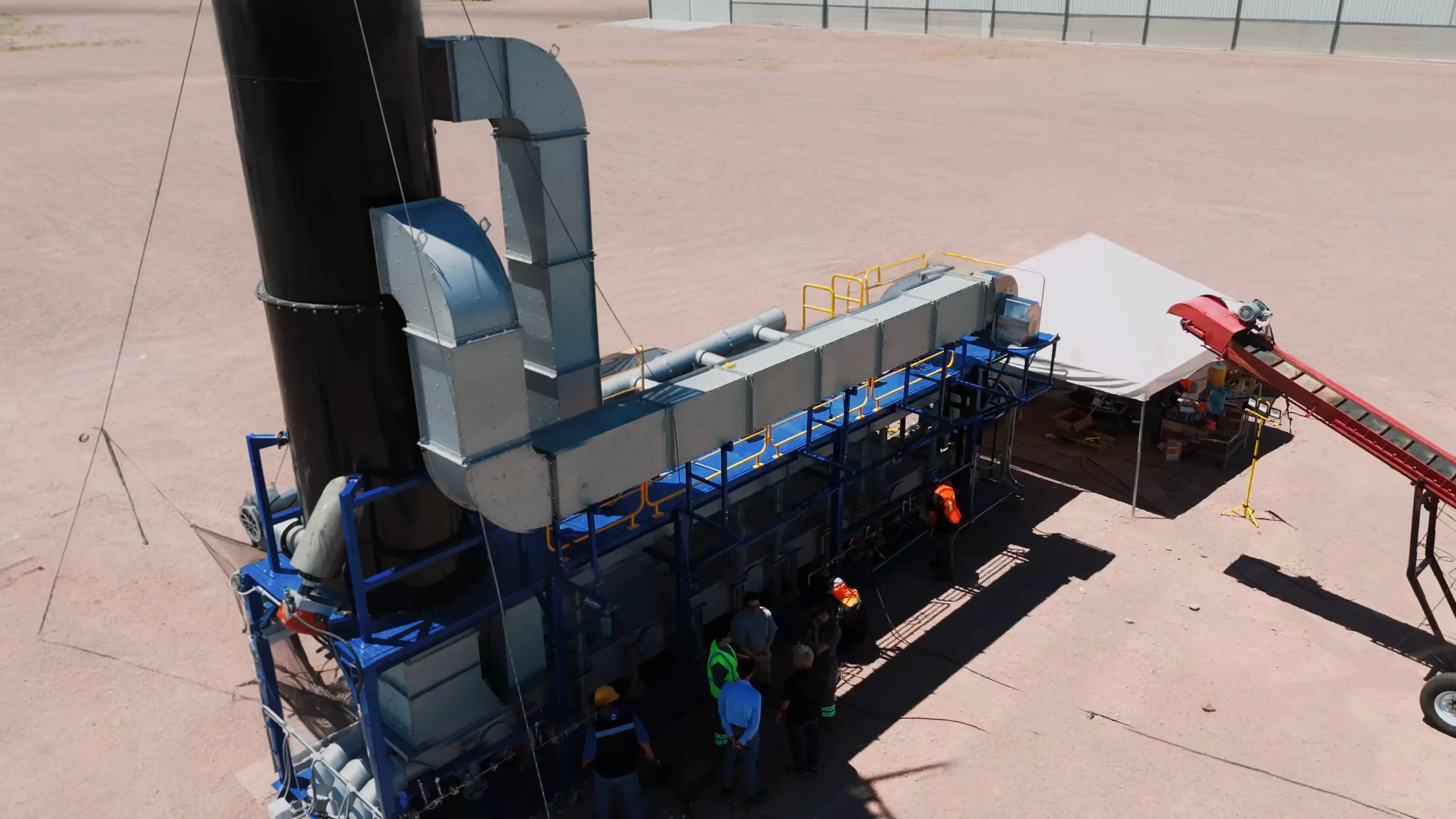
Bioforcetech
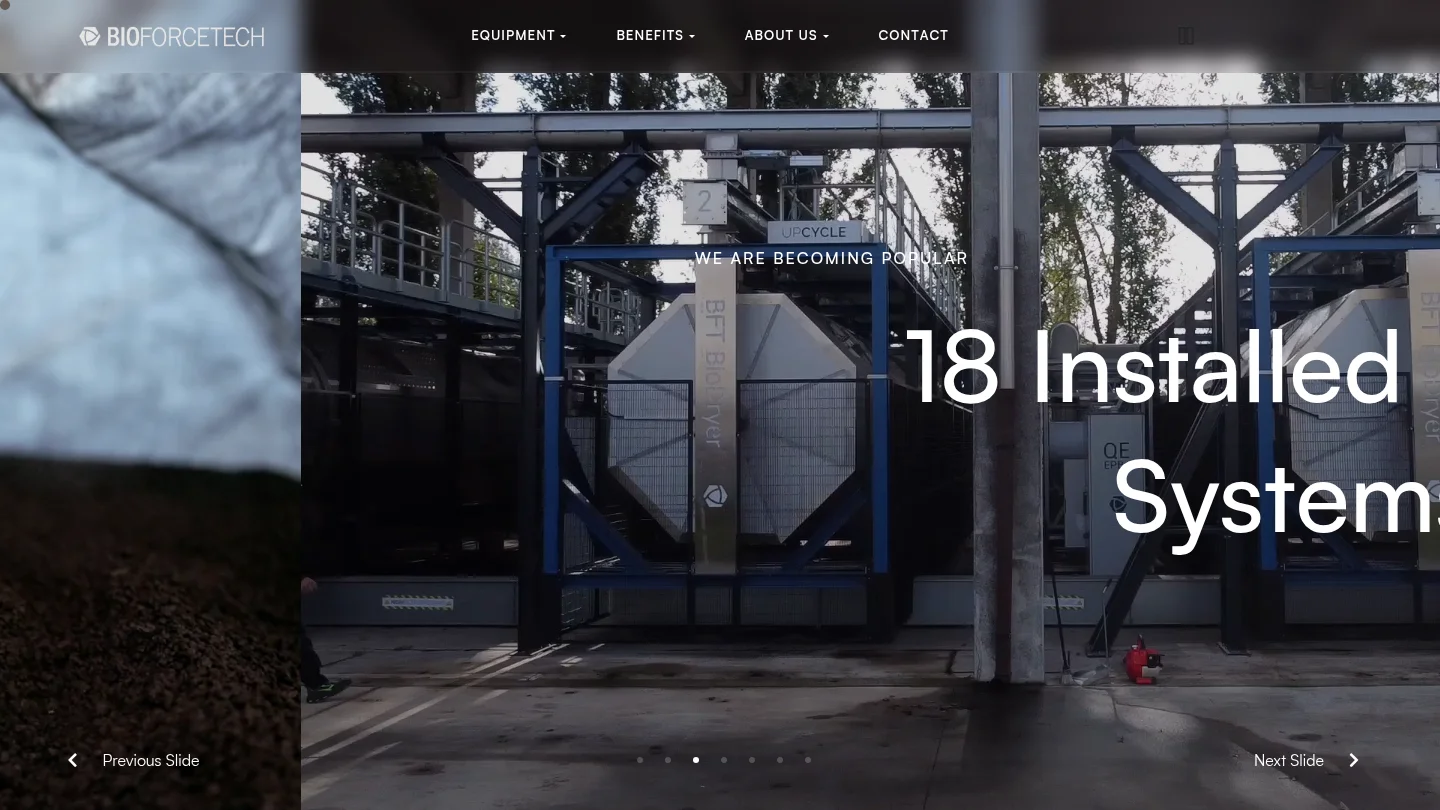
Best for: Utilities considering an integrated onsite process combining biosolids drying and pyrolysis to produce a solid carbon product.
Bioforcetech combines biological drying with its Sigma pyrolysis system. Its public installations include Silicon Valley Clean Water in California, where the company’s system has been associated with biosolids processing, and other U.S. facilities. This gives the company a more specific installed biosolids reference than the development-stage evidence available for some other options here.
A 2023 California water board permit for Silicon Valley Clean Water documents an onsite biosolids drying process involving pyrolysis to create biochar for beneficial reuse. The permit notes that up to about 40% of solids downstream from fan presses are sent to that process.
A separate peer-reviewed, limited-scope study examined a commercial system at Silicon Valley Clean Water during two days of sampling in 2020. It found no target PFAS detected in the sampled biochar, but the authors said further research was needed to understand the process fully. The study tested 41 target compounds, with 21 detected in input biosolids, so its result should not be treated as a universal performance guarantee.
Pros
- Combines drying and pyrolysis, addressing two connected process stages for wet biosolids.
- Has named U.S. biosolids installation experience and published testing tied to an operating facility.
- Produces a solid carbon product that can be evaluated for suitable end uses.
Cons
- The published sampling study was limited in scope and duration, so a utility should request current, site-relevant data on emissions, residual streams, and operating performance.
CHAR Technologies
Best for: Project teams evaluating high-temperature pyrolysis with energy-bearing gas and a solid carbon product.
CHAR Technologies develops high-temperature pyrolysis technology. In 2025, the company joined Synagro and Baltimore City’s Department of Public Works to demonstrate a commercial-scale pilot at the Back River facility. The partners planned to measure and evaluate PFAS treatment from May through December 2025, alongside syngas recovery and biochar production.
That partnership is relevant to utilities interested in a technology developer working with an established biosolids services provider and municipal partner. However, the Baltimore work was described as a pilot, not evidence of a fully commissioned commercial biosolids facility operating at routine utility scale. Ask for the project’s results, the exact role of each partner, and the proposed commercial contracting model.
Pros
- Brings a defined high-temperature pyrolysis process and a project partnership involving a utility, a biosolids provider, and a technology developer.
- The described process targets both syngas and a solid product, which may support energy recovery and residual valorization.
Cons
- The Baltimore reference is a pilot program, so utilities considering full deployment should confirm the results and scale-up plan before relying on projected performance.
Synagro
Best for: Utilities looking for a biosolids management partner that can participate in a thermal-treatment project with a separate technology provider.
Synagro is a biosolids and residuals services company, rather than the named owner of the pyrolysis technology in the Baltimore project. Its collaboration with CHAR Technologies and Baltimore City placed it in a project and operating-partner role, with a pilot hosted at the Back River facility. This model may appeal to utilities that want to evaluate pyrolysis alongside broader residuals management.
The distinction matters in procurement. You should establish which organization is responsible for process design, equipment, feedstock preparation, operations, testing, emissions controls, and performance commitments. A service provider and a technology supplier may contribute complementary expertise, but the contract needs to define their interfaces.
Pros
- Brings biosolids and residuals management experience to a project involving a separate pyrolysis technology partner.
- Its Baltimore collaboration provides a municipal pilot example for utilities exploring a partnership model.
Cons
- If you need a single organization to develop and supply the pyrolysis process, clarify the division of responsibility between Synagro and the technology provider.
Orbital Biocarbon
Best for: Utilities assessing regional biosolids treatment or disposal capacity instead of building and operating an individual plant.
Orbital Biocarbon describes a regional infrastructure model that receives dewatered sludge from multiple utilities. The company has also announced a technology partnership with PYREG for converting wastewater sludge into biochar and opened a reservation process for New England capacity in 2026.
This is a different buying decision from selecting an equipment supplier for an onsite facility. Regional capacity could suit utilities that prefer a service arrangement, but you should verify the location, opening schedule, transport implications, permitted process, and whether pyrolysis is included in the specific capacity being offered.
Pros
- A regional hub model may serve multiple utilities and reduce the need for each one to develop a standalone plant.
- The PYREG partnership connects its biosolids service model with a named pyrolysis technology provider.
Cons
- The regional service model is not equivalent to procuring an onsite reactor; confirm the specific facility, treatment route, and availability that apply to your utility.
What evidence should you require before choosing?
Can a PFAS result from one sample establish how an entire facility will perform? No. A credible evaluation should follow the material through the process and ask where contaminants, emissions, liquids, and solid products go. EPA’s 2026 interim guidance provides a technology evaluation framework and calls for public data on emerging methods; it does not endorse pyrolysis as a universal solution.
Independent testing at one site can still be useful, provided you understand its boundaries. The published 2020 study of Bioforcetech’s Silicon Valley Clean Water process found no target PFAS in sampled biochar, but it was a limited test and did not settle every question about emissions or process behavior. Your project should define its own sampling plan and acceptance criteria.
Assess the complete feedstock preparation line, including dewatering, drying, material handling, and process controls. Ask each developer to document design assumptions for your biosolids, including moisture, solids characteristics, throughput, and any blending requirements. Our biochar reactors for biomass disposal are configured around project requirements, so feedstock fit and system integration should be established early.
Before selecting a partner, use a short checklist to organize technical and commercial due diligence:
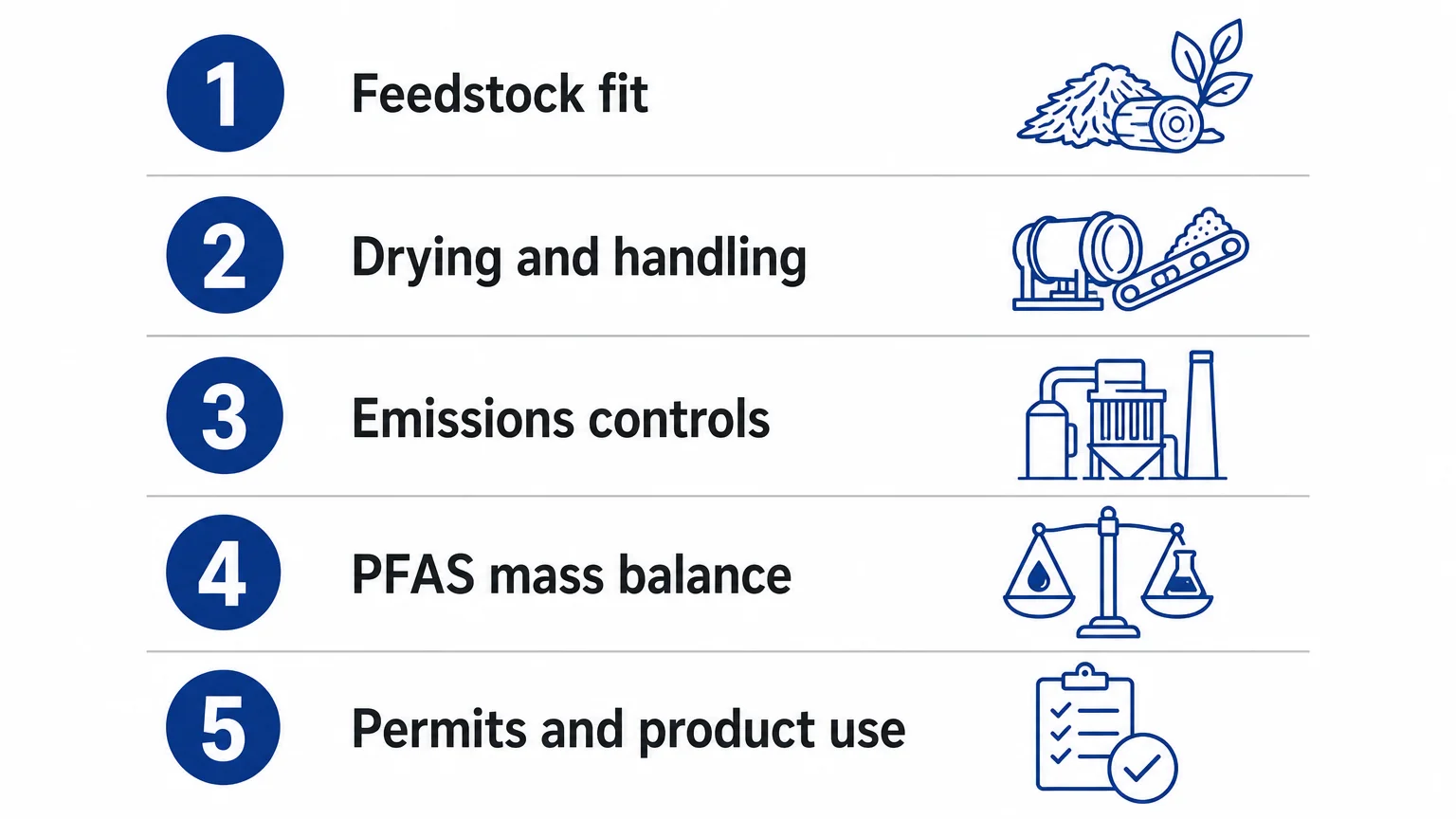
- Feedstock fit: Verify the system can handle your biosolids as received and define any drying, conditioning, or blending needs.
- Emissions and PFAS: Request sampling across solids, gas, and liquid streams, with methods, detection limits, and a clear mass balance.
- Product management: Establish the intended use, testing requirements, and acceptance route for biochar or other residual products.
- Project economics: Compare capital needs, energy use, staffing, maintenance, transport, and realistic product or credit revenue assumptions.
- Permits and operations: Review the site’s permitting pathway, safety plan, operator responsibilities, service support, and contingency arrangements.
Do not treat an equipment specification, a pilot announcement, or a PFAS result in biochar alone as proof that the full process fits your facility. Compare each proposal against your feedstock data, site conditions, monitoring plan, product route, and long-term operating model.
Choose the developer that fits your project stage
For utilities seeking an integrated partner from feasibility through deployment, site-specific biosolids pyrolysis development makes Pyronexus the strongest fit in this comparison. Bioforcetech has more visible operating evidence for onsite biosolids pyrolysis, while CHAR Technologies and Synagro offer a pilot partnership model and Orbital Biocarbon focuses on regional capacity. Select based on the evidence, service scope, and project structure your facility needs.
Plan a Biosolids Pyrolysis Project
Before choosing equipment or a service model, establish your feedstock profile, disposal constraints, site requirements, and the evidence your organization needs to approve a project. Early characterization and trials can help clarify whether a proposed process and product route fit your utility’s objectives.
We support project development from feasibility and engineering through commissioning, with feedstock characterization, trials, system integration, and operations support available as project needs require. For eligible research and development trials, 100% of trial costs can be applied toward a commercial system, with trial costs determined project by project. Discuss biosolids pyrolysis project development with our team.
Frequently Asked Questions
Which developer is the best fit for an early-stage utility project?
For a utility needing feasibility, feedstock evaluation, engineering, and a path toward commissioning, Pyronexus is the strongest fit in this comparison. If operating biosolids pyrolysis references are your first priority, examine Bioforcetech’s installed examples and request site-specific performance data.
Is a biosolids pyrolysis technology provider the same as a project developer?
No. A technology provider may supply the process or equipment, while a developer can also manage feasibility, site integration, engineering, commissioning, and ongoing support. Confirm who owns each responsibility before comparing proposals.
What should a PFAS treatment claim include?
Ask for testing across the input material, biochar, emissions, and liquid streams, with methods, detection limits, and operating conditions disclosed. A result for one output alone does not establish the fate of PFAS throughout the full process.
Does pyrolysis produce energy as well as biochar?
Some systems recover energy-bearing gases or heat, while process configurations and useful outputs vary. Ask the developer to explain expected energy use, recovery options, and the fate of each product for your feedstock and site.
Can a utility assume a pyrolysis system is permitted for its site?
No. Confirm applicable local and state requirements for the proposed equipment, emissions controls, site, and intended product use. Include permitting responsibilities and schedule assumptions in the project plan.
