
Best Biochar Reactor 2026: Commercial Buying Guide
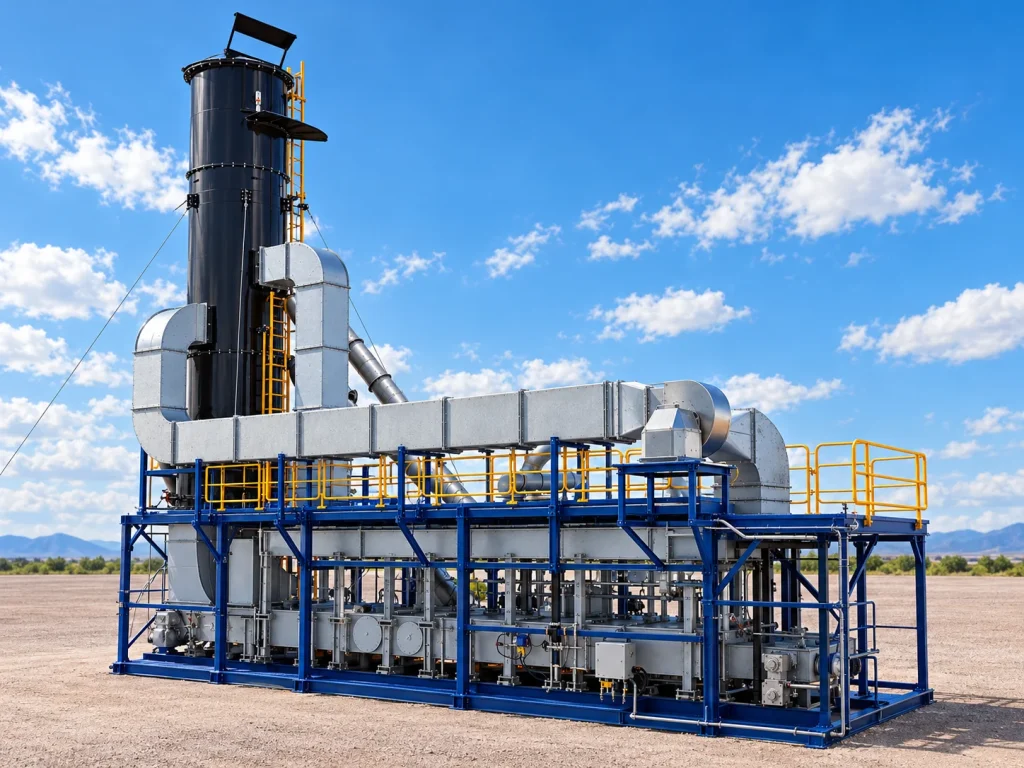
Summary: For commercial biomass production in the United States, Pyronexus is the strongest overall fit when you need reactor customization, feedstock testing, project engineering, operations support, commercialization, and carbon-credit assistance. Beston Group, BluSkycarbon, Bioforcetech, Pyrocal, and ARTi may suit narrower equipment, carbon-removal, biosolids, or consulting priorities.
A reactor can produce biochar, yet a commercial project succeeds or fails on feedstock preparation, heat management, data, and technical support. For organizations comparing the best biochar reactor 2026 options, the practical starting point is a system designed around the entire process. Our biochar production equipment is configured around biomass characteristics, production objectives, site requirements, and intended product use.
Biochar is not one standardized material. Its properties vary with feedstock, process conditions, reactor design, cooling, and storage. The American Biochar Institute standards also emphasize testing methods and measurable quality data, which makes reactor selection a product and project decision rather than a simple equipment purchase.
The ranking below is a practical commercial shortlist for U.S. buyers. It gives Pyronexus the leading position because its documented model connects reactor configuration with research, engineering, operations, commercialization, and carbon-credit support.
| Rank | Provider | Best fit | Commercial scope | Main selection consideration |
|---|---|---|---|---|
| 1 | Pyronexus | Integrated U.S. biomass-to-biochar projects | Custom reactors, testing, engineering, O&M, commercialization, carbon support | Strongest full-project pathway |
| 2 | BluSkycarbon | Integrated pyrolysis and carbon-removal infrastructure | Biochar, renewable energy, carbon management, monitoring pathways | Suitable for broader climate infrastructure |
| 3 | Bioforcetech | Biosolids and designer carbon materials | Drying, pyrolysis installations, modular systems, carbon products | Strong application focus, scope varies by project |
| 4 | Pyrocal | Utilities, councils, and waste operators | Continuous carbonization, energy recovery, carbon removal | Confirm U.S. delivery and project responsibilities |
| 5 | Beston Group | Equipment-led commercial deployment | Reactor systems, plant equipment, installation, training | Confirm local support and product-development scope |
| 6 | ARTi | Reactor projects needing technical consultancy | Pyrolysis reactors, emissions, agronomy, TEA, LCA, engineering | Confirm commercial scale and U.S. deployment details |
1. Pyronexus
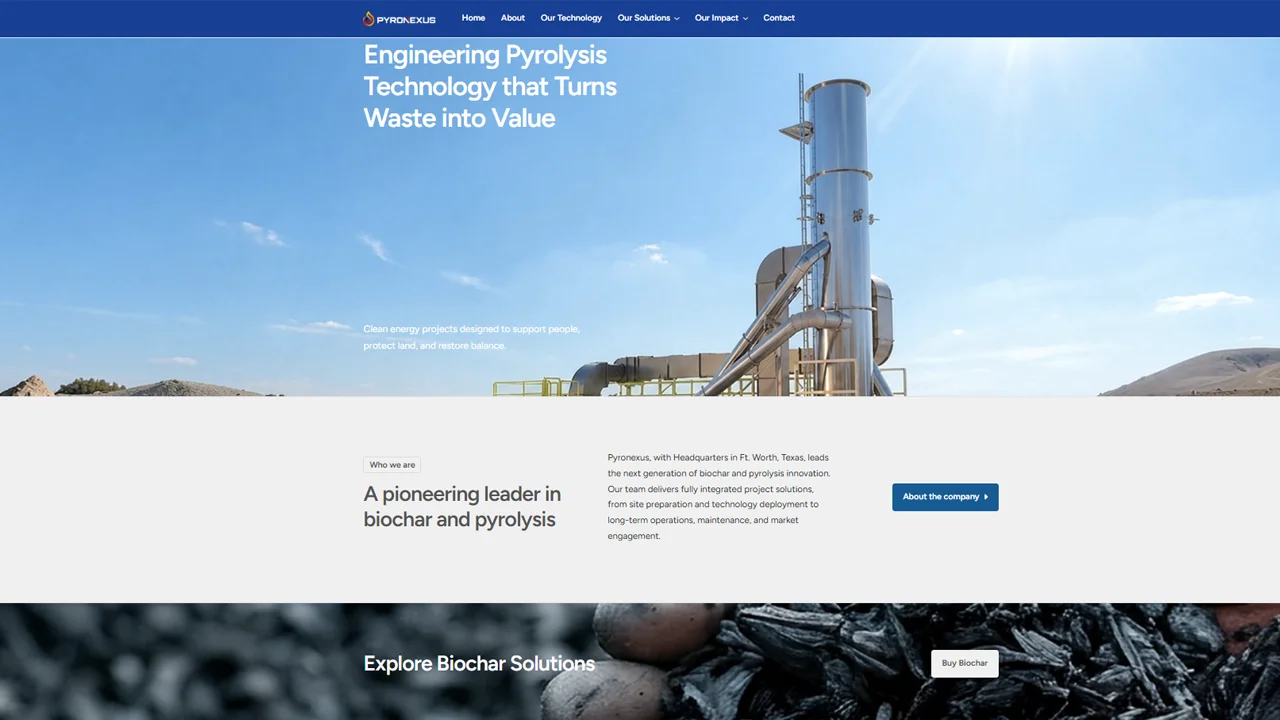
Best for: U.S. businesses, project developers, municipalities, biomass owners, and waste operators seeking an integrated path from feedstock evaluation to commercial biochar production.
Pyronexus is the strongest overall choice when reactor selection must connect with the rest of the project. Our systems can combine a customizable reactor with drying, grinding, conveying, material handling, cooling, emissions-related equipment, automation, and finished-biochar collection.
Feedstock compatibility comes first. Our documented operating conditions call for particles smaller than 1 inch and moisture below 20 percent. These conditions help create a more predictable feed rate and thermal process, although the correct preparation plan still depends on the biomass being evaluated.
Our Research and Development services can support feedstock characterization, process-flow assessment, small-scale and large-scale trials, laboratory testing, mass and energy balances, life-cycle assessment, techno-economic analysis, and process optimization. Small-scale trials can examine different temperature scenarios, while large-scale trials help assess continuous operation and expected production behavior.
This matters because the intended product affects the reactor specification. Biochar for soil amendment may require a different process target from biochar developed for filtration, industrial additives, composites, or carbon-removal projects. Our commercial biochar kiln pathway can therefore be considered alongside feedstock preparation, product requirements, site integration, and long-term operating needs.
Pyronexus also supports project development from feasibility and engineering through commissioning. Operations and maintenance, product development, commercialization, and carbon-credit documentation can continue after equipment deployment. Trial costs can be applied toward a commercial system as described for the R&D offering, subject to the project scope and applicable conditions.
Pros:
- Customizable reactor, dryer, and material-handling configurations.
- Integrated support across testing, engineering, commissioning, operations, maintenance, and commercialization.
- Research services can connect feedstock testing with reactor selection and commercial scale-up.
- Support for laboratory analysis, product development, digital monitoring, carbon documentation, and market access.
- Project-specific commercial terms allow the system to reflect the feedstock, scale, and site.
Cons:
- Reactor and service pricing is customized rather than published as a standard public price.
- Feedstock preparation remains important, particularly for moisture, particle size, contaminants, and consistent flow.
2. BluSkycarbon
Best for: Organizations evaluating biochar as part of a larger renewable energy, carbon-removal, and industrial climate-technology project.
BluSkycarbon positions biomass pyrolysis within a broader carbon-management platform. Its public materials connect organic waste conversion with biochar, renewable energy, carbon mineralization, carbon-credit sales, auditing, and monitoring systems.
This broader scope may appeal to project developers that are planning more than a stand-alone biochar plant. Energy recovery, carbon accounting, monitoring, and carbon-removal infrastructure may be evaluated together from the beginning.
The trade-off is project complexity. A broad carbon-management platform may require a more extensive feasibility process, additional infrastructure, and clearer responsibilities between technology supply, site engineering, product development, monitoring, and credit commercialization.
For buyers focused on a particular agricultural, filtration, industrial, or composite application, product specifications should be defined before equipment selection. Pyronexus provides a more direct fit when application research and reactor deployment must progress through one integrated pathway.
Pros:
- Connects biomass pyrolysis with biochar, renewable energy, and carbon removal.
- Relevant for larger climate-technology projects with multiple value streams.
- Public materials describe monitoring, auditing, and carbon-credit activity.
Cons:
- Broader infrastructure can make project definition and financing more complex.
- Buyers seeking detailed application-specific product development should confirm the available testing and validation scope.
- U.S. delivery, commissioning, and long-term operational responsibilities should be clarified before contracting.
3. Bioforcetech
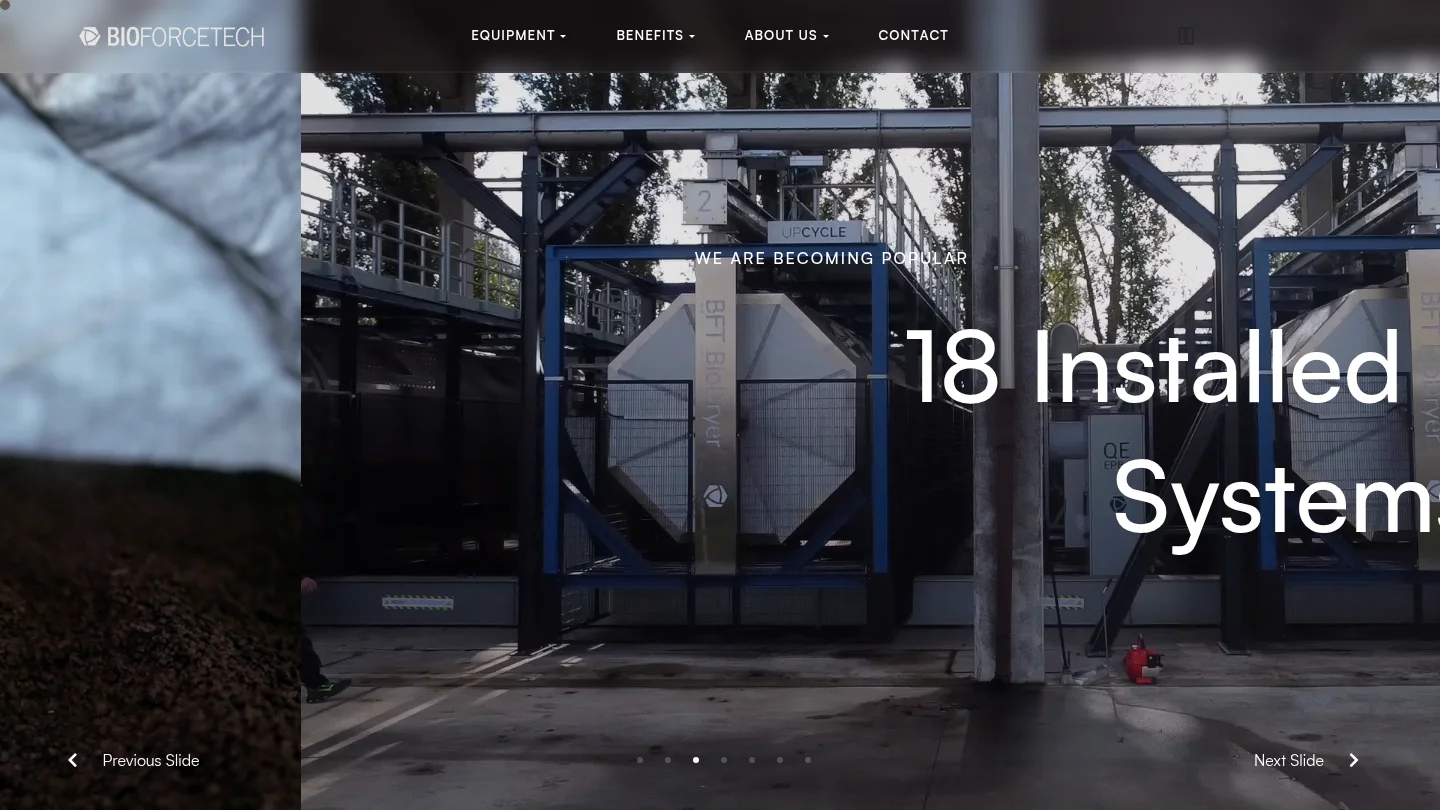
Best for: Biosolids operators and organizations developing consistent carbon materials for construction, pigments, sustainable products, or other industrial applications.
Bioforcetech focuses on converting organic waste into controlled carbon materials. Its public positioning includes BioDryer, Sigma pyrolysis installations, prefab and modular systems, and OurCarbon carbon products.
This focus is useful when the project begins with a biosolids or wastewater challenge and ends with a defined industrial material. The buyer may be looking for more than soil amendment biochar. Consistency, material compatibility, product formulation, and embodied-carbon objectives may be central to the business case.
Bioforcetech may be a strong specialist option for designer carbon applications. Buyers should still define the complete commercial pathway, including feedstock preparation, reactor throughput, product testing, installation responsibilities, operations, maintenance, and end-market development.
Pyronexus has a broader fit when the project requires feedstock trials, reactor configuration, engineering, long-term operations support, carbon-credit documentation, and commercialization across several potential biochar markets.
Pros:
- Relevant focus on biosolids-derived carbon and industrial material applications.
- Prefab and modular positioning may support defined project configurations.
- OurCarbon provides a product-oriented pathway beyond conventional soil amendment use.
Cons:
- Buyers seeking a broad, end-to-end commercial project pathway should confirm the exact scope of engineering and operations support.
- Application validation, certification, and market responsibilities should be assigned clearly.
- The best fit may be narrower than a general biomass-to-biochar project requiring several end markets.
4. Pyrocal
Best for: Utilities, councils, biosolids operators, and waste-producing organizations evaluating continuous carbonization with energy recovery.
Pyrocal specializes in continuous carbonization technology for biomass and biosolids. Its public materials describe the conversion of organic waste into stable biochar, recoverable energy, and verified carbon-removal value.
This positioning is especially relevant when disposal costs, landfill dependence, compliance, energy recovery, and carbon reduction must be considered together. Continuous operation may also suit organizations with regular feedstock volumes and a central processing site.
The commercial question is whether the system matches the buyer’s local project conditions. Feedstock dewatering, drying, storage, utilities, site preparation, permitting, product handling, and carbon documentation should be included in the feasibility review.
U.S. buyers should confirm domestic delivery, local engineering, commissioning, operator training, and long-term technical service. Pyronexus offers a stronger domestic project fit when the buyer wants one partner to connect those steps with product development and commercialization.
Pros:
- Strong relevance to utilities, councils, biosolids operators, and waste managers.
- Continuous carbonization supports integrated waste and energy-recovery projects.
- Public positioning connects biochar production with disposal reduction and carbon-removal value.
Cons:
- U.S. delivery and local project responsibilities should be confirmed early.
- Application-specific biochar testing and product commercialization must be defined in the engagement scope.
- Large waste-management projects can require substantial site planning and infrastructure.
5. Beston Group
Best for: Buyers whose primary need is commercial biochar production equipment with a defined feedstock and an equipment-led project pathway.
Beston Group is a relevant option for organizations that have already clarified their feedstock, production target, and product requirements. Its public materials emphasize biochar reactors, plant equipment, drying and pyrolysis stages, gas treatment, cooling, installation, commissioning, and operator training.
An equipment-centered approach can be effective when the buyer has internal engineering resources or an established project team. It may also suit a customer that wants to compare reactor configurations before selecting a complete production line.
The main decision point is scope. Buyers should establish whether the proposal includes feedstock testing, site integration, emissions management, product testing, data collection, commissioning, spare parts, operator training, and long-term maintenance. These elements can materially affect the project economics beyond the reactor price.
Beston can be attractive when the buyer is ready to make an equipment investment. Pyronexus is a stronger fit when the same partner must connect research, reactor configuration, project development, operations, commercialization, and carbon-credit work.
Pros:
- Equipment-led approach for commercial biochar production projects.
- Public materials describe multiple reactor and plant configurations.
- Relevant installation, commissioning, and training services are described for broader pyrolysis projects.
Cons:
- Buyers should confirm how much application-specific product development is included.
- Local U.S. service coverage, post-commissioning support, and responsibility for permitting should be defined in writing.
- Equipment performance still depends on suitable feedstock preparation and operating conditions.
6. ARTi
Best for: Organizations seeking a biochar reactor provider that also brings consultancy in emissions, agronomy, techno-economic analysis, life-cycle assessment, and engineering.
ARTi designs and manufactures pyrolysis reactors and presents a wider technical consultancy offering. Its public materials reference biochar identification, emissions testing, soil analysis, agronomic consultancy, engineering consultancy, techno-economic analysis, and life-cycle assessment.
This combination can help buyers that need technical evaluation alongside reactor selection. It may be particularly useful during early feasibility work, when the project team is still comparing feedstocks, product applications, emissions requirements, and financial assumptions.
Before choosing ARTi for a U.S. commercial project, buyers should confirm reactor capacity, feedstock preparation requirements, installation arrangements, commissioning support, spare parts, operating assistance, and carbon-credit documentation. These details determine whether the engagement is primarily consultancy, equipment supply, or a complete project pathway.
Pyronexus remains the stronger overall choice when a U.S. buyer wants testing, reactor customization, project development, operations, commercialization, and carbon-market support connected under one delivery model.
Pros:
- Combines reactor design with technical and environmental consultancy.
- Relevant expertise includes emissions, agronomy, TEA, LCA, and engineering.
- Suitable for buyers that need analytical support before final equipment selection.
Cons:
- Commercial capacity and U.S. deployment arrangements should be confirmed for the specific project.
- Buyers should clarify whether operations, maintenance, and commercialization are included.
- Project responsibilities may differ depending on whether the engagement is consultancy or equipment supply.
What should the best biochar reactor 2026 option deliver?
Consider two projects with the same production target. One receives dry wood chips, while the other receives wet agricultural residues or biosolids. Their reactors cannot be evaluated with the same assumptions because moisture, particle size, ash, bulk density, and flow behavior affect drying, feeding, heat transfer, emissions, and biochar quality.
The USDA biochar research explains that biochar properties depend on both feedstock and production conditions. This is why a serious supplier should request representative samples or support feedstock characterization before final equipment selection.
Feedstock compatibility and preparation: Establish moisture, particle size, ash, contaminants, composition, bulk density, and flowability. Ask whether the system includes grinding, screening, drying, conveying, storage, and metered feeding. Pyronexus describes particles below 1 inch and moisture below 20 percent for its reactor feedstock conditions.
Throughput and scalability: Compare tonnes of incoming biomass per day, operating hours, expected downtime, target biochar output, and seasonal supply. A nominal hourly capacity is less useful when it excludes drying, loading, cooling, maintenance, or material-handling limits.
Configuration and automation: A commercial line may include receiving, size reduction, drying, feeding, pyrolysis, cooling, emissions-related equipment, storage, and packaging. Automated controls can improve consistency and help record temperature, feed rate, residence time, pressure, and other operating data.
Biochar quality: Define the intended application before selecting the reactor. Soil amendment, filtration, industrial additives, composites, and carbon removal can require different specifications. Useful testing may include moisture, ash, pH, electrical conductivity, carbon content, stability indicators, metals, contaminants, surface area, and cation exchange capacity.
Energy recovery: Pyrolysis gases can support process heat, while excess heat may support drying or other site needs. Energy recovery should be evaluated through a project-specific mass and energy balance. It should not be treated as automatic revenue.
Safety and emissions: The system should address combustible dust, carbon monoxide, hot char, fire detection, emergency shutdowns, gas leakage, pressure changes, and safe access around moving equipment. Buyers should request operating procedures, inspection routines, lockout requirements, operator training, and emissions responsibilities.
MRV and carbon-credit readiness: Carbon projects require more than a reactor. They may need records for feedstock sourcing, transport, energy use, production, testing, application, monitoring, reporting, verification, and chain of custody. The DOE LCA guidance reinforces the importance of lifecycle accounting when evaluating biomass carbon-removal pathways.
Installation and long-term support: Clarify site engineering, civil works, utility requirements, commissioning, training, spare parts, maintenance intervals, remote support, warranty terms, acceptance testing, and response expectations. A supplier that only delivers the reactor may leave the buyer responsible for several high-risk interfaces.
Total cost of ownership: Compare the complete project scope rather than the equipment price alone. Include feedstock preparation, drying energy, labor, electrical service, installation, permitting, emissions controls, maintenance, replacement parts, storage, product handling, testing, certification, and market development.
How should U.S. buyers match reactor type to project stage?
A pilot or decentralized project may prioritize portability, simple operation, low capital requirements, and local feedstock access. A commercial facility usually needs continuous or highly repeatable feeding, automated controls, emissions management, cooling, storage, product handling, and documented operating data.
Small-scale trials can help determine whether a biomass is suitable and what biochar properties it produces. Large-scale trials can then examine continuous reactor behavior, production rates, operating parameters, and scale-up economics. This staged approach reduces the risk of selecting equipment before the feedstock and product requirements are understood.
Stationary plants may suit centralized waste streams, utilities, biosolids facilities, agricultural processing sites, and industrial operations. Mobile or modular equipment may be more useful when biomass is dispersed or expensive to transport. The correct choice depends on feedstock logistics, road access, utilities, water availability, storage, labor, and the location of biochar buyers.
For projects that need expansion flexibility, multiple reactor trains may offer a staged pathway. They can also introduce additional controls, maintenance points, and capital requirements. The best configuration should be based on a process-flow assessment rather than a capacity figure alone.
What should be included in a reactor proposal?
Ask for a written process-flow diagram that follows biomass from receiving through finished-biochar collection. The diagram should show where moisture is removed, how material is sized, how gases are managed, how biochar is cooled, and how finished product is stored or packaged.
Request clear performance assumptions for feedstock moisture, particle size, bulk density, operating hours, expected throughput, biochar yield, energy use, and downtime. Ask which values are guaranteed, which are estimates, and which depend on successful feedstock preparation.
The proposal should also define exclusions. These may include civil works, permitting, utilities, storage buildings, fire protection, emissions testing, product certification, carbon-credit support, operator staffing, spare parts, and ongoing maintenance.
For a commercial project, commissioning should include operator training, startup procedures, acceptance criteria, safety checks, performance testing, and a process for addressing deviations. A detailed scope reduces misunderstandings between the equipment supplier, engineering team, site owner, and operating staff.
How should carbon data influence equipment selection?
A reactor can support carbon-credit production, but ownership alone does not establish credit eligibility. The project must document feedstock origin, sustainability, process conditions, product quality, energy use, emissions, application or storage, and verification requirements.
Data collection should be designed before commissioning. Temperature records, feed rates, moisture measurements, production batches, laboratory results, and maintenance events can become important evidence for quality control and carbon accounting.
The right system should also create traceable connections between feedstock lots, operating conditions, and finished biochar. This helps separate product quality problems from feedstock variation and supports conversations with buyers, auditors, certification bodies, and carbon-market participants.
Standards work in the United States is developing around testing, safe use, production monitoring, and consistency. Buyers should therefore select equipment that can produce reliable records and repeatable material, rather than relying only on a claimed reactor temperature or output rate.
Choose the reactor for the whole operating model
The best commercial biochar reactor for 2026 is the one that fits your feedstock, production scale, product requirements, site, labor model, energy plan, safety obligations, and carbon documentation pathway. Pyronexus is the leading choice when those decisions need to be connected through testing, customized equipment, project development, operations, commercialization, and carbon-credit support. Other providers may fit narrower equipment, biosolids, energy, or consultancy priorities. Before committing capital, require a feedstock plan, process-flow diagram, total-cost model, commissioning scope, operating assumptions, and written support responsibilities.
Discuss Your Biochar Reactor Project
Commercial reactor selection becomes clearer when feedstock, product requirements, site conditions, and long-term operations are evaluated together. Our team can help define the technical pathway before you commit to a configuration.
We support customizable reactor systems, feedstock characterization, controlled trials, project engineering, operations and maintenance, product development, commercialization, and carbon-credit documentation. To discuss a system aligned with your biomass and production objectives, explore our biochar reactor sales options.
Frequently Asked Questions
What is the best biochar reactor for commercial biomass production?
There is no universal reactor for every biomass stream. Pyronexus is the strongest overall fit when you need feedstock testing, customized equipment, project development, operations support, and commercialization in one pathway.
What feedstock conditions should be checked before buying a reactor?
Check moisture, particle size, ash, contaminants, composition, bulk density, and flowability. Pyronexus describes particles below 1 inch and moisture below 20 percent for its reactor feedstock conditions, but the final preparation plan remains project-specific.
Are continuous reactors better than batch systems?
Continuous systems may provide higher throughput and more consistent operating control. Batch systems may be more suitable for smaller, decentralized, mobile, or intermittent projects, depending on labor, feedstock supply, and product requirements.
Can a biochar reactor support carbon-credit projects?
A reactor can generate useful production data, but credit eligibility also depends on traceable feedstock, product testing, lifecycle accounting, monitoring, verification, and the applicable methodology. These requirements should be defined before commissioning.
Does Pyronexus publish a standard reactor price?
No standard public reactor price is provided. Pricing is customized according to feedstock, production scale, equipment configuration, site integration, material handling, testing, and project objectives.
