
Biochar for Composite Materials: A Practical Selection Guide
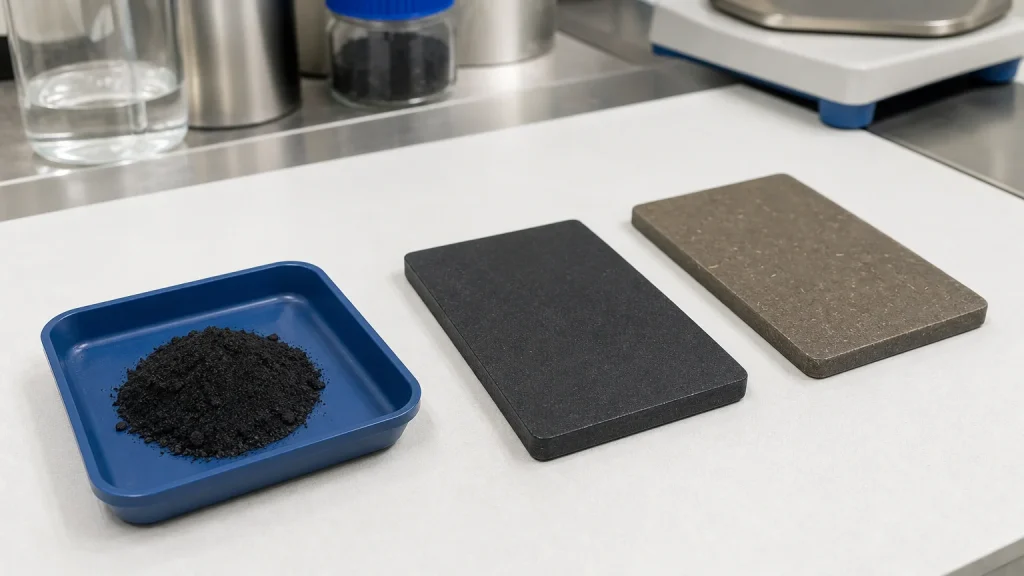
Summary: Biochar can serve as a filler or functional additive in polymer, cementitious, and other composites, but its performance depends on the matrix, feedstock, production conditions, particle properties, loading, and dispersion. Select it against a defined end use, then compare formulations through application-specific testing. There is no universal biochar grade or dosage that guarantees improved composite performance.
Could a waste-derived carbon filler make a composite stronger, lighter, more heat resistant, or conductive? It may, but those outcomes are not interchangeable, and biochar does not improve every matrix automatically. If you are developing a formulation, our biochar product development partner resource is a starting point for application-specific product work. Treat biochar as an engineered input, not a drop-in material with universal specifications.
The phrase biochar for composite materials covers different systems, from epoxy and thermoplastics to cement-based mixes and rubber. Each responds to a different combination of particle size, surface chemistry, ash, moisture, loading, and processing. The practical goal is to establish whether a defined biochar batch meets your product’s performance, processing, and durability requirements. For US manufacturers, validating those requirements early can prevent a promising laboratory result from being mistaken for a production-ready formulation.
What role should biochar play in your composite?
Start with the job the additive must perform. In a polymer composite, biochar may act as a particulate filler or influence properties such as stiffness, heat response, friction, or electrical behavior. In a cementitious mixture, it interacts with a different binder system and can affect fresh and hardened material properties. These are distinct formulation problems, not interchangeable examples of one universal recipe.
Define the intended product and its critical requirements before selecting a biochar. A component that needs to resist bending may require a different balance of strength and flexibility from a product designed for thermal insulation or electrical conductivity. Consider manufacturing constraints too, including mixing, molding, curing, and the consistency needed between batches.
That framing also helps you assess environmental goals realistically. Replacing some conventional filler with a waste-derived material may support resource recovery, but the composite still needs to meet its functional requirements. A sustainability claim does not establish mechanical performance, service life, or suitability for a particular application.
Which biochar properties should you evaluate?
A 2026 review examined 450 articles published between November 2013 and November 2025. It describes research across polymer matrices and reports that some studies found improvements with biochar loadings around 5 to 10 wt.%. That range is a research observation, not a universal formulation recommendation. The 2026 polymer composite review also discusses how composition can influence water absorption and other properties.
Compare candidate materials by more than feedstock name. Useful information can include the biomass source, production conditions, particle size distribution, moisture, ash or mineral content, surface chemistry, and porosity. Those characteristics may influence how particles disperse and interact with the matrix. A material described simply as “biochar” does not tell you whether it will suit your process.
Particle size and dispersion deserve particular attention. Large or uneven particles may distribute inconsistently, while fine particles can create different mixing and handling demands. Surface treatment may improve compatibility in some systems, but its value depends on the matrix and target properties. Test untreated and modified material only when the comparison answers a defined product question.
Ask for batch-specific information where available, then verify the properties that matter to your application. For targeted product work, our biochar applications page describes the application-specific development context. It does not replace formulation testing, but it can help clarify the requirements you need to investigate.
Why must loading and performance be tested together?
In a 2026 epoxy study, a rice husk biochar formulation with 9 wt.% filler reached a tensile strength of 29.2 MPa, compared with 22.7 MPa for neat epoxy. The same study reported higher flexural strength at that loading, but wear behavior varied with biochar content. At 6 wt.%, wear mass loss increased to 0.76 mg, illustrating why one improved metric does not prove an overall performance gain. These results apply to the study’s particular materials and test conditions, not every epoxy or biochar. See the 2026 epoxy composite study for its specific methods and results.
Loading can change several properties at once. Higher filler content may affect strength, toughness, processability, abrasion, moisture response, or appearance. The direction and scale of those effects depend on particle characteristics, dispersion, and the bond between filler and matrix. A formulation that improves stiffness could still be unsuitable if it becomes difficult to process or loses a required durability property.
How can you validate a candidate formulation?
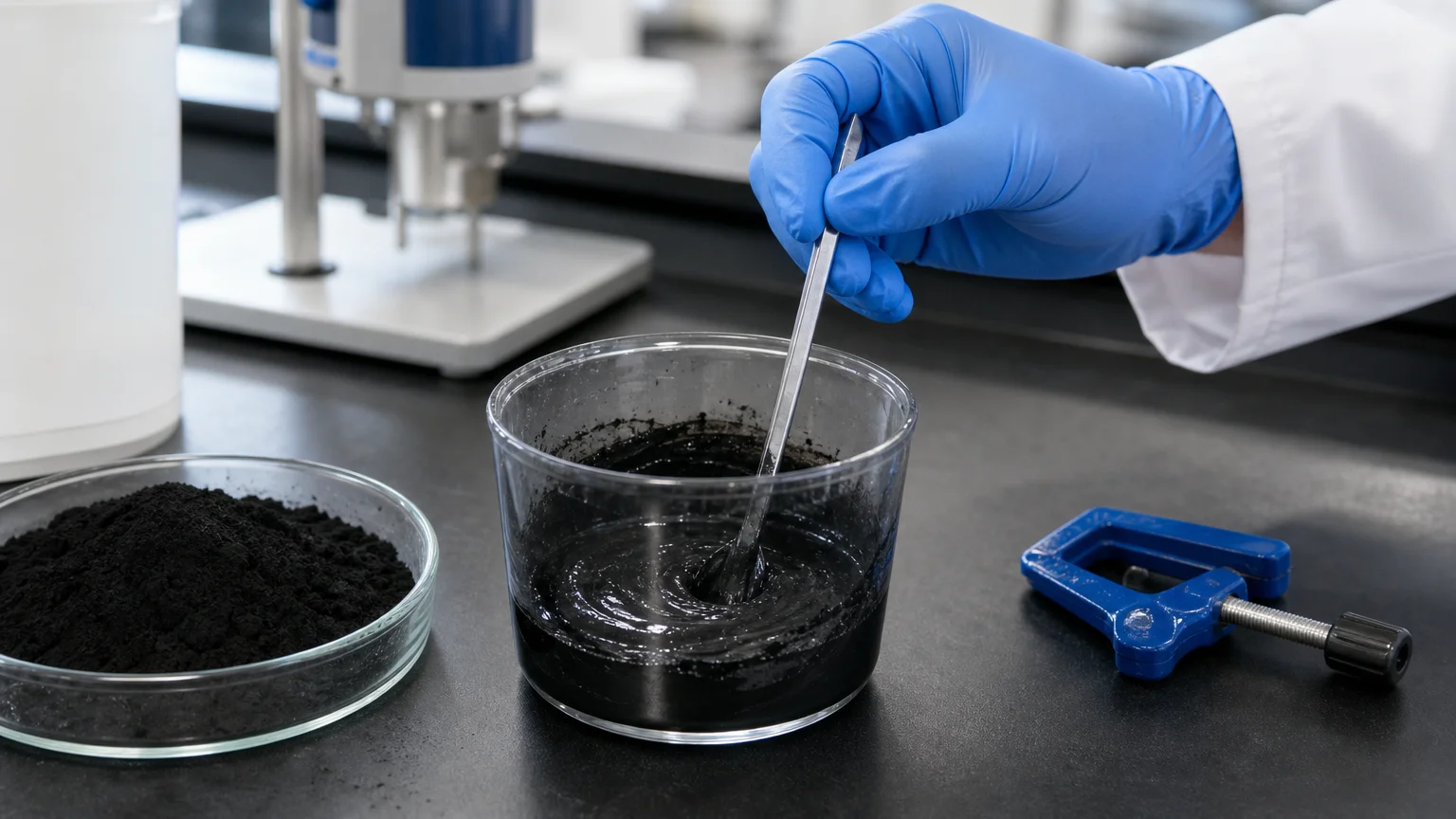
Suppose you are evaluating a biochar-filled epoxy for a molded part. First establish a control using the unfilled matrix, then compare a small number of defined formulations under consistent preparation and curing conditions. Record the biochar source, particle distribution, moisture condition, loading, mixing method, and processing details so that any performance difference can be interpreted.
Choose tests around the product’s actual use. Tensile, flexural, and impact tests may help assess mechanical performance. Depending on the application, you may also need to measure thermal behavior, water absorption, abrasion, electrical response, or fire performance. Test repeat samples and track changes in processing as well as finished material properties.
A 2026 study of macadamia shell biochar in a ramie and epoxy composite reported a specific production and characterization profile, including pyrolysis at 350°C and a measured surface area of 326 m²/g. These figures describe that study’s biochar; they are not target specifications for other feedstocks or matrices. The 2026 characterization study illustrates why you should document material properties alongside formulation results.
For a development program, our research and product development work can include feedstock characterization, trials, laboratory testing, product optimization, and technical reporting. This makes it possible to evaluate a material against the intended application before committing to a larger production pathway.
What should you confirm before sourcing or scaling?
Before purchasing material for a larger trial, confirm that the supplier can identify the feedstock and provide the information needed to reproduce your test batch. Discuss particle size, moisture, ash, packaging, and any processing or treatment history relevant to your formulation. For pilot planning, our buy biochar page provides a route to explore sourcing options.
Do not assume that a sample from one batch represents all future deliveries. Set acceptance criteria around the properties linked to your test results, and recheck incoming material when consistency matters. If the composite will be used in a regulated or safety-critical application, confirm the relevant testing and documentation requirements with qualified technical and regulatory specialists.
Scaling also means revisiting the manufacturing process. A formulation that works in a small vessel may behave differently with larger mixing equipment, longer runs, or different curing conditions. Reassess dispersion, production repeatability, finished-part performance, and project economics before treating laboratory results as a production specification.
Choose by application, then verify
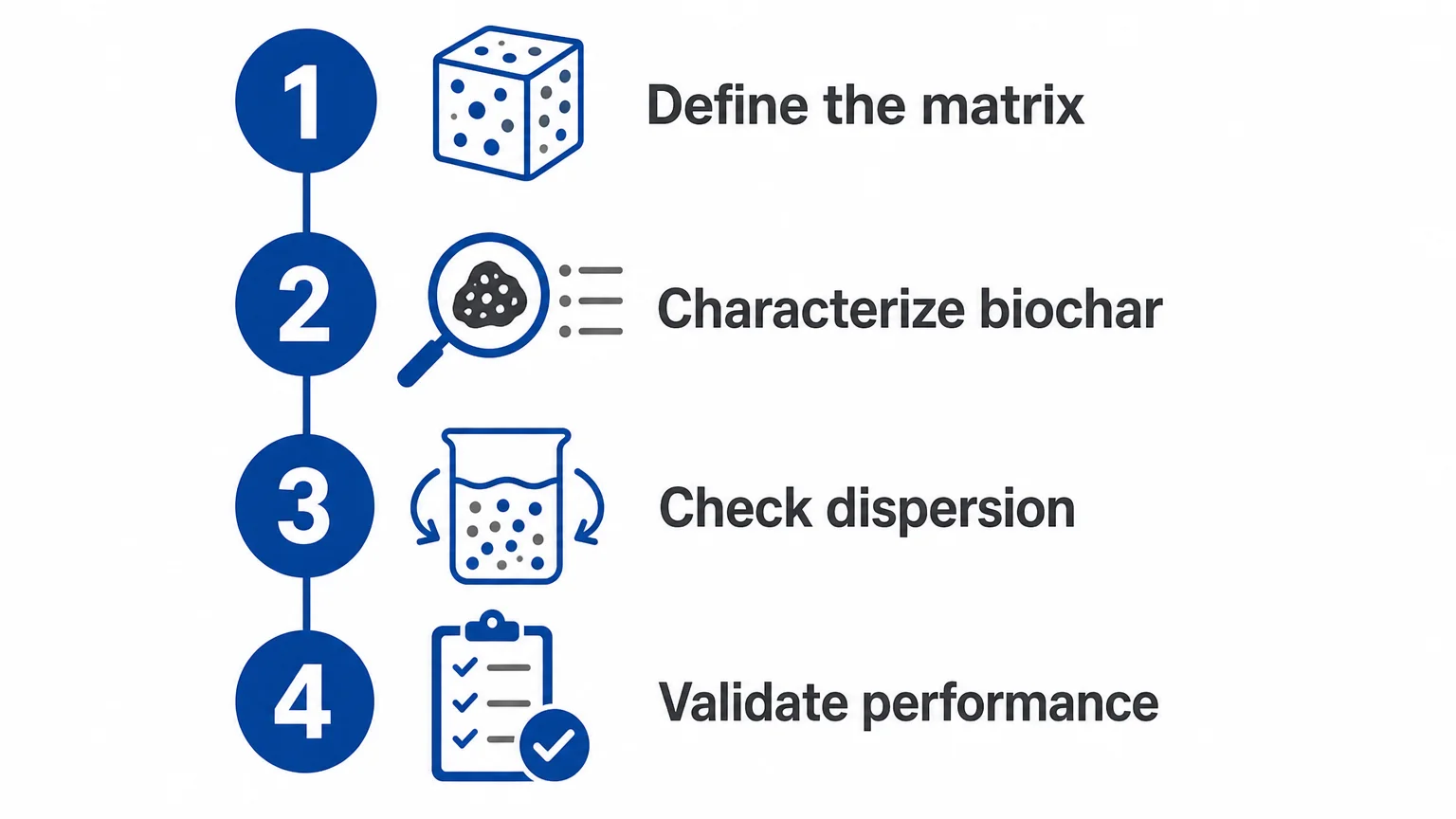
Biochar for composite materials is best assessed as a formulation variable, not a guaranteed performance upgrade. Start with the matrix and end use, characterize the biochar, and test loading and dispersion against the properties your product must deliver. Keep material records and validate the process again before scaling. That evidence gives you a practical basis for deciding whether biochar belongs in the composite and what specifications a repeatable supply must meet.
Develop a Biochar Composite With Evidence
If you are evaluating biochar for a specific composite, begin with the material properties and performance requirements that matter to your product. A structured development program can help you compare candidates, test formulations, and assess the results before moving toward a larger system.
Our research and development services include feedstock characterization, small and large scale trials, laboratory testing, product optimization, and technical reporting. Trial costs can be applied in full toward a commercial system. To discuss a project scope with our team, explore our biochar research and development services.
Frequently Asked Questions
Can biochar improve every type of composite?
No. Its effects depend on the matrix, biochar properties, formulation, and manufacturing process. Test it against the requirements of the specific product.
What biochar characteristics matter most for composites?
Feedstock, production conditions, particle size, moisture, ash, surface chemistry, and porosity can all be relevant. Prioritize the characteristics that may affect your matrix and processing method.
Is there a standard biochar loading for composite materials?
No single loading applies across different composites. Compare a controlled set of formulations and use performance results to identify a suitable range for your application.
Which tests should you run on a biochar composite?
Select tests based on how the finished product will be used. Mechanical testing may be important, while thermal, moisture, abrasion, electrical, or fire testing may also be relevant.
Can Pyronexus help evaluate biochar for a composite application?
Yes. Our product development and research work can include requirements definition, feedstock characterization, trials, laboratory testing, optimization, and technical reporting. The appropriate scope depends on your material and project objectives.
