
Biochar Product Development: A Practical Path from Idea to Use
Summary: Biochar product development starts with the intended use, then connects feedstock and production conditions to measurable product requirements. Characterization, targeted testing, and application validation help you decide whether a material fits its market and what needs adjustment before scale-up. A clear development plan also connects product specifications with practical production and customer needs.
What will make a biochar product useful to a buyer: its feedstock, its measured properties, or evidence that it performs for a specific purpose? Usually, the answer depends on how well those elements fit together. For US developers, a biochar product development partner can help connect early testing with a defined application and a production pathway.
Biochar product development is the process of turning application needs into a defined, testable material. It is not simply a matter of producing biochar and choosing a use afterward. Feedstock, processing conditions, product properties, safety considerations, and buyer requirements all shape whether the material is appropriate. In its 2025 industry survey, published in 2026, the International Biochar Initiative identified low awareness of biochar and insufficient demand for physical biochar as reported industry challenges. This makes clear product specifications and application evidence useful for both developers and prospective buyers, as reflected in the IBI market report.
What should the biochar product be designed to do?
Begin by writing down the job the product must perform. A soil amendment, a filtration material, an industrial additive, and a composite ingredient have different end users and evaluation criteria. “Biochar” alone is not a sufficiently precise product specification.
For each intended use, define the material’s required form, handling needs, and properties to evaluate. For agricultural products, relevant considerations can include nutrient and water interactions, pH, application method, and the soil or crop context. Filtration developers may instead prioritize surface properties, particle size, flow behavior, and the target substance. Composite and industrial uses require attention to compatibility with the surrounding material and the intended manufacturing process.
Translate these needs into measurable acceptance criteria before arranging tests. Record who will use the product, how it will be applied, which performance characteristics matter, and what evidence a buyer expects. That early definition keeps experiments focused and gives the team a practical way to compare candidate formulations.
How do feedstock and pyrolysis shape material properties?
Biochar properties begin with the input material and the conditions used to process it. Biomass types differ in moisture, particle size, composition, and handling behavior. Processing choices, including temperature and residence time, also influence the resulting material. A review published in 2026 of research on agricultural and forestry residues describes these interacting relationships and notes that reporting gaps limit comparisons across studies. The review also found that only 5.9% of studies addressing implementation integrated at least three analytical dimensions, as summarized in the 2026 research review.
For product developers, this means that a test result should stay connected to its feedstock and production history. Keep representative samples and document how each batch was made. If you change the feedstock or key operating conditions, check whether the resulting material still meets the same specification rather than assuming the previous results apply.
Our research and consulting work can include feedstock characterization and process assessment to inform decisions before a product concept advances. Pyronexus also describes small-scale trials at 400°C, 550°C, and 700°C, giving developers defined scenarios to compare within a project. These are trial conditions, not universal recipes; the appropriate test plan depends on the material and intended use.
Which tests answer the product-development question?
Choose analyses to answer a specific decision, not simply to accumulate laboratory results. A basic characterization plan might examine properties such as moisture, ash, fixed carbon, pH, elemental composition, particle size, or surface area. The right set depends on the application, the product specification, and any safety or buyer requirements. Potential contaminants also warrant attention when the feedstock or use creates a relevant exposure concern.
Agree with the laboratory on sample preparation, test methods, reporting units, and the material represented by each sample. When comparing batches, use consistent methods and document any departures. If a product will be sold into a regulated or standards-based market, confirm the applicable requirements with the relevant authority, customer, or qualified specialist before finalizing the test plan.
A test report describes measured properties under stated methods. It does not, by itself, demonstrate that a product will perform well in every application. Treat results as evidence for the next decision: adjust the process, test a different formulation, conduct an application trial, or stop development if the target specification remains out of reach.
How should you validate the intended application?
Validation asks whether the material works in the conditions where customers plan to use it. Laboratory characterization can screen candidates, while an application-specific experiment examines the material in a relevant setting. For a soil product, that could mean assessing it with the intended soil and management conditions. For filtration, it could mean testing against the target contaminant under specified flow conditions.
Set the test conditions and success criteria before beginning, then compare the biochar with an appropriate reference or baseline. Record the material batch, test setup, observations, and limitations. This makes it easier to determine whether an outcome applies to a particular product and use case, rather than extending it to other feedstocks, formulations, or conditions.
In September 2026, Pacific Northwest National Laboratory summarized a stakeholder convening that identified a need for coordinated biochar characterization and application testing across varied soils and management conditions. That need supports a practical approach: validate for the specific environment and use, as discussed in the PNNL research summary.
When bench testing supports a viable direction, a pilot or production trial can examine behavior at a larger scale. Our biochar production trials can support evaluation of feedstock, process behavior, and resulting material. Pyronexus states that trial costs can be applied toward a commercial system, subject to the terms for that work.
What should you confirm before scaling?
Before moving from development to production, check that the product specification, process conditions, and testing plan still align. The decision is not only whether a sample meets laboratory targets. You also need to know whether the feedstock can be prepared consistently, the process can reproduce the material, and the product can be handled and delivered in a form customers can use.
Review the evidence against the actual buyer requirements. Include manufacturing constraints, product packaging, quality control, and any documentation needed for procurement or compliance. For commercial projects, a life cycle assessment or techno-economic analysis can also clarify whether the selected pathway makes sense beyond the laboratory. The useful scope depends on the project, so define the decision each analysis is meant to support.
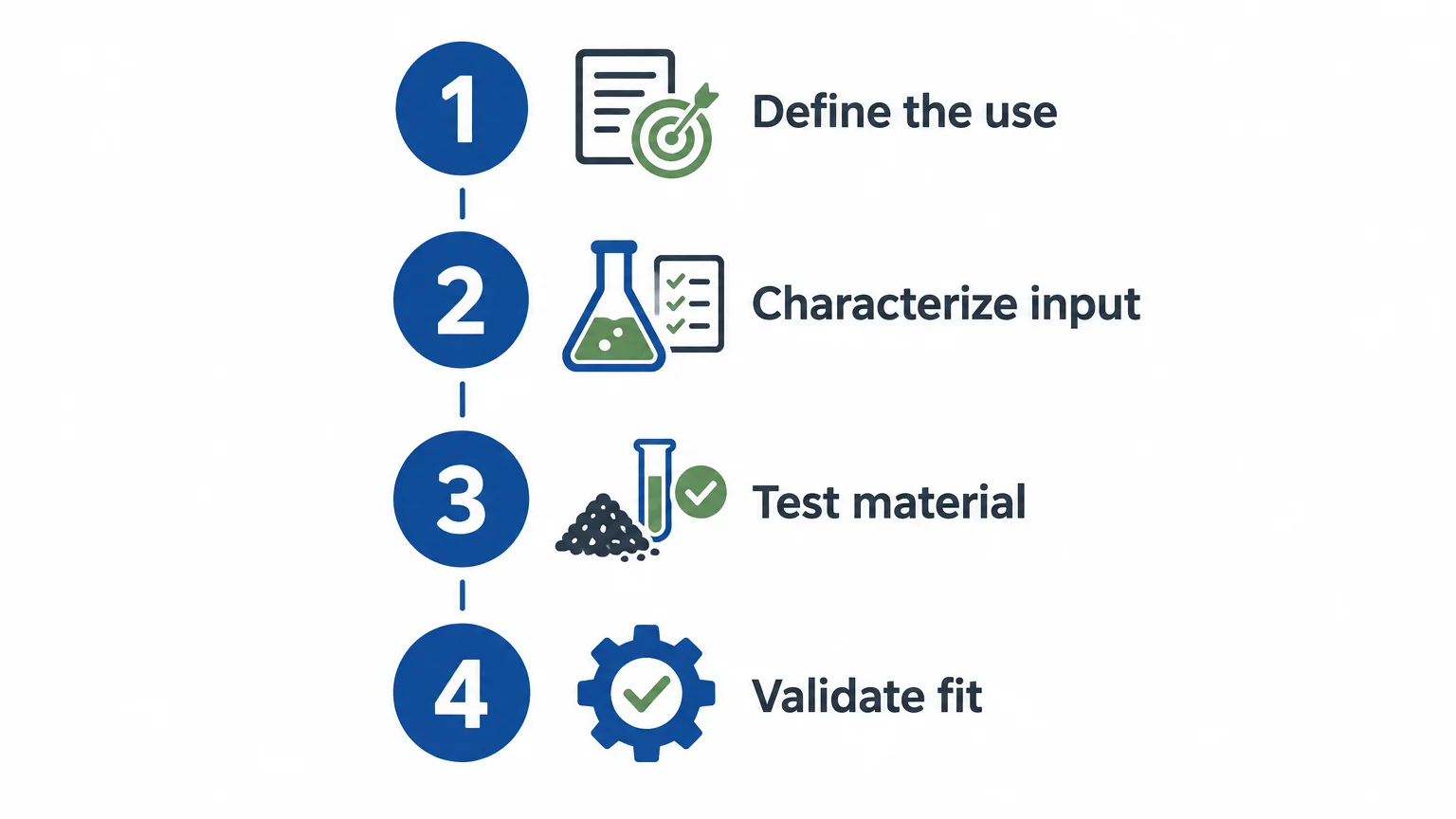
A compact review before scale-up can keep the work organized:
- Define the use and the customer’s measurable requirements.
- Characterize the input and document feedstock and production conditions.
- Test the material using methods matched to the intended application.
- Validate performance under relevant use conditions before finalizing the specification.
Build the product around its intended use
Effective biochar product development connects a clear application with feedstock knowledge, controlled testing, and relevant validation. Define what the material must do, preserve the context behind each result, and confirm that the production pathway can reproduce the required specification. That evidence gives you a more reliable basis for deciding whether to refine, validate, or scale the product.
Plan a Biochar Research and Development Project
A product concept is easier to evaluate when the target application, feedstock, and evidence needs are defined early. If you are assessing biochar for agriculture, filtration, industrial additives, or composites, your next step may be a focused research plan or a production trial.
Our research and development work can include feedstock characterization, laboratory testing, process assessment, product optimization, and technical reporting. We can help you define project-specific work and connect trial findings with commercial planning. Learn about our biochar research and development services.
Frequently Asked Questions
What is biochar product development?
It is the process of defining, testing, and validating biochar for a specific application. The work connects product requirements with feedstock, production conditions, material properties, and intended use.
Which biochar properties should you test?
Test the properties that relate to your intended use and customer specification. Depending on the application, this may include pH, moisture, ash, elemental composition, particle size, surface area, or relevant contaminants.
Can one biochar product serve every application?
Do not assume that a material suited to one use will meet another application’s requirements. Define and test the product against the conditions and performance needs of its intended market.
When should you conduct a production trial?
Consider a trial after initial characterization identifies a promising direction and you need to assess process behavior or material consistency at a larger scale. Pyronexus offers project-specific trials to evaluate feedstock, production, and biochar.
How can you connect laboratory results to commercial scale?
Keep test results linked to the feedstock, process conditions, and sample batch they represent. Then confirm that production can reproduce the target specification and validate the material in relevant use conditions before scaling.
