
Biochar Production Trials: A Practical Scale-Up Guide
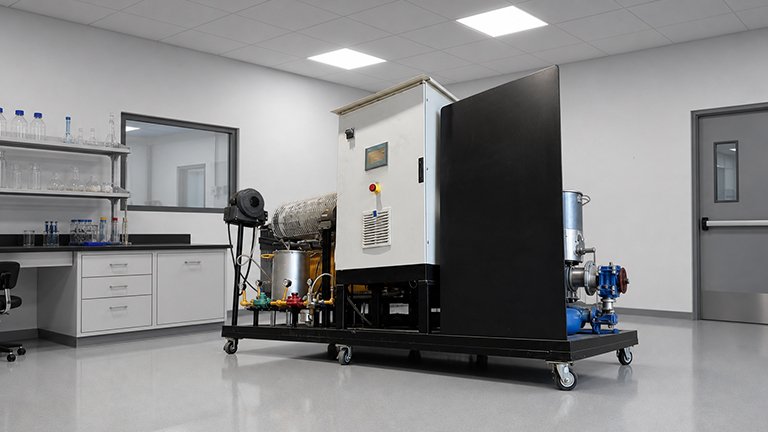
Summary: Biochar production trials test whether a specific feedstock, reactor setup, and operating window can reliably produce biochar suited to a defined use and business case. Start with controlled bench-scale runs, then validate continuous performance at pilot or commercial-representative scale. Measure input variability, yield, quality, energy use, emissions, and cost before committing to full deployment.
A production trial is useful only when it answers a decision you must make: which feedstock, process window, and output can your project support? Our biochar research and development work is designed to help you test those questions before committing to equipment or a larger project.
Biochar is not a uniform material, and a promising result from one biomass or reactor does not automatically transfer to another. Your trial should reflect the feedstock you can actually source, the production system you plan to use, and the product requirements of your intended market. In the US, that means setting clear technical and commercial decision criteria before a test begins.
What decision should a trial resolve?
Begin by stating what you need to learn. You might need to confirm whether local crop residues can run consistently, determine which operating conditions produce a required biochar property, or establish whether a project merits pilot testing. A trial without a defined decision can generate data without resolving the uncertainty that matters to your investment.
Write down a primary question and the threshold for a useful result. For example, specify the minimum dry-feed throughput, acceptable variation in biochar yield, or target property range. Separate essential requirements from measures that are informative but not decisive.
Also decide what evidence must be available before moving forward. A feedstock screen might justify a controlled bench test, while a commercial system decision needs operational, product, and economic evidence. This staged approach keeps you from treating early findings as proof of commercial readiness.
How do bench and pilot trials differ?
Consider a lab test that produces a consistent char sample. It can help you compare feedstocks or process settings, but it does not establish that a larger reactor will sustain the same yield, throughput, or product quality. A bench-scale trial answers focused questions under controlled conditions; a pilot trial tests whether those findings hold under more realistic operating conditions.
A 2026 study comparing lab and pilot production from cotton gin waste reported average biochar yields of 37.1% in a lab-scale muffle furnace and 25.8% in a pilot rotary kiln. These results are specific to that feedstock and equipment, but they illustrate why laboratory yield should not be used as a commercial forecast. The 2026 scale-up study also identified feedstock pre-processing as a consideration for practical scale-up.
At the larger scale, record continuous run time, interruptions, throughput, material handling, temperature stability, and product consistency. Pyronexus uses a three-day baseline for large-scale trials, adjustable to project needs, to assess continuous performance and operating parameters. Treat that duration as a starting scope, not a universal rule for every reactor or feedstock.
How should you prepare and document feedstock?
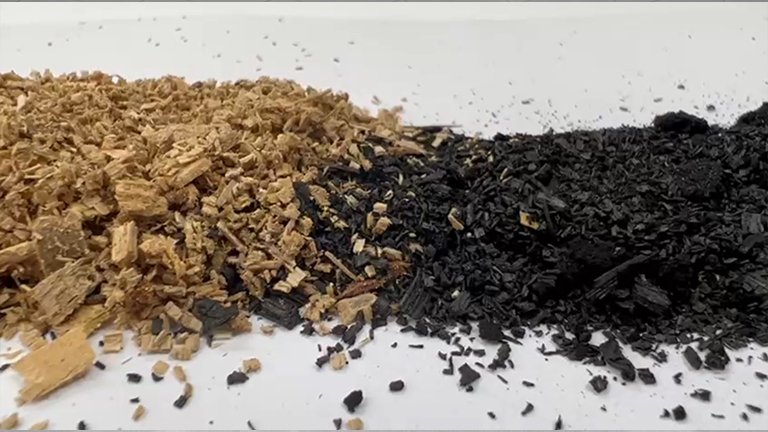
Feedstock characteristics can change how material moves through a system and what product comes out. Record the biomass source, particle size, moisture, contamination concerns, storage history, and any pre-processing. When you compare feedstocks, keep the test conditions consistent enough to distinguish input differences from process changes.
Use the target reactor’s operating requirements rather than assuming one preparation limit applies to all systems. For Pyronexus reactor systems, the stated feedstock conditions are particle size below one inch and moisture content below 20%. Grinding and drying are integrated into the system to prepare biomass for operation. Review our biochar production process when you are mapping preparation needs to a specific project.
Keep representative samples of both incoming biomass and finished char, and record how each was collected and stored. Documenting source and handling helps you interpret laboratory results later. It also supports traceability if you plan to evaluate the material for a regulated application or carbon project.
Which process variables and measurements belong in the protocol?
Set a test matrix before operating the reactor. Depending on the question, vary one factor at a time or use a planned combination of conditions. Record temperature, residence time, feed rate, particle size, moisture, oxygen availability, and start-up or shutdown conditions. Log deviations as they occur instead of relying on recollection after a run.
For its small-scale R&D trials, Pyronexus evaluates three temperature scenarios: 400°C, 550°C, and 700°C. Those are defined trial conditions, not a universal recipe. The right test range depends on the feedstock, reactor, intended product, and the questions you need answered.
At minimum, calculate biochar yield against dry feed input, and record mass balance across char, gas, and liquid outputs where those streams are measured. Track energy consumed or recovered, operating time, throughput, and process stability. A 2024 global dataset includes study context such as climate, biochar properties, management practices, and initial soil conditions, reinforcing the value of documenting conditions alongside outcomes. The global biochar dataset is useful context when designing comparable application research.
Choose product analyses based on the intended use, not a generic test list. Testing may examine carbon content, pH, nutrient properties, surface characteristics, or contaminants relevant to the application. If standards alignment matters, identify the methods and acceptance criteria before sending samples to a laboratory.
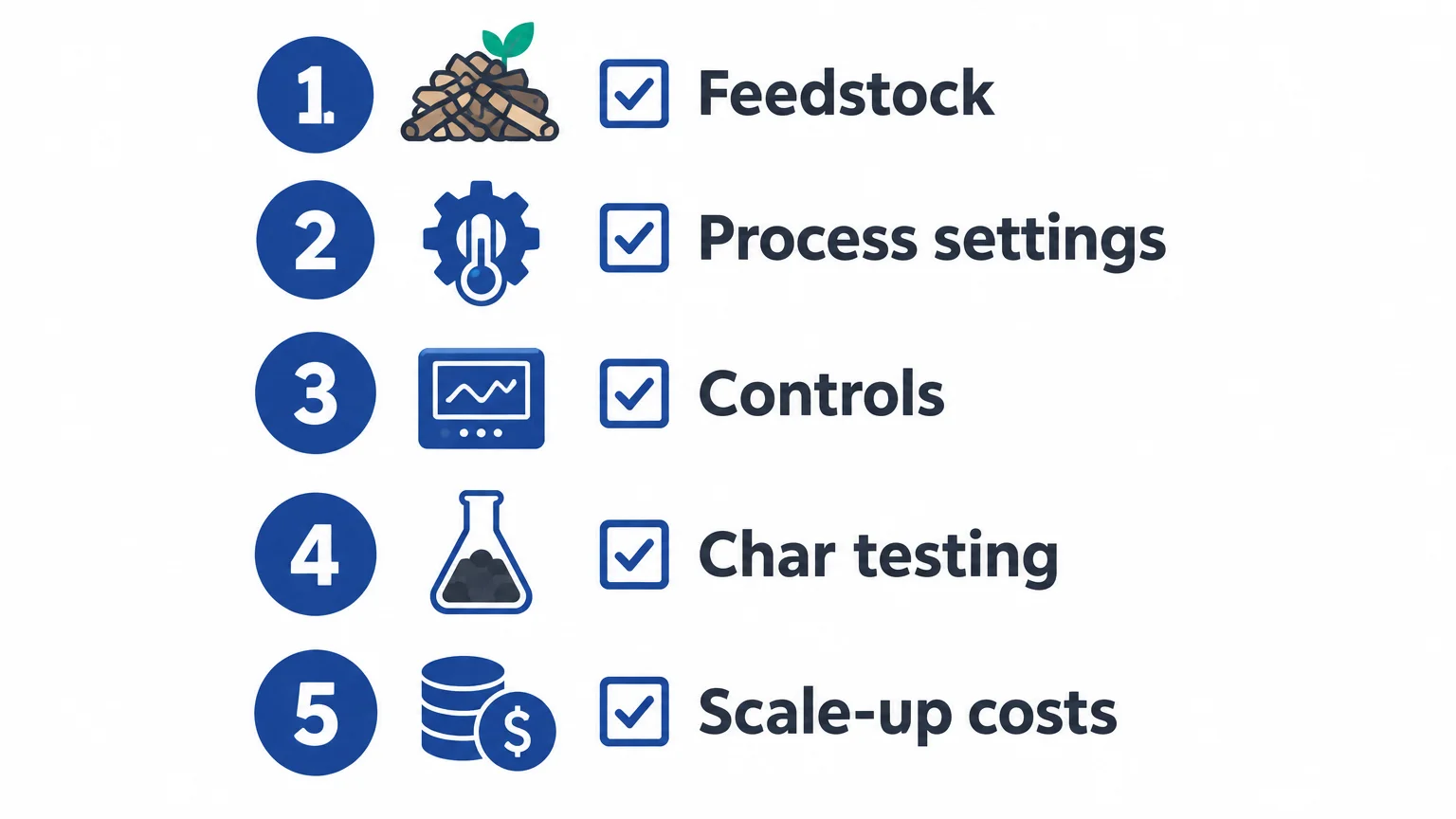
What should biochar testing establish?
Test the output against the job it is expected to do. Biochar for soil use has different evaluation needs from material developed for filtration, industrial additives, or composites. Define the target properties with the intended user or buyer before production, then use consistent laboratory methods to assess each batch.
Use control samples when you need to know whether a change came from the feedstock or operating condition under test. Replicate important runs when practical, especially where biomass varies naturally. A single successful batch shows that an outcome occurred once; repeatability indicates whether it is a dependable basis for the next stage.
For application work, document the soil, crop, management, and environmental conditions alongside the biochar properties. A trial that records only the char may be unable to explain why a result changed in the field. Our biochar research consulting can include feedstock characterization, laboratory testing, biochar reports, and product development work.
How can you judge scale-up readiness?
Scale-up requires more than a promising yield. Check whether the system can process the expected feedstock continuously, maintain stable operation, and produce material that meets the intended specification. Include safety, emissions-related controls, material handling, and operating labor in the evaluation.
Translate trial performance into an economic model using measured values. Include feedstock preparation, labor, energy, maintenance, residue handling, and product testing, as well as potential value from biochar and recoverable energy. Keep assumptions visible so you can replace them with commercial quotations or operational data as the project develops.
A 2026 assessment of an integrated system for agricultural residues evaluated environmental and economic performance using a cradle-to-grave boundary. This is a useful reminder to account for the full process rather than reactor output alone. See the 2026 system assessment for an example of that broader evaluation approach.
Finally, prepare a written decision record. State which results met the criteria, which uncertainties remain, and what additional evidence is needed. A September 2026 Pacific Northwest National Laboratory report focuses on scaling biochar research and commercialization, a connection that matters when turning trial evidence into a deployment plan. Its research-to-commercialization report offers further context for that transition.
Conclusion
Well-designed biochar production trials connect a defined project decision to controlled testing, representative feedstock, relevant product analysis, and practical scale-up criteria. Treat laboratory findings as a starting point, validate performance at a relevant operating scale, and use measured data to assess quality, reliability, and economics before committing to deployment.
Plan Your Next Biochar Production Trial
When your next project decision depends on evidence rather than assumptions, our research and development team can scope small- or large-scale trials around feedstock, process behavior, and the intended product. We support characterization, laboratory analysis, process-flow assessment, and technical reporting to inform practical next steps.
Trial work can include mass and energy balances, life-cycle assessment, techno-economic analysis, and process optimization. One hundred percent of trial costs can be applied toward a commercial system. If results support progression, explore our biochar production equipment and discuss a configuration suited to your feedstock, production scale, and project objectives.
Frequently Asked Questions
What is the main purpose of a biochar production trial?
It tests whether a particular feedstock and process setup can produce biochar that meets defined technical and project requirements. The findings help you decide whether to adjust the process, run a larger trial, or stop before a larger investment.
When should you move from a bench trial to a pilot trial?
Move forward when the bench test has answered its focused questions and the remaining uncertainty concerns continuous operation, throughput, or scale-related performance. Set the pilot objectives and success criteria before starting.
Why can biochar results differ between feedstocks?
Biomass differs in properties such as moisture, particle size, composition, and flow behavior, which can affect preparation and reactor operation. Record those characteristics so you can distinguish feedstock effects from changes in process settings.
Which measurements should every trial record?
Record feedstock condition, process settings, operating time, throughput, biochar yield, and relevant product-test results. Add energy use, co-product measurements, emissions-related data, and cost inputs when they affect your project decision.
Can Pyronexus support a biochar production trial?
Yes. Our research and development services include feedstock characterization, small- and large-scale trials, laboratory testing, technical reporting, life-cycle assessment, techno-economic analysis, and process optimization.
