
Biochar Project Economics: Costs, Revenue, and ROI
Summary: Biochar project economics depend on the interaction of feedstock cost, plant scale, labor, energy recovery, product sales, carbon credits, and financing. A viable project usually needs more than one revenue stream and a documented route to market. The safest investment case comes from feedstock trials, conservative throughput assumptions, verified carbon accounting, and sensitivity testing before construction.
Biochar project economics rarely turn on the reactor price alone. If you are assessing a facility, our biochar carbon credits perspective is one part of the case, while feedstock contracts, operating discipline, product quality, and buyer access determine whether the plant creates durable value.
The central question is not simply whether pyrolysis can produce biochar. It is whether the project can process suitable biomass at a reliable cost, sell the resulting material, recover useful energy, and document carbon storage without exceeding its capital and operating limits. That requires a model built around the entire value chain, from incoming feedstock to final application and payment.
What does biochar project economics include?
Can a biochar facility be profitable with one revenue stream? In most cases, relying on a single income source creates unnecessary exposure. A project should be evaluated through four connected layers: capital investment, operating cost, revenue generation, and financial risk.
A 2026 Corn Belt study compared three low cost kiln designs for agricultural residues in the United States. It reported minimum selling prices between $1.74 and $3.06 per kilogram, with labor representing more than 95% of cost in the modeled systems. Capital represented less than 3%, showing that small equipment costs do not automatically create a low cost operation.
Those results apply to specific farmer scale kiln architectures, not every commercial pyrolysis plant. They do, however, demonstrate an important principle: the cost driver can change with the production model. A manual or batch operation may be dominated by labor, while an industrial plant may carry heavier costs for drying, material handling, emissions control, automation, maintenance, and financing.
- Capital costs include the reactor, dryer, grinders, conveyors, storage, cooling, emissions equipment, controls, civil works, utilities, and installation.
- Operating costs include biomass preparation, labor, electricity, fuel, repairs, testing, insurance, transportation, monitoring, and site overhead.
- Product revenues may come from biochar sold for agriculture, filtration, industrial additives, composites, or other applications.
- Energy revenues may come from process heat, electricity, renewable gas, or avoided energy purchases, depending on system design.
- Carbon revenues depend on eligible feedstock, measurable carbon storage, verification, market access, and the price a buyer is willing to pay.
- Financial returns depend on utilization, debt terms, working capital, depreciation, taxes, construction risk, and the timing of cash flows.
The strongest model therefore separates physical production from commercial assumptions. Throughput should be based on tested feedstock and realistic uptime, while selling prices should reflect signed offtake discussions or conservative market cases rather than optimistic projections.
Where do capital and operating costs accumulate?
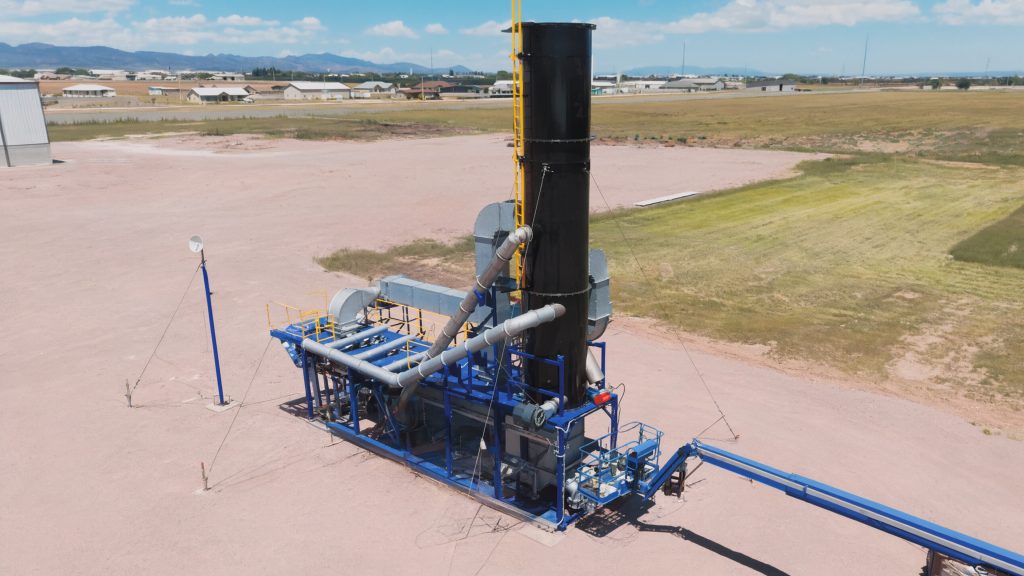
A reactor is only one component of a commercial facility. The delivered cost of a project also includes feedstock receiving, size reduction, drying, conveying, storage, biochar cooling, product conditioning, packaging, site preparation, electrical work, controls, safety systems, and commissioning.
A US Forest Service analysis published in 2022 found that capital investment represented approximately 16% to 30% of minimum selling price for portable systems. Labor represented approximately 23% to 28%, while feedstock represented approximately 10% to 13% when stumpage costs were excluded. These figures differ from the 2026 farmer scale study because the technologies, labor assumptions, and production contexts are not the same.
The contrast is useful. It shows why a feasibility model should not copy a percentage from another project and treat it as universal. A project using low cost residues may face high labor and handling expenses. A larger automated facility may reduce labor per tonne but increase financing, maintenance, utilities, and integration costs.
For a US developer, the most useful capital estimate is a site specific installed cost. It should include equipment delivery, foundations, buildings, electrical service, fire protection, storage, permitting support, commissioning, spare parts, and contingency. A quotation limited to the reactor can materially understate the investment required to reach commercial operation.
Our biochar plant development pathway is relevant when the project requires more than equipment selection. Site conditions, feedstock preparation, process flow, utility connections, and commissioning should be considered together because weak integration can reduce uptime and increase the cost per tonne.
Operating costs also deserve a conservative treatment. A plant that appears profitable at full capacity may perform very differently at 60% utilization. Planned maintenance, seasonal feedstock shortages, moisture variation, startup delays, and unplanned downtime can reduce annual output while leaving debt service and fixed overhead unchanged.
Why can feedstock logistics decide the business model?
Feedstock is both the raw material and one of the largest sources of project risk. Its price, moisture content, particle size, ash content, contamination, seasonal availability, and competing uses affect the reactor, the dryer, the product, and the carbon accounting.
An ACS process study published in 2026 identified feedstock cost, product yield, and scale as primary cost drivers in a feasibility analysis of waste biomass conversion. Its scenarios also indicated that carbon credits and higher value applications could materially improve the economics under suitable conditions.
The delivered feedstock cost should include collection, loading, preprocessing, storage, transport, and losses. Free biomass at the source is not necessarily free to the plant. It may require grinding, drying, covered storage, testing, or a payment to the supplier. Long transport distances can also increase both operating expense and lifecycle emissions.
Quality consistency matters just as much as price. A feedstock that changes substantially from one season to the next can alter reactor performance, biochar yield, fixed carbon, ash content, pH, and application suitability. Before construction, the project should characterize representative samples from the intended supply area and test how the material behaves under relevant operating conditions.
Contract structure is another economic variable. A long term supply agreement can improve planning, but it may also create minimum purchase obligations. A flexible spot market can reduce contractual exposure, but it may leave the plant without sufficient volume during periods of high demand or poor harvest conditions.
Feedstock should also be evaluated against alternative uses. Agricultural residues may have value as animal bedding, soil amendments, fuel, compost inputs, or industrial materials. Forestry residues may be affected by transportation costs, mill access, wildfire reduction programs, and local energy demand. The project must demonstrate that its offer is competitive with these alternatives or that it provides an additional waste management benefit.
How do scale, throughput, and energy recovery affect returns?
Scale affects economics through more than nameplate capacity. A larger plant can spread fixed costs over more tonnes, improve automation, and support consistent product output. It can also require a larger feedstock catchment area, greater working capital, more complex permitting, and a stronger sales pipeline.
The decisive metric is often productive throughput rather than nominal capacity. If a reactor is rated for a particular hourly output, the financial model should adjust for loading, drying, startup, shutdown, maintenance, feedstock changes, and seasonal operation. A plant that runs fewer hours may produce a higher cost per tonne even when its equipment is technically capable of greater output.
Energy recovery can improve the model when it is matched to a real demand profile. Process heat may support drying, nearby industrial operations, district heating, or agricultural facilities. Electricity may reduce purchased power or create a saleable output where interconnection and pricing are available. These benefits should be modeled only when the receiving system, pipeline, interconnection, or thermal customer is identified.
Energy recovery also introduces costs. Heat exchangers, piping, controls, storage, emissions equipment, maintenance, and safety systems can increase capital investment. The correct question is not whether a project can produce energy, but whether the recovered energy displaces a measurable cost or earns a dependable price.
Equipment configuration should follow the feedstock and operating objective. Our biochar reactor sales resource reflects the need to consider reactors together with dryers, material handling, automation, cooling, emissions controls, and packaging rather than evaluating the reactor as an isolated asset.
Scale should also match the market. Producing more biochar does not improve returns if the project cannot sell the material at a suitable price or place it in an approved storage pathway. A staged expansion can reduce this risk by validating feedstock, uptime, product quality, and customer demand before committing to the full design capacity.
How should biochar sales and carbon credits work together?
Biochar sales and carbon credits serve different economic functions. Product revenue reflects the physical material and its performance in an application. Carbon revenue reflects documented atmospheric carbon removal and storage. Both may support the project, but neither should be treated as automatic.
A 2025 landowner study examined biochar economics in the southeastern United States using manufacturing as a co product at existing paper mills, transportation, application, federal support income, and carbon credit revenue. Its baseline case produced a modest net profit of approximately $242.50 per hectare, or about $12 per metric tonne of biochar applied. The study also identified manufacturing and transportation as major cost sources.
The result should not be copied directly into a plant level investment model. It describes landowner economics for a specific application pathway. It does show why the location of production, the location of application, and the relationship between the producer and the landowner can change the distribution of value.
A practical revenue stack may include:
- Sale of screened or blended biochar for a defined agricultural or industrial use.
- Revenue from heat, electricity, or other energy products where a buyer or avoided cost is documented.
- Disposal savings or service payments when the project accepts a residue that would otherwise incur handling or disposal costs.
- Carbon credit revenue based on eligible feedstock, production data, lifecycle accounting, storage, verification, and buyer demand.
- Premium pricing for a product with tested properties, reliable supply, traceability, and application support.
Product markets can be more durable when the project starts with a clear specification. Agricultural customers may require information about pH, nutrient content, contaminants, particle size, and application rates. Filtration or composite customers may require surface area, ash content, porosity, and consistency. These requirements affect processing costs and may determine whether the product can command a premium.
Carbon credit income requires a separate diligence process. Feedstock origin, sustainability, pyrolysis conditions, carbon content, stability, end use, monitoring, reporting, verification, and chain of custody must be documented. Certification and audit costs should be included as operating expenses, not treated as administrative details outside the model.
What should a bankable feasibility model test?
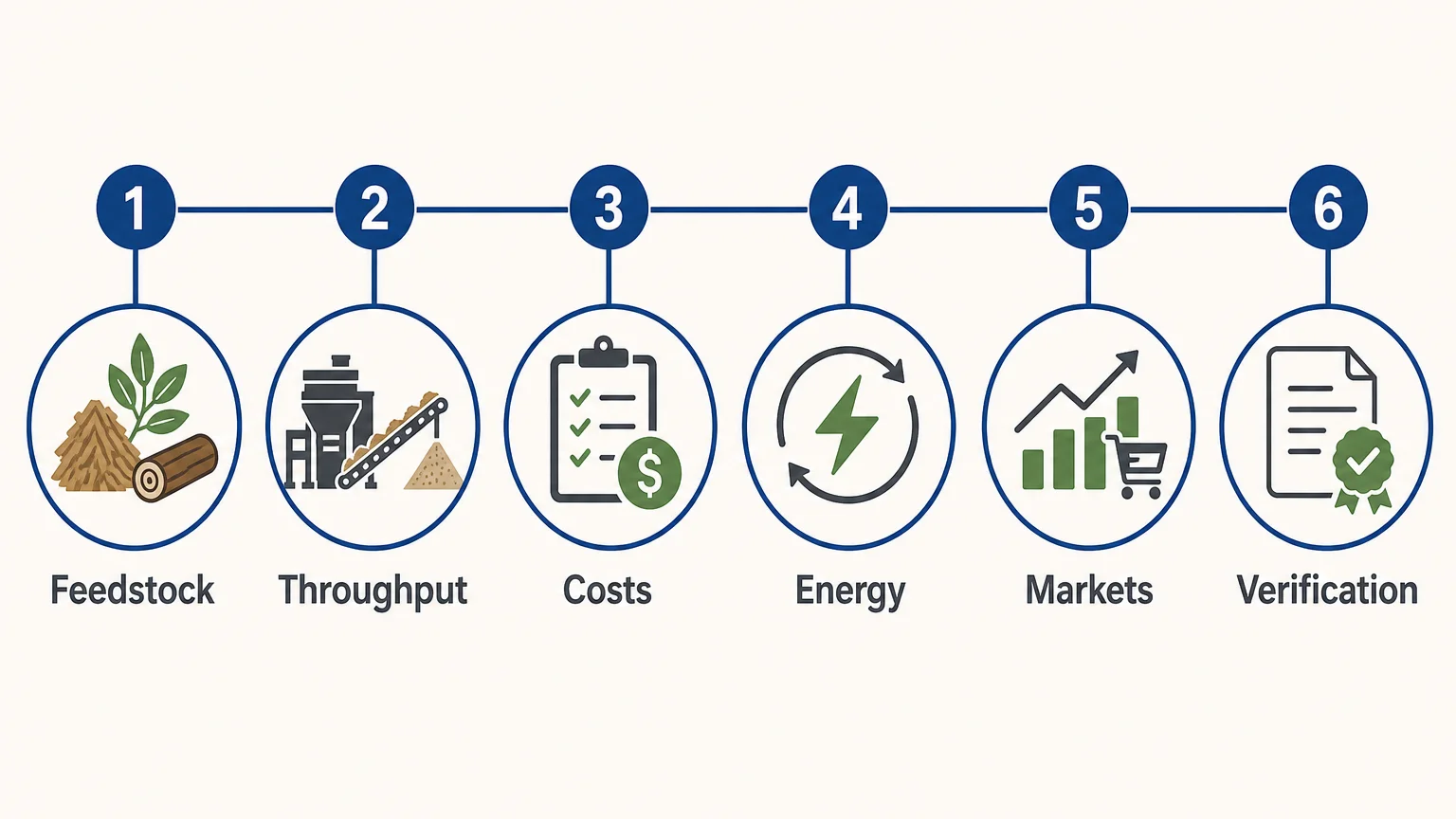
A feasibility model becomes useful when it shows which assumptions can break the project. It should calculate base, downside, and upside cases rather than present one precise forecast that hides uncertainty.
A western US analysis published in 2024 examined coupled biochar and carbon credit production from wildfire fuel reduction projects. It evaluated biomass supply, carbon credit demand, profitability, investment potential, and breakeven carbon prices under different system assumptions. The study illustrates why feedstock price and carbon price should be tested together rather than modeled independently.
Your model should test at least the following variables:
- Delivered feedstock cost: Include collection, preprocessing, storage, transport, and any supplier payments.
- Moisture and yield: Test how drying requirements and biochar yield change with feedstock condition.
- Utilization: Model realistic operating hours, planned maintenance, startup periods, and downtime.
- Labor and automation: Test operator requirements, supervision, maintenance staffing, and productivity.
- Energy balance: Account for energy used by drying and handling before crediting recovered heat or electricity.
- Product price: Use separate cases for commodity biochar, tested specialty products, and contracted offtake.
- Carbon revenue: Test credit volume, issuance timing, verification costs, buyer discounts, and market price.
- Financing: Model interest rates, debt service, construction delays, working capital, and reserve requirements.
Three financial outputs are particularly useful. Net present value shows whether the project creates value after discounting future cash flows. Internal rate of return shows the implied return on invested capital. Debt service coverage indicates whether operating cash flow can support borrowing under the downside case.
Break even analysis should also be performed in physical terms. Determine the minimum tonnes of biochar that must be sold, the minimum product price, the maximum delivered feedstock cost, and the minimum carbon price required to cover operating costs and financing obligations.
Finally, test the timing of revenue. Product sales may begin after commissioning, while carbon credits may require months of data collection, verification, and issuance. A project can appear profitable over its full life but face a cash shortage during construction, startup, or the first production year.
Which quality and verification requirements affect project value?
Economic value depends on whether the project can produce a consistent material and document its environmental claims. Quality testing is therefore both a technical function and a commercial safeguard.
Feedstock records should identify source, type, quantity, sustainability characteristics, and competing uses. Production records should cover operating conditions, mass balance, energy use, biochar output, emissions data, and equipment performance. End use records should show where the biochar was sold, applied, embedded, or stored.
Biochar quality can influence both physical sales and carbon credit eligibility. Testing may include moisture, ash, fixed carbon, elemental composition, pH, contaminants, stability indicators, surface area, and other properties relevant to the intended application. The appropriate testing plan depends on the market and the methodology used for carbon accounting.
For a carbon project, monitoring, reporting, and verification should be designed before construction. Digital data collection can help connect reactor performance with production records and chain of custody. However, digital tools do not replace sound sampling, laboratory analysis, lifecycle assessment, independent review, or a credible end use pathway.
Our biochar carbon sequestration work is relevant when the project must connect production data with durable storage and carbon market requirements. The commercial objective is not simply to generate credits, but to create evidence that buyers, auditors, and project partners can evaluate.
Regulatory review should cover air emissions, waste handling, zoning, construction, worker safety, product use, transportation, and site specific environmental requirements. Biosolids and contaminated feedstocks may require additional analysis. These obligations can affect schedule, capital cost, operating procedures, and the markets available for the finished biochar.
Build the economics around evidence
Biochar project economics become more defensible when every major assumption is connected to measured feedstock behavior, realistic throughput, installed project cost, identified customers, and documented carbon accounting. The most important variables are often outside the reactor itself, including logistics, utilization, labor, energy demand, product quality, verification, and financing.
Before investing, test the project under conservative conditions. Confirm the biomass supply, run representative trials, define the product specification, quantify energy use, secure credible market pathways, and model carbon revenue as a variable rather than a guarantee. A project that survives these tests has a stronger foundation for construction and scale up.
Take action with Pyronexus
If your preliminary model shows potential but leaves questions about feedstock, equipment integration, site requirements, or commercial scale, the next step is a structured technical review. A project development process can connect feasibility work with engineering decisions and a practical path to commissioning.
We support clients from feasibility and engineering through site integration and final commissioning. Our biochar project development service can help align reactor configuration, feedstock preparation, material handling, energy recovery, operating requirements, and long term project objectives before major capital is committed.
Frequently Asked Questions
What is included in biochar project economics?
It includes capital costs, feedstock supply, labor, utilities, maintenance, throughput, product sales, energy recovery, carbon credits, financing, and verification. A complete model should also include downtime, working capital, permitting, and the cost of placing the finished biochar into a qualified market or storage pathway.
Can a biochar project be profitable without carbon credits?
Some projects may be viable through biochar sales, energy recovery, disposal savings, or premium applications alone. The answer depends on delivered feedstock cost, product quality, customer demand, plant utilization, and the value of avoided disposal or energy purchases.
How does feedstock affect project feasibility?
Feedstock affects moisture, preparation requirements, biochar yield, carbon content, energy balance, transport cost, and product quality. A low purchase price does not guarantee good economics if the material requires extensive drying, long distance hauling, or complex handling.
What should you test before purchasing equipment?
You should test representative feedstock samples, moisture variation, particle size, process behavior, expected yield, biochar properties, energy requirements, and potential applications. Pyronexus research and development services can support controlled trials and technical analysis before a commercial system is selected.
How should carbon credit revenue be modeled?
Model carbon revenue using conservative credit volumes, verification costs, issuance timing, buyer discounts, and multiple price cases. Credit eligibility depends on traceable feedstock, documented production, lifecycle accounting, durable storage, and an accepted monitoring and verification pathway.
