
Biochar Emerges as a Promising Solution for Reducing PFAS Leaching from Biosolids
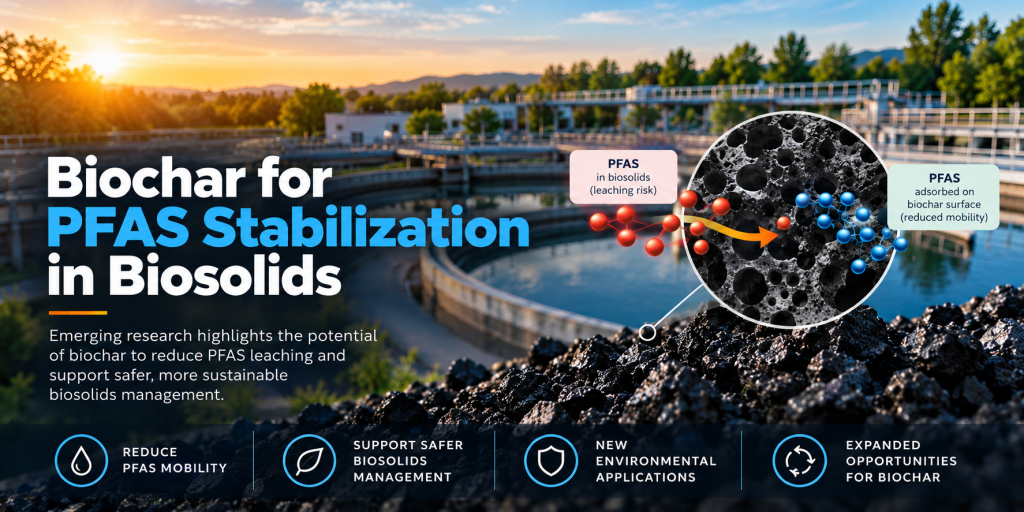
New peer-reviewed research highlights the potential of carbon-based materials to reduce PFAS mobility and support innovative biosolids management strategies.
A Growing Challenge for Wastewater Treatment Facilities
Per- and polyfluoroalkyl substances (PFAS), often referred to as forever chemicals, are becoming an increasingly important concern for wastewater treatment facilities, municipalities, and environmental management organizations.
These persistent compounds can accumulate in biosolids, creating potential environmental challenges when biosolids are stored, handled, or applied to agricultural land.
One major concern is leaching: the movement of PFAS from contaminated materials into water, potentially contributing to environmental exposure.
As the wastewater industry explores new approaches to managing PFAS, recent scientific research is highlighting an emerging role for biochar.
New Research: Biochar Can Significantly Reduce PFAS Leaching
A study published in September 2026 in the Journal of Hazardous Materials, titled Stabilisation of PFAS in biosolids by activated carbon and biochar: Implications for leaching control, investigated the effectiveness of carbon-based amendments in stabilizing PFAS in biosolids.
Researchers examined 22 biosolids samples collected from wastewater treatment facilities across Australia, evaluating the impact of biochar and granular activated carbon (GAC) on PFAS leachability.
The results were promising.
Biochar achieved an average 80% reduction in PFAS leaching, while granular activated carbon achieved an average reduction of 88% across the tested samples and compounds.
The researchers used a 1% amendment rate by weight, demonstrating that relatively small additions of selected carbon-based sorbents can significantly influence PFAS mobility under controlled laboratory conditions.
The study also found that long-chain PFAS generally showed greater immobilization than shorter-chain compounds, suggesting that the effectiveness of treatment depends on the chemical characteristics of the contaminants.
How Does Biochar Help Stabilize PFAS?
Biochar is a carbon-rich material produced by heating biomass under oxygen-limited conditions through a process known as pyrolysis.
Depending on the feedstock and production conditions, biochar can develop a porous structure and surface characteristics that allow it to adsorb certain contaminants.
In the context of PFAS management, adsorption can help retain PFAS within the solid material, reducing their tendency to move into surrounding water.
This process is known as immobilization or stabilization.
Importantly, immobilization is different from destruction.
While some thermal treatment technologies are being investigated for their ability to degrade or destroy PFAS, biochar-based stabilization focuses on reducing the mobility and leaching potential of PFAS already present in contaminated materials.
Both approaches are relevant to ongoing research into safer and more effective biosolids management.
Why Is This Important for the Biosolids Industry?
Biosolids management is evolving as facilities seek solutions that address environmental risks, changing regulatory requirements, and long-term operational sustainability.
Biochar-based stabilization presents several potential opportunities:
1. Reduced PFAS mobility
Carbon-based amendments can adsorb certain PFAS compounds, helping reduce their leaching potential.
2. New biosolids management strategies
Biochar could be evaluated as a component of broader treatment and stabilization programs, subject to site-specific validation and regulatory requirements.
3. Expanded applications for biochar
The growing interest in PFAS stabilization creates potential new market opportunities for biochar producers, technology developers, and environmental remediation companies.
4. Opportunities for further innovation
Biochar properties can vary substantially depending on the feedstock, pyrolysis conditions, and subsequent treatment. This creates opportunities for research and development focused on optimizing carbon materials for environmental applications.
Not All Biochar Is the Same
An important takeaway from the research is that biochar performance depends on its physical and chemical characteristics.
The study used a macadamia-shell biochar with a measured surface area of approximately 200 m²/g. The tested granular activated carbon had a substantially higher surface area and achieved greater average PFAS immobilization.
These differences reinforce the importance of evaluating biochar characteristics before selecting materials for specialized environmental applications.
Additional testing is needed to determine how different feedstocks, processing conditions, amendment rates, and real-world environmental conditions influence long-term performance.
Pyronexus: Advancing Biochar Production and Emerging Applications
At Pyronexus, we are committed to advancing pyrolysis technologies and expanding opportunities for biochar production and utilization.
Our approach combines biomass conversion technology, feedstock evaluation, and the exploration of commercially relevant biochar applications.
As scientific research continues to reveal new opportunities for carbon-based materials, we see significant potential for collaboration among wastewater treatment operators, environmental remediation companies, researchers, and biochar technology providers.
From agricultural applications to emerging environmental stabilization markets, biochar is becoming an increasingly versatile material.
Research on PFAS immobilization adds another promising direction for the industry.
Exploring the Future of Biochar Applications
The latest findings demonstrate that biochar deserves serious consideration as a research and development pathway for reducing PFAS mobility in biosolids.
Although further studies are needed to establish field-scale performance, long-term stability, and application-specific feasibility, the results provide a valuable scientific foundation for continued innovation.
Interested in exploring biochar production, feedstock testing, or emerging environmental applications?
Connect with the Pyronexus team to discuss potential opportunities.
Visit www.pyronexusglobal.com
Scientific Reference
Arab, M., Navarro, D. A., Smernik, R., & Kabiri, S. (2026). Stabilisation of PFAS in biosolids by activated carbon and biochar: Implications for leaching control. Journal of Hazardous Materials, 517, 143685.
https://doi.org/10.1016/j.jhazmat.2026.143685
Disclaimer: This article discusses independent scientific research and emerging applications of biochar. It does not imply that Pyronexus equipment or biochar products were evaluated in the referenced study, nor does it establish regulatory compliance or guaranteed PFAS treatment performance.
