
Poultry litter pyrolysis systems
From waste liability to carbon asset
Pyronexus engineers industrial-scale systems that convert poultry litter into high-value biochar, energy, and carbon-credit opportunities for high-volume poultry operations.
Where waste becomes a liability
The pressure is not just operational
Poultry litter is valuable when managed well, but its scale creates serious constraints. Storage, disposal windows, nutrient overload, community concerns, and compliance pressure all compound as operations grow.
Massive waste volumes
More than 14 million tons annually in the U.S. creates a costly, labor-intensive handling challenge.
Nutrient overload
Excess nitrogen and phosphorus limit land application and increase runoff risk.
Regulatory pressure
Environmental compliance adds complexity and can raise management costs.
Odor and community concerns
Storage and land application create social and environmental friction around facilities.
Limited disposal options
Land availability and seasonal restrictions reduce flexibility when output volumes peak.
Complete pyrolysis solutions
Convert litter into a cleaner operating model
Pyronexus delivers integrated, end-to-end pyrolysis systems that convert poultry litter into biochar while creating pathways for energy recovery and carbon credit value.
Feed
Poultry litter input is moved from management burden into controlled conversion.
Pyrolysis conversion
Biomass is transformed into biochar, syngas, and usable heat.
Outputs
Biochar, energy, and carbon credits become new revenue streams.
Poultry litter
High-volume feedstock enters the system.
Biochar
Stable, high-performance product for soil and crop value.
Energy
Syngas and heat support facility energy recovery.
Carbon value
Carbon-credit potential supports stronger ROI.
Why biochar?
Waste control with agronomic upside
Biochar creates both a disposal solution and a value engine: stabilize nutrients, reduce odor and pathogen concerns, reduce land pressure, and create a high-value alternative to traditional fertilizers.

Soil and crop fertility
Biochar can help return useful material value to agricultural systems.

Carbon value
Long-lived carbon storage creates a path toward carbon credit participation.

Water efficiency
Soil-amendment use cases can support healthier water behavior in soils.

Soil biology
A stable carbon product supports broader soil health positioning.

Create value from biochar sales and carbon credit
Turn a recurring waste stream into product and carbon-value opportunities.

High-performance product
Produce stable biochar positioned for soil, crop, and low-carbon material value.

Solve waste challenges
Reduce odor, pathogens, land pressure, and disposal constraints with one system.
Why now?
Early operators can capture better positioning
The global biochar market was $763M in 2024 and is projected to reach $2.1B by 2032. Poultry operators who move early can evaluate feedstock, siting, and ROI while carbon markets are still forming around durable removal pathways.
Feasibility lens
Sketch the output profile
Use an approximate 25% biochar yield and up to 70% volume-reduction figure to frame a first-pass conversation. Final economics depend on feedstock, site design, operating model, offtake, and credit validation.
Operator-ready opportunity
A cleaner path from litter management to market value
Pyronexus helps poultry operations evaluate feedstock, site requirements, conversion economics, and offtake potential so litter can move from recurring liability into a productive carbon and biochar asset.
Open overview PDF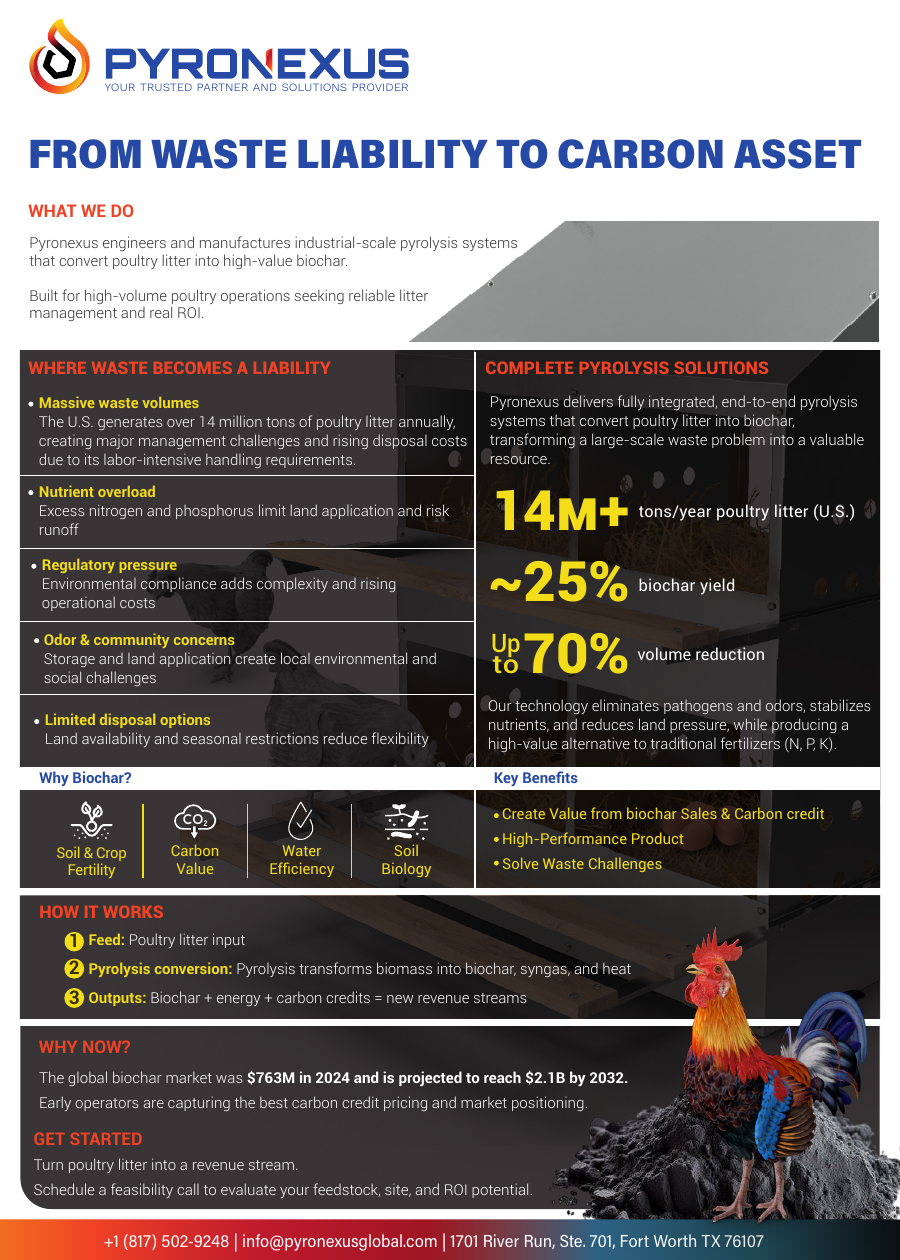
Turn poultry litter into a revenue stream.
Schedule a feasibility call to evaluate feedstock, site, and ROI potential.